
Stegobot: The Invisible Botnet Hiding in Your Social Feed
Stegobot: A Covert Social Network Botnet
This paper introduces Stegobot, a next-generation decentralized botnet that utilizes social network overlays and JPEG steganography for covert Command and Control (C&C). By embedding malicious payloads within images shared on platforms like Facebook and Flickr, it achieves a communication channel that is probabilistically unobservable to traditional traffic analysis.
TL;DR
Researchers have designed Stegobot, a botnet that doesn't "talk" in a way traditional firewalls can hear. By leveraging the trust and traffic of Online Social Networks (OSNs) and hiding data inside standard JPEG images using steganography, Stegobot can exfiltrate tens of megabytes of sensitive data monthly without ever creating a new network connection.
Problem & Motivation: The Visibility Trap
Legacy botnets (like those using IRC) and even modern P2P botnets (like Storm or Conficker) share a fatal flaw: topological visibility. They create connections between IP addresses that shouldn't be talking, or they produce rhythmic traffic "heartbeats" that give them away to statistical analysis.
The authors' core insight is that the most dangerous place to hide a needle is in a needle factory. By piggybacking on legitimate human social interactions—specifically image sharing—the botnet's communication becomes indistinguishable from a user simply browsing their friends' vacation photos.
Methodology: The Art of Invisible Communication
1. Social Malware Propagation
Stegobot spreads through "social phishing." It doesn't just send spam; it hijacks existing social trust. If a bot infects one user, it waits for that user to send a legitimate email or message with an attachment, then "infects" that attachment. This creates a botnet topology that is a direct mirror of a real human social graph.
2. The Steganographic C&C Channel
The "secret sauce" of Stegobot is the use of JPEG Steganography.
- Push-Pull Model: When an infected user uploads an image to Facebook, the bot intercepts it and embeds "botcargo" (stolen data).
- Covert Retrieval: When a Facebook friend (who is also infected) views the page, their bot automatically "pulls" the image, extracts the data, and prepares to forward it further along the social chain.
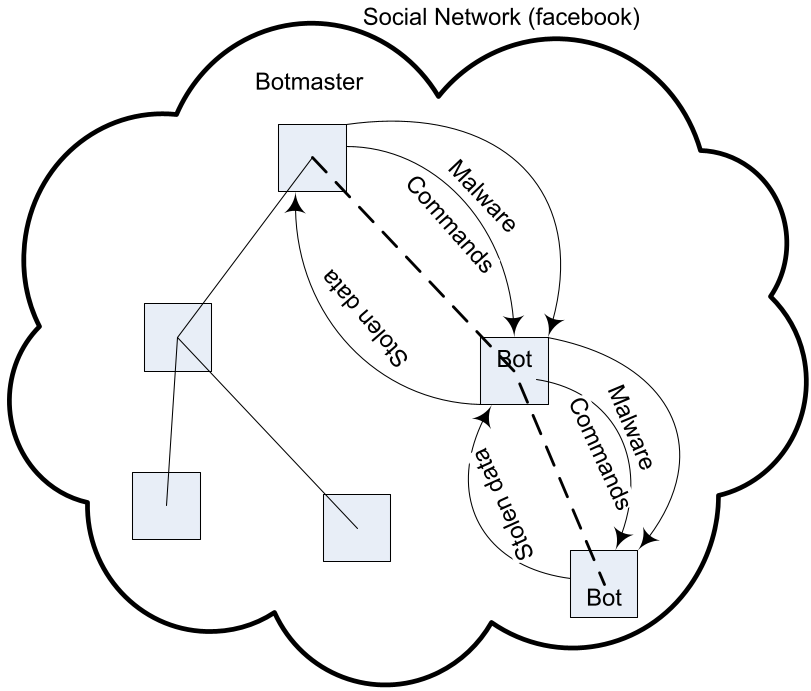 Figure 1: The Stegobot communication architecture over social network edges.
3. Overcoming Platform Interference
Social networks like Facebook often re-compress images, which usually destroys hidden data. Stegobot uses YASS (Yet Another Steganographic Scheme), which embeds data in a way that survives JPEG re-compression by targeting specific DCT (Discrete Cosine Transform) coefficients that remain stable during processing.
Experiments & Results: Stealth at Scale
The authors tested Stegobot against a crawl of 7,200 Flickr nodes over 40 months of activity.
- Resilience to "Noise": By adjusting the redundancy parameter , the researchers achieved a 0% Bit Error Rate (BER) even after Facebook's aggressive image optimization, provided they avoided "bad" images (those with low self-correlation).
- Throughput: Even with a simple "Restricted Flooding" routing algorithm, a botmaster could successfully collect roughly 18,000 messages per month, totaling up to 86MB of data. While this seems small compared to high-speed fiber, it is more than enough to steal thousands of passwords, credit card numbers, or sensitive documents.
 Table 1: Bit Error Rate (BER) across different YASS quality factors on Facebook.
Critical Analysis & Conclusion
Takeaway
Stegobot represents a shift from "brute force" botnets to "semantic" botnets. It proves that a functional, wide-scale malicious network can exist entirely within the "noise" of legitimate human behavior.
Limitations
- Latency: Because communication depends on humans sharing images, data exfiltration can take days or weeks (high latency).
- Platform Dependency: If a social network changes its image processing pipeline significantly (e.g., migrating to WebP or very aggressive filtering), the steganographic channel might break until the bot evolves.
Future Outlook
The authors suggest that routing could be significantly improved by targeting "hubs" (high-degree social nodes). As we move toward a world of encrypted traffic (HTTPS/TLS), identifying Stegobot-like behavior will likely require AI-driven behavioral analysis rather than simple packet inspection.
Final Thought: Next time you "like" a friend's photo, remember—you might be unknowingly participating in a global data heist.