
STEM on Twitter: Mapping the Architecture of Digital Education Discourse
STEM conversations in social media: Implications on STEM education
This paper presents a longitudinal social network analysis (SNA) of STEM education conversations on Twitter over a one-year period. By analyzing 146,976 tweets, it identifies a network structure dominated by organizations as opinion leaders and individuals as conversation facilitators, highlighting key trends in K-12 and graduate-level STEM discourse.
TL;DR
This study provides a year-long deep dive into how STEM (Science, Technology, Engineering, and Math) is discussed on Twitter. By analyzing nearly 150,000 tweets, researchers mapped the power structures of the community, revealing that while organizations hold the most influence, individuals (like teachers and scientists) are the ones actually keeping the conversation alive. The discourse is heavily weighted toward K-12 engagement and helping PhD students escape the "ivory tower" for industry roles.
Background: The Knowledge Economy & The Digital Bridge
In a world where "21st-century competencies" like critical thinking and digital literacy are the new currency, STEM education has become a global priority. However, the transition from classroom to career remains rocky. Social media, specifically Twitter, has emerged as a vital bridge between students, educators, and the industry. This paper asks: Who is actually leading these conversations, and what are they talking about?
Methodology: Graph Theory as a Sociological Tool
The authors didn't just count tweets; they used Social Network Analysis (SNA) to build a map of human (and corporate) interaction.
- Nodes: Users who tweet using the #stem hashtag.
- Edges: Connections formed when one user mentions another.
To find the real "VIPs," they used three specific metrics:
- In-Degree: Who is getting the most mentions? (Popularity)
- Eigenvector Centrality: Who is connected to other influential people? (Authority)
- PageRank: If you were "browsing" the STEM conversation, which accounts would you inevitably land on? (Influence)
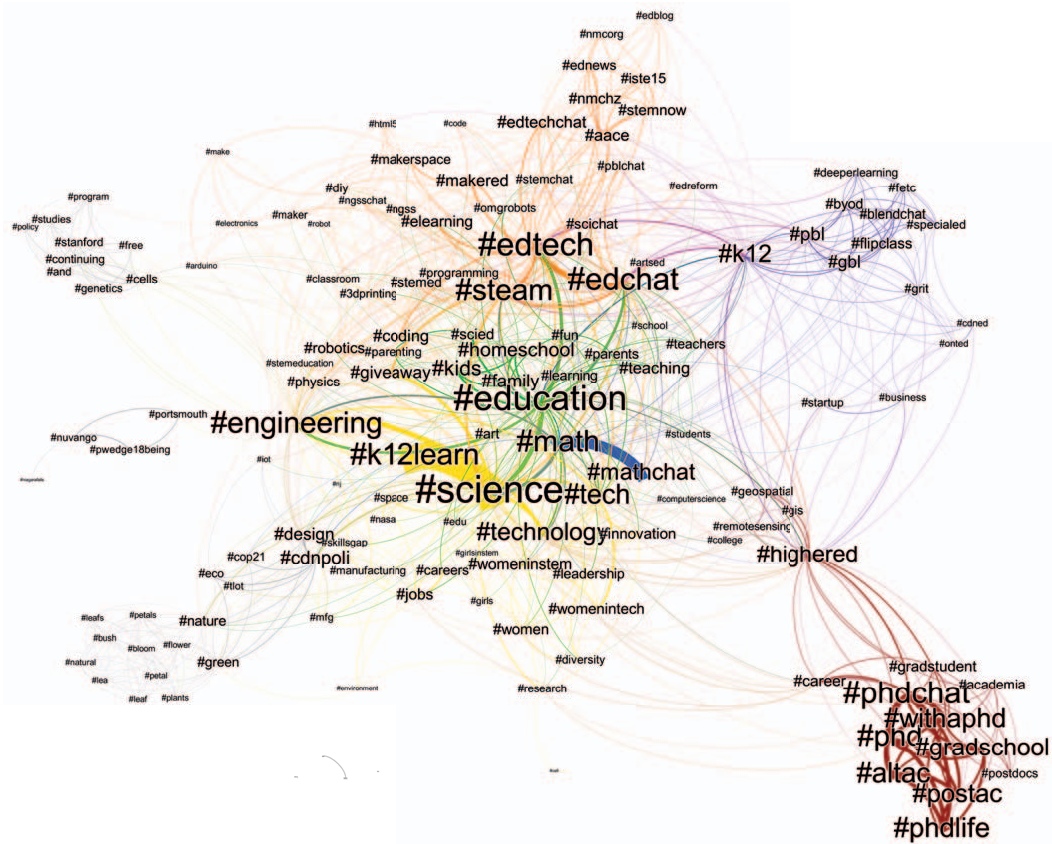 Fig 1: The thematic clusters of STEM conversations, showing dense groupings around education, science, and graduate studies.
Power Players: Opinion Leaders vs. Facilitators
The study found a fascinating divide in labor within the network:
1. The Opinion Leaders (The "Whales")
Analysis showed that the top 20 influencers are almost exclusively organizations. This includes:
- NASA: A perennial favorite for space and science.
- STEM Vendors: Companies selling kits and classroom supplies.
- Energy Corporations: Major players like oil and tech firms.
Interestingly, these organizations have a high In-Degree but low Out-Degree. They are the "destinations" of information—people talk to them, but they rarely talk back to individual users.
2. The Facilitators (The "Connectors")
Conversely, the users with the highest Out-Degree—those mentioning others and sparking dialogue—are often individuals. The most active facilitator in the entire sample was an elementary school teacher. These individuals act as the glue of the community, spreading news and resources that the big organizations post.
Content Trends: What's the Buzz?
By clustering hashtags, the researchers identified six major "neighborhoods" in the STEM conversation:
| Cluster | Focus Area | Key Observations |
|---|---|---|
| #science | General Interest | News items designed to make science relevant to a broad audience. |
| #phdchat | Graduate Life | A strong focus on "Alt-Ac" (Alternative to Academia)—luring PhDs into industry jobs. |
| #edtech | Tools | Promoting robots, programming apps, and digital games for K-12. |
| #k12 | Methodology | Heavy emphasis on Project-Based Learning (PBL) and Game-Based Learning. |
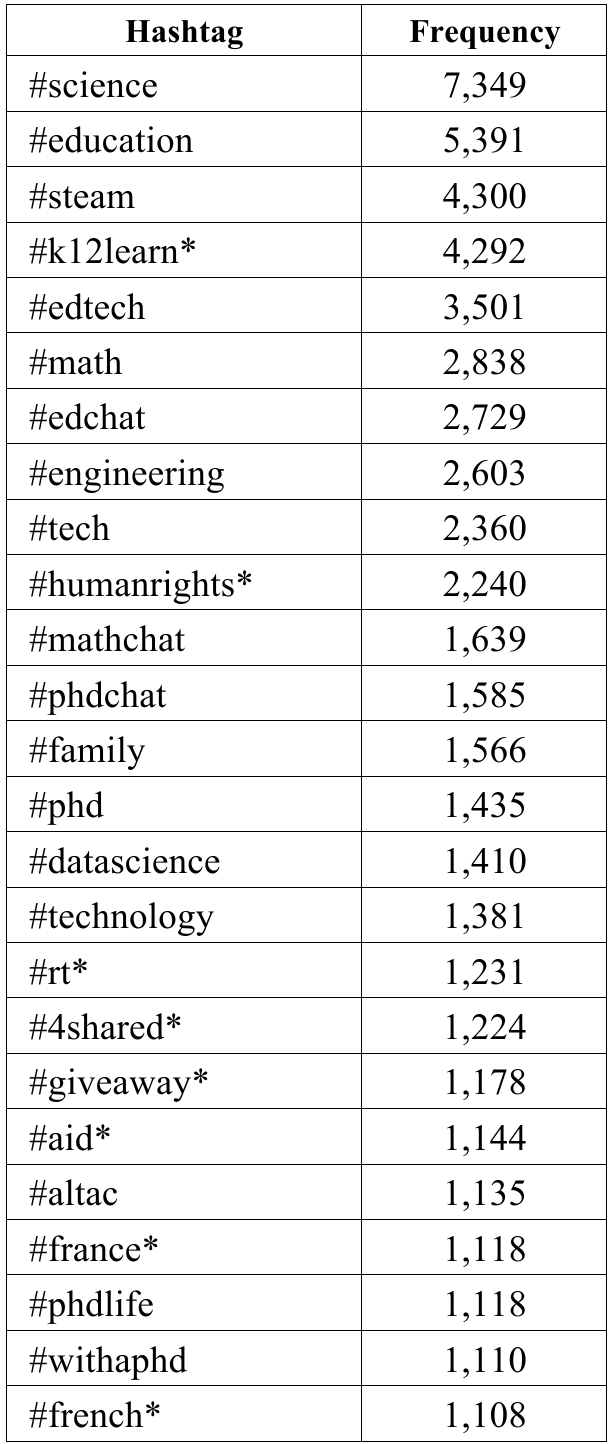 Fig 2: Science and Education dominate the discourse, but "SPAM" hashtags (starred) remain a challenge for social media researchers.
Critical Insight: The "Missing" Undergraduate
One of the paper's most striking findings is a gap in the "pipeline." While there is massive energy directed at K-12 students (to spark interest) and Doctoral students (to recruit for industry), the undergraduate population is strangely quiet in the #stem network. This suggests that the university years might be a "black hole" where students are less engaged with the broader professional community on social media.
Future Outlook & Limitations
The study acknowledges the noise of the digital world—specifically Spam. A significant portion of the most frequent hashtags (like #giveaway or #humanrights in a STEM context) were actually bots or promotional noise.
Takeaway for Educators: If you want your message to spread, you shouldn't just target the big organizations like NASA. Instead, find the "Facilitators"—the teachers and scientists with high Out-Degrees—who act as the network's amplifiers. The "Knowledge Economy" is not just about what you know, but who facilitates that knowledge in the digital commons.
Conclusion
This research confirms that the STEM industry has successfully integrated itself into the educational discourse. As we move forward, the challenge for educators will be to fill the gaps—particularly for undergraduate engagement—and to move beyond one-way broadcasting into true interactive mentorship.