
The STEP Project: Gamifying and Digitizing Youth Engagement in Environmental Policy
The STEP Project: Societal and Political Engagement of Young People in Environmental Issues
The STEP Project introduces a digital e-participation platform (web/mobile) designed to engage young Europeans in environmental decision-making. By integrating social media mining, gamification, and machine translation, it aims to bridge the gap between youth and public authorities across six pilot sites in Europe.
TL;DR
The STEP Project (Societal and Political Engagement of Young People in Environmental Issues) is a Horizon 2020 initiative that leverages a cloud-based platform to bring young citizens into the heart of environmental decision-making. By combining social media mining, machine translation, and gamification, it transforms "wooden" political processes into interactive, accessible digital experiences.
Context: The Distance Between Policy and Youth
Decisions made today regarding climate change and resource depletion will weigh most heavily on the younger generation. However, Eurobarometer data reveals a stark reality: nearly half of young Europeans distrust the EU, and traditional political engagement—voting or joining parties—is at an all-time low. The "wooden" language of politicians and overly formalized procedures create a barrier that traditional ICT tools haven't yet breached.
The Insight: Meeting Youth Where They Live
The central motivation of the STEP project is to replace alienation with integration. The authors recognize that for participation to be effective, it must:
- Be Multi-Channel: Reach users via mobile (iOS/Android) and web.
- Be Social: Use mining technologies to aggregate existing social media discussions.
- Be Frictionless: Use Machine Translation (MT) to allow cross-border collaboration without language barriers.
Methodology: A Modular, Service-Oriented Architecture
The STEP platform isn't just a website; it’s a sophisticated SaaS ecosystem. Built on Service-Oriented Architecture (SOA), it allows public authorities to pick and choose components (like e-Petitions or Idea Generation) without overhauling their existing infrastructure.
The Social Media Mining Engine
One of the most technically robust features is the Social Media Mining tool. Built on a stack of Java, MongoDB, and Apache Solr, it monitors platforms like Twitter and YouTube to visualize trends for policy makers.
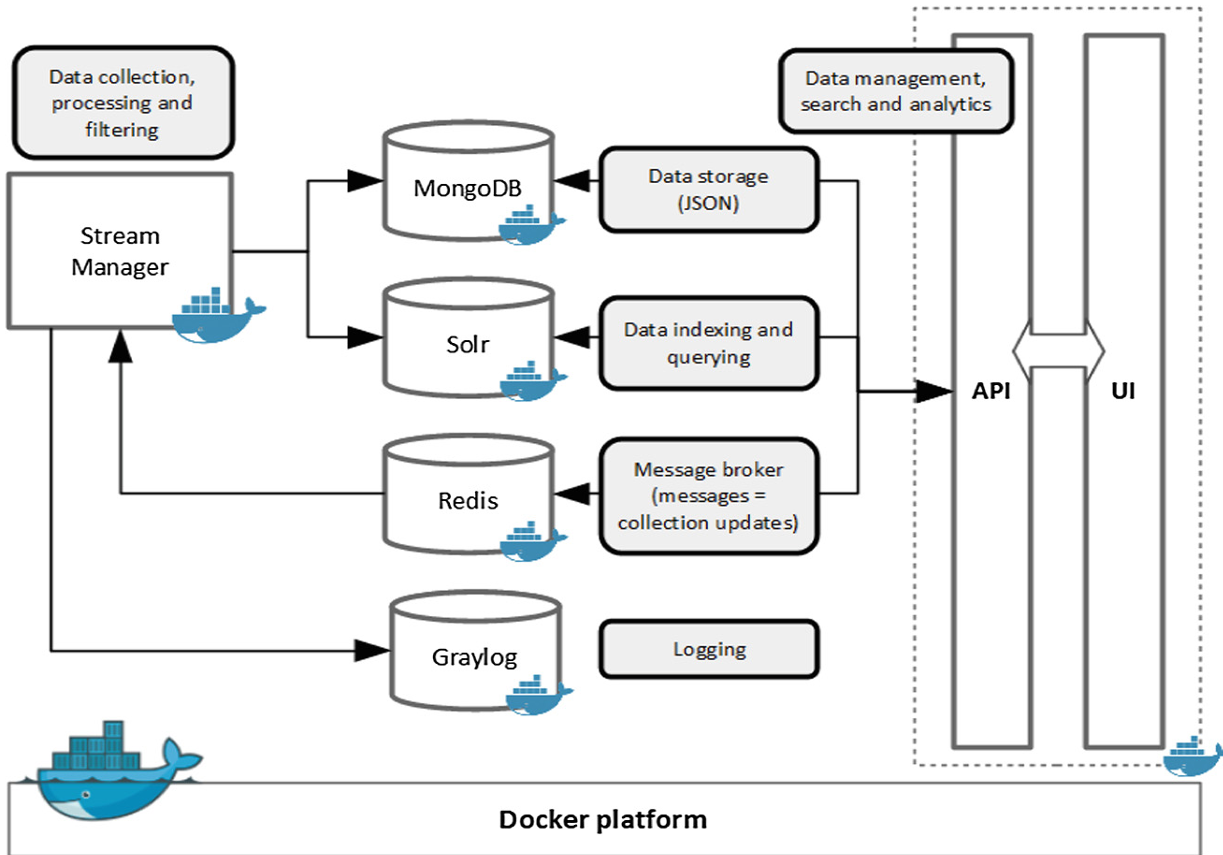 Figure 1: The modular containerized architecture for social media monitoring and analytics.
The Human Framework: 5 Steps to Engagement
Technology alone is insufficient. The authors developed a structured framework to guide local authorities through the engagement lifecycle:
- Background & Planning: Mapping stakeholders and setting rules.
- Action & Communication: The active phase of digital consultation and outreach.
- Feedback & Evaluation: An iterative loop ensuring users see the impact of their input.
Pilots and Real-World Impact
As of early 2017, the platform was deployed in six pilots across Italy, Spain, Greece, and Turkey. These weren't hypothetical tests; they involved regional authorities and associations of municipalities tackling real-world environmental questions.
Key technical features that drove adoption included:
- Gamification: Leaderboards and badges to reward active participation.
- Text-to-Speech (TTS): Enhancing accessibility by converting complex policy documents into audio files (WAV/MP3).
- Machine Translation: Utilizing Statistical Machine Translation (SMT) to foster a pan-European environmental discourse.
Critical Insight & Future Outlook
The STEP project represents a shift toward "Citizen-Centered e-Government." Its strength lies in its modularity—allowing a small municipality to implement a simple "Idea Generation" module while a large region might deploy the full social mining suite.
Limitations: The paper notes that evaluation was ongoing through late 2017. The ultimate challenge for such platforms remains "closing the loop"—ensuring that once a young person submits an idea, the political machine actually acts upon it. Without visible policy impact, even the most gamified platform risks becoming another "wooden" tool.
Conclusion: STEP serves as a blueprint for modernizing democracy. By treating citizens as "users" with preferences that can be mined and analyzed, it provides policy makers with the data-driven insights needed to govern in the 21st century.