
HMCI: Engineering Self-Organization in Hybrid Human-Machine Teams
Stimulating Self-Organization in Human-Machine Collective Intelligence Environment
The paper introduces a framework for Human-Machine Collective Intelligence (HMCI) designed for decision support in complex, dynamic environments. It features a novel team-formation algorithm based on combinatorial optimization and a game-theoretic mechanism to stimulate long-term participant development and self-organization in ad hoc hybrid teams.
TL;DR
In complex decision-making environments, neither rigid AI workflows nor complete human autonomy suffice. This paper introduces a Human-Machine Collective Intelligence (HMCI) environment that stimulates self-organization through mathematical team-formation models and game-theoretic incentive structures. By using "process patterns," it reduces the management burden on human leaders while maintaining the flexibility of ad hoc teams.
The Motivation: Why Ad Hoc Teams Fail
Decision-making in government or business today is plagued by uncertainty and variables that are difficult to formalize for pure AI. While "ad hoc" teams (teams formed specifically for one task) are the natural solution, they suffer from two major issues:
- Coordination Chaos: Without a predefined workflow, teams spend more time deciding how to work than actually working.
- The Incentive Gap: In environments with "weak ties" (like crowdsourcing), participants lean toward free-riding (low effort) or false-reporting (customers evading payment).
The authors argue that the solution is not more "programming" of humans, but a system that provides the right stimuli for self-organization to emerge naturally.
Methodology: The Core Mechanics
The HMCI environment rests on two pillars: Intelligent Team Formation and Strategic Development Mechanisms.
1. Multi-Objective Team Formation
The authors formulate team assembly as a combinatorial optimization problem. Instead of just picking the "best" individuals, the algorithm selects a set of participants to maximize a global function involving:
- Diversity Factor: Ensuring the team has the breadth of skills to handle unexpected sub-tasks.
- Redundancy: Creating overlap so members can replace each other if one becomes unavailable.
- Affinity (Compatibility): Using historical data to pair participants who have collaborated effectively in the past.
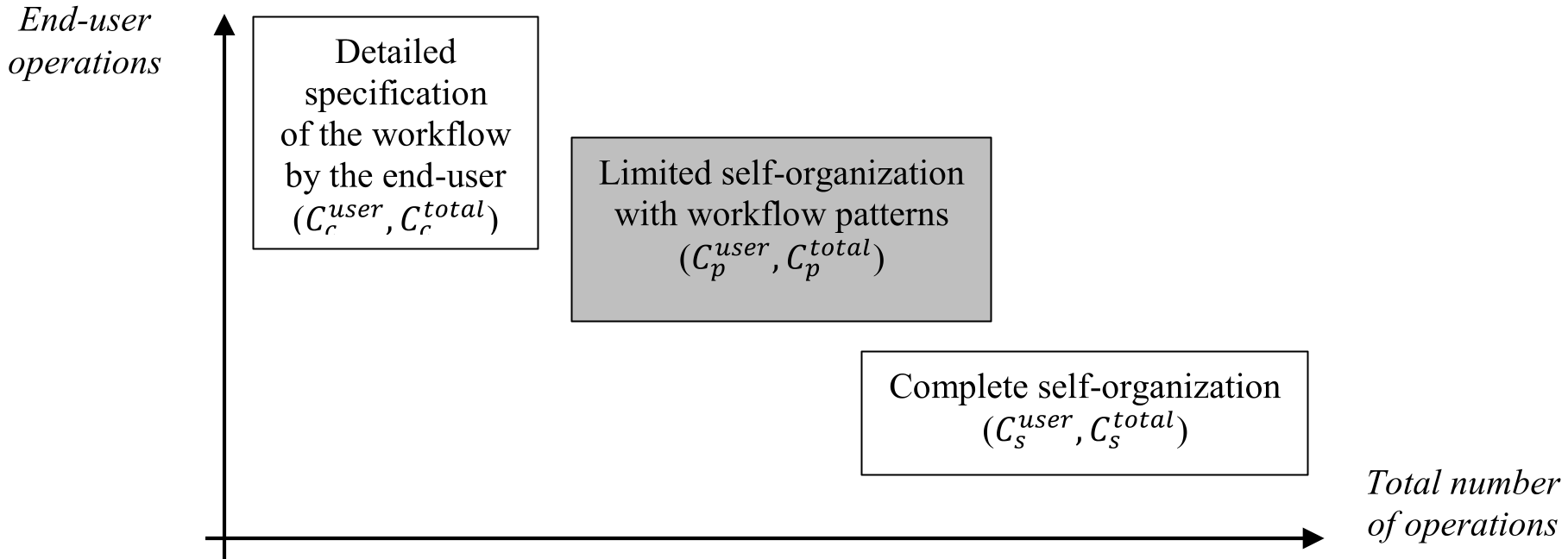 Figure 1: Comparison of complexity between centralized planning, pure self-organization, and the proposed HMCI approach.
2. Stimulating Effort via Game Theory
To solve the "free-rider" problem, the paper proposes a Reputation-based Social Norm. They model the interaction as a repeated game where:
- Reputation () determines a participant’s "status."
- Threshold Strategies: High-status participants get access to better tasks; if reputation falls below a threshold , the participant is temporarily "blocked" from the environment.
- Punishment/Reward: High effort () increases reputation; low effort () decreases it.
The mathematical beauty here lies in the One-Time Deviation Principle, ensuring that for a rational agent, the long-term utility of staying in the system is higher than the short-term gain of being lazy.
Experiments & Theoretical Impact
The authors evaluate the efficiency of HMCI against two baselines: Detailed Workflow Specification (The "Manager" approach) and Complete Self-Organization (The "Anarchy" approach).
- For the End-User: In a standard complexity curve where is the number of tasks, the HMCI approach flattens the curve to by using "Collaboration Patterns."
- For the Team: It avoids the quadratic growth of coordination costs typical in pure self-organization by providing structured voting and proposal protocols.
Critical Analysis & Future Outlook
The framework’s reliance on multi-aspect ontologies is its greatest strength and a potential bottleneck. While ontologies allow agents to "understand" human intent, they require significant initial effort to build.
Takeaway: This work represents a shift from "AI as a tool" to "AI as an orchestrator." By focusing on the environment rather than the specific algorithm, the authors provide a scalable blueprint for hybrid organizations that are more resilient than traditional hierarchies but more disciplined than standard crowdsourcing.
Future Work: A fascinating next step would be integrating Large Language Models (LLMs) to dynamically generate the multi-aspect ontologies, further reducing the setup friction for these hybrid environments.