
STK-Anonymity: Securing Social Networks Against Structural and Textual Identity Attacks
STK-anonymity: k-anonymity of social networks containing both structural and textual information
The paper introduces STK-Anonymity, a novel framework for privacy preservation in social networks that simultaneously anonymizes both structural (node degrees) and textual (edge labels) information. It proposes a two-phase approach using a set-enumeration tree and three pruning strategies to achieve K-anonymity while minimizing information loss.
TL;DR
Published in SIGMOD, this research addresses a critical gap in data privacy: the vulnerability of social networks to "mixed-knowledge" attacks. By introducing STK-Anonymity, the authors provide a rigorous method to ensure each node is indistinguishable from others based on both their connections (structure) and the descriptions of those connections (textual labels). The core innovation lies in a two-phase global optimization that prevents the chaotic "ripple effect" of changes in connected graph data.
The Problem: The Hidden Leak in Edge Labels
Anonymizing a social network is more than just removing names. Most researchers focus on Structural Anonymization (making sure your degree or neighborhood isn't unique). However, real-world data is "annotated." If an attacker knows Alice has only one friend made in "2006" with the label "Classmate," she can be easily spotted even if her node degree is shared with others.
The difficulty in fixing this is Correlation. In a table, changing a cell affects one row. In a graph, changing the label of edge changes the textual profile of both node and node . Traditional local anonymization causes a chain reaction—fixing one node might break the anonymity of its neighbor.
Methodology: The Two-Phase Global Strategy
To solve the correlation problem, the authors move away from local edits and propose a Global Candidate Scheme.
Phase 1: Structural Alignment
The network is first processed to satisfy K-degree anonymity. This involves adding edges so that every node shares its degree with at least others. This provides the structural skeleton for the next step.
Phase 2: Solving the Label Explosion
Instead of tweaking edges one by one, the authors use a Set-Enumeration Tree to explore "Global Annotation Targets."
- The Insight: If we apply a uniform generalization rule across the entire graph (e.g., "Change all specific years to 5-year intervals"), we eliminate the back-propagation risk.
- Hierarchy-Driven: Using domain hierarchies (like Year Interval), the system searches for the "least general" set of labels that satisfies the K-anonymity requirement.
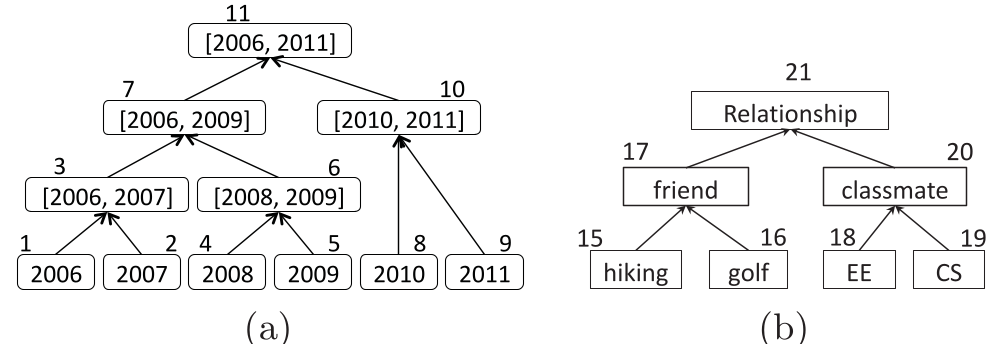 Figure: Hierarchies used to generalize temporal and relationship data.
Pruning the Search Space
The search space for label combinations is (where is the number of possible labels), which is computationally explosive. The authors introduced three pruning strategies:
- Downward Closure: If a specific label set doesn't provide enough privacy, any more specific version of it definitely won't either.
- Redundancy Pruning: Avoiding overlapping label groups that represent the same information level.
- Solution Optimization: Once a solution is found, subsets that offer no better information loss are skipped.
Experiments and Results
The framework was tested on the Enron email dataset and large-scale DBLP records.
Efficiency and Scalability
The pruning strategies were the "secret sauce." As shown in the performance charts, combined pruning (P123) reduced execution time from hours to seconds by eliminating millions of unnecessary checks.
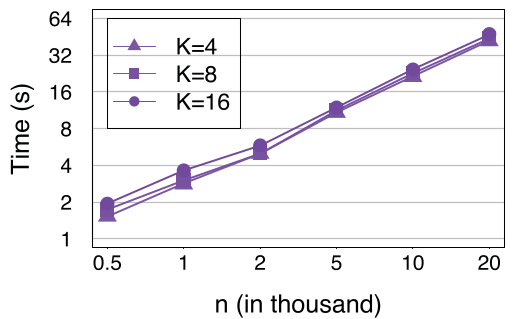 Figure: The impact of different pruning strategies on the number of nodes expanded in the search tree.
Information Loss
The researchers found that for larger values of , structural anonymization (adding edges) contributes more to information loss than textual generalization. This justifies their choice to handle degrees first, as it settles the most "expensive" part of the privacy cost upfront.
Deep Insight: Why This Matters
The shift from Categorical Anonymity to Relational Anonymity is the defining characteristic of this work. By treating the node and its edges as a single "profile" while acknowledging the mathematical dependencies between nodes, the authors bridged the gap between traditional K-Anonymity (usually for static tables) and Graph Theory.
Conclusion and Limitations
STK-Anonymity is a robust defense against sophisticated adversaries. However, it assumes that the graph structure is static. In the age of streaming social data, maintaining STK-Anonymity as the graph evolves without recalculating the entire global label set remains an open challenge. Additionally, the approach relies on pre-defined "generalization hierarchies," which requires significant domain expertise to construct correctly.
For technical practitioners, this paper serves as a blueprint for how to handle high-dimensional, correlated attributes in non-Euclidean data structures.