
STK-Anonymity: Protecting Social Networks from Structural and Textual Identity Attacks
STK-anonymity: k-anonymity of social networks containing both structural and textual information
The paper introduces STK-anonymity, a novel privacy-preserving framework for social networks that protects against adversaries using both structural (node degrees) and textual (edge labels) information. It proposes a two-phase approach—degree anonymization followed by edge label generalization—achieving SOTA privacy protection while maintaining data utility on real-world datasets like Enron and DBLP.
TL;DR
In the era of big data, releasing social network datasets is a double-edged sword: they are vital for research but a nightmare for privacy. Standard de-identification is not enough. This paper presents STK-Anonymity, a solution that ensures a user remains indistinguishable from at least others, even if an attacker knows both their social connections (degrees) and the specific types of relationships (edge labels) they have.
Background Positioning
Most structural anonymization works treat social networks as "naked" graphs. However, real-world social data is annotated (e.g., a "friend" edge in 2007 vs. a "colleague" edge in 2008). This paper bridges the gap between tabular K-anonymity and graph-based privacy, addressing the "curse of correlation" inherent in networked data.
The Core Problem: The Back-Propagation Trap
Why can't we just use standard K-anonymity? In a table, rows are independent. In a graph, nodes are connected by edges. If you change a label on an edge connected to Node A to satisfy its privacy requirement, you simultaneously change the information for Node B. This "back-propagation" can create an endless loop of changes, making local anonymization algorithms unstable and inefficient.
Methodology: The Two-Phase Global Strategy
The authors solve this by splitting the problem into two distinct phases:
- Phase 1: Degree Anonymization: Grouping nodes to have identical degrees (using edge addition/deletion).
- Phase 2: Global Edge Label Anonymization: Instead of looking at nodes, the authors look at the Hierarchy of Labels.
The Set-Enumeration Tree
To find the best way to "blur" (generalize) labels (e.g., turning "2006" and "2007" into "[2006-2007]"), they use a Set-Enumeration Tree. This tree maps out every possible combination of label generalizations.
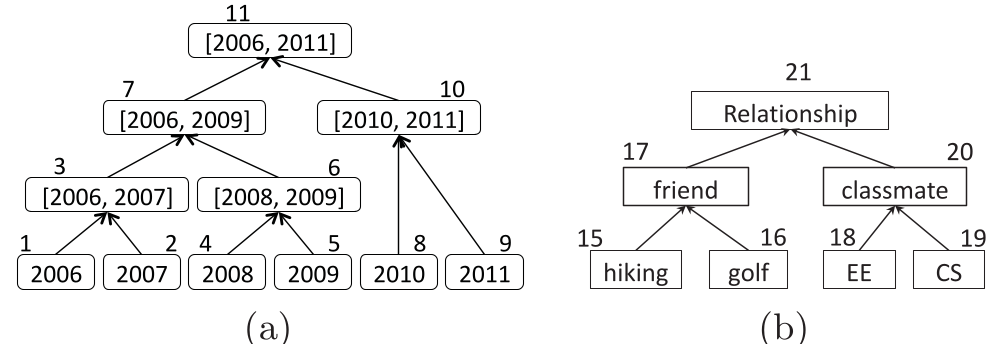 Figure: Generalization hierarchies used to build the global search space.
To make this search feasible, they introduced three pruning strategies:
- Downward Closure: If a specific label set doesn't provide enough anonymity, any more specific version of it won't either.
- Redundancy Pruning: Skipping sets that yield the same conversion result as previously checked sets.
Experimental Insights
The research tested these algorithms on the Enron Email Dataset and large-scale DBLP graphs.
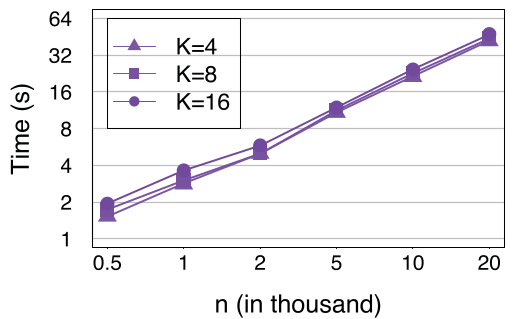 Figure: Performance comparison showing that combining all three pruning strategies (P123) significantly reduces execution time.
Key findings include:
- Scalability: The running time scales linearly with the number of nodes once the label domain is fixed.
- Utility: The "Information Loss" is primarily driven by structural changes rather than label generalization at high values of , proving that their two-phase approach targets the right bottleneck.
Critical Analysis & Conclusion
Takeaway
STK-Anonymity is a robust framework for releasing rich social data. By transforming a graph-local problem into a global hierarchy-search problem, it successfully avoids the pitfalls of edge-label correlation.
Limitations
The current approach assumes a fixed social structure after Phase 1. An integrated approach that optimizes structure and text simultaneously could potentially yield even lower information loss, though the computational cost would be significantly higher (likely requiring heuristic or RL-based solvers).
Future Outlook
This work lays the groundwork for "Semantic Anonymity." Future research could apply these principles to Knowledge Graphs or Multi-modal networks where edges contain images or complex metadata.