
Stochastic Decision Making: Revolutionizing Medical Big-Data Crowdsourcing via 60-GHz Networks
Stochastic Decision Making for Adaptive Crowdsourcing in Medical Big-Data Platforms
This paper introduces two novel algorithms for adaptive crowdsourcing in 60-GHz medical big-data platforms: a Max-Weight Uplink Scheduling algorithm and a Stochastic Decision-Making algorithm for power-and-latency-aware buffer management. The system leverages the high bandwidth of the 802.11ad standard to handle massive medical imaging data while ensuring queue stability and energy efficiency.
TL;DR
The explosion of high-resolution medical imaging (MRI, CT, etc.) necessitates a robust wireless infrastructure for data aggregation. This paper presents a dual-algorithm approach: a Max-Weight Uplink Scheduler to optimize network throughput and a Stochastic Power Allocation scheme based on Lyapunov drift to prevent device buffer overflows. By utilizing the 60-GHz (IEEE 802.11ad) spectrum, the system achieves superior data rates while maintaining energy efficiency in sensitive hospital environments.
Problem & Motivation: The "Big Data" Bottleneck in Hospitals
Modern medical devices generate enormous amounts of data—digitized X-rays can require up to 3 Gbps for transmission. In a "crowdsourcing" medical platform, where various practitioners and devices upload data to a central cloud, two major problems arise:
- Buffer Overflow: Large data bursts from MUs can easily overwhelm local device memory if the scheduling isn't "backlog-aware."
- Energy vs. Latency Tradeoff: High-speed transmission at 60-GHz consumes significant power. Simply blasting data at max power is inefficient, while low power leads to massive queuing delays.
The authors argue that existing schedulers like Sum-Rate-Maximization (SRM) are "buffer-blind," leading to potential data loss for users with large backlogs but temporarily poor channel conditions.
Methodology: Joint Scheduling and Stochastic Control
1. Max-Weight Uplink Scheduling
The system uses a Max-Weight principle where the priority of a link between a Medical User (MU) and an Access Point (AP) is defined not just by the data rate , but by the product of the rate and the current queue size : This ensures that devices "in danger" of overflowing get higher priority. To solve the resulting non-convex optimization, the authors cleverly reformulated the constraints to make the problem convex and solvable in real-time.
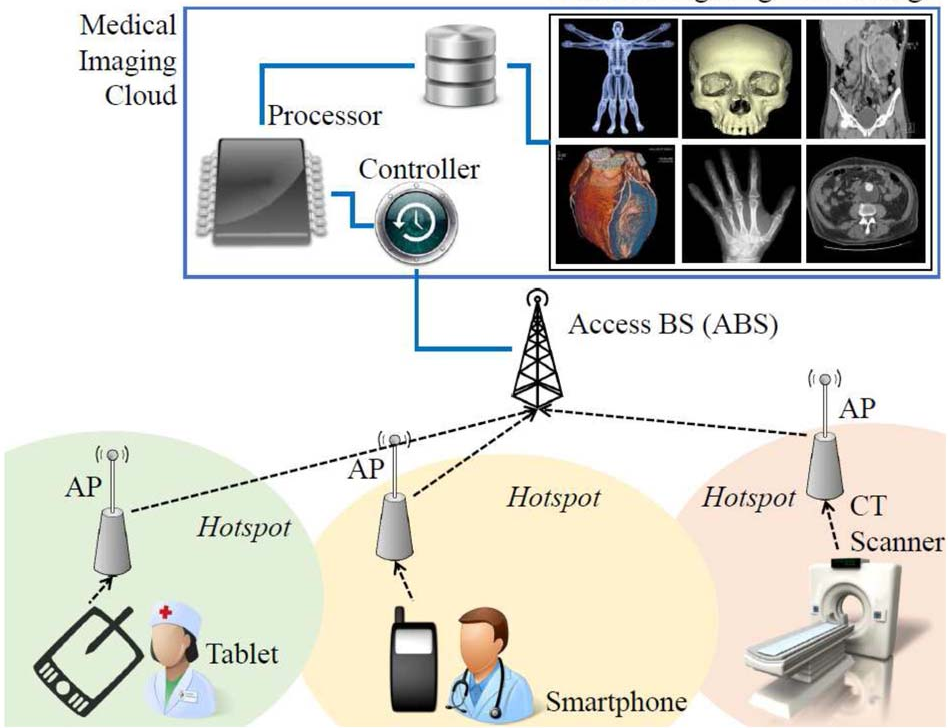 Fig 1: The architecture of the medical big-data platform using 60-GHz APs and MUs.
2. Distributed Power Allocation via Lyapunov Drift
Each MU independently decides its transmit power . The authors defined a quadratic Lyapunov function to track "network congestion." By minimizing the "drift-plus-penalty" (where the penalty is power consumption), they derived a closed-form solution for the optimal transmit power: This water-filling-like solution adaptively increases power when the queue grows, effectively stabilizing the buffer.
Experiments & Performance
The researchers tested their algorithms against traditional SRM and Random schedulers using real-world medical imaging formats (from Nuclear Medicine to 3Gbps Radiography).
Scheduling Gains
The proposed Max-Weight scheduler significantly outperformed the SRM scheduler. Results indicated that a random scheduler could only reach 60% of the proposed method's efficiency, proving that being "backlog-aware" is critical in high-load scenarios.
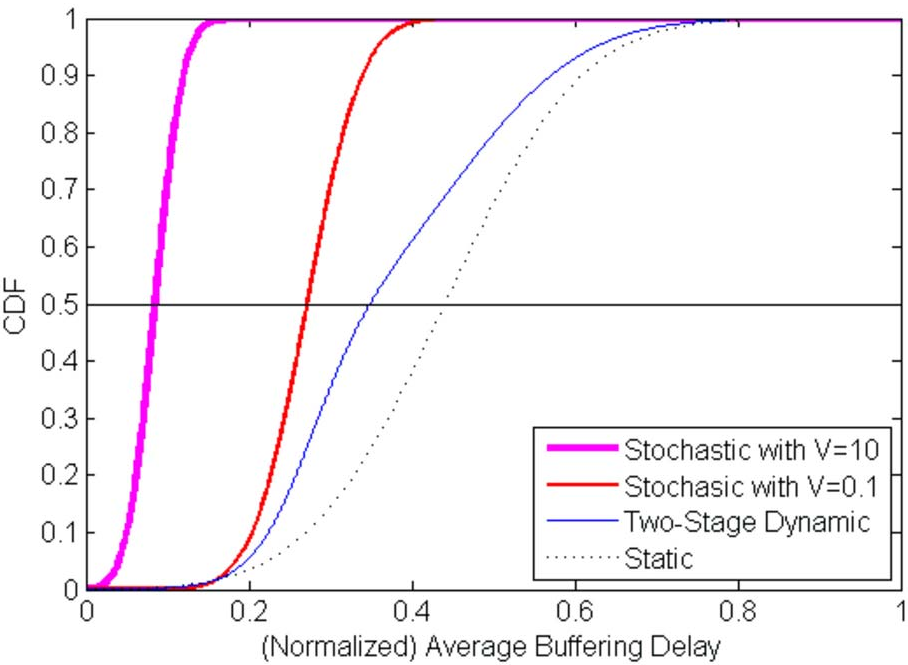 Fig 2: Relative performance of Max-Weight vs. SRM and Random schedulers.
Buffering Efficiency
Using a control parameter , the stochastic buffering approach achieved the lowest cumulative delay. Compared to static power allocation, the proposed method reduced median delays by nearly 80%, ensuring that medical images reach the central storage rapidly and reliably.
Critical Insight & Conclusion
This work highlights a shift in wireless design: moving from pure throughput maximization to Stability-Aware Resource Management. In the context of medical imaging, where data integrity is a matter of life and death, the ability to mathematically guarantee buffer stability via stochastic decision-making is a major advancement.
Limitations: The study assumes Line-of-Sight (LoS) for the 60-GHz links. In complex hospital environments with heavy human movement, the impact of "shadowing" or blockage—a common issue for mmWave—remains a subject for further investigation.