
Stochastic Driver Velocity Prediction: Why Particles Beat Matrices in the Real World
Stochastic Driver Velocity Prediction with Environmental Features on Naturalistic Driving Data
The paper introduces two stochastic frameworks for long-range driver velocity prediction—a linear Gaussian model using Kalman Filtering/RTS Smoothing and a non-parametric model utilizing Bootstrap Particle Filtering/Backward-simulation Smoothing. By incorporating environmental features like road curvature and speed limits, the non-parametric Particle Smoother achieved the highest accuracy (NRMSE 30.05%) on a 1500 km naturalistic driving dataset.
TL;DR
Predicting how a human will drive over several kilometers is a "wicked" problem due to the chaotic nature of traffic and individual habits. This paper proves that non-parametric stochastic models (specifically Particle Smoothers) outperform both traditional linear filters and Neural Networks by leveraging environmental context—like road curvature—to accurately forecast vehicle velocity.
Background Positioning
In the landscape of Advanced Driver Assistance Systems (ADAS), velocity prediction is the "engine" for energy management in BEVs and HEVs. This work moves beyond simple time-series forecasting to a context-aware stochastic framework, positioning itself as a robust alternative to unstable "black-box" neural networks.
The Core Motivation: The Fallacy of Linearity
Most traditional filters (like the Kalman Filter) assume that the world is linear and Gaussian. However, as the authors observe, the relationship between road curvature and driver velocity is anything but linear.
- The Intuition: On a straight highway, velocity is high and variance is low. In a sharp turn, velocity drops sharply. A linear model fails to capture these "edge cases" of high curvature, which are exactly where precise prediction is most needed for safety and energy optimization.
Methodology: Switching Hidden Markov Models (SHMM)
The authors propose a hierarchical approach. First, they divide the driving environment into four "consolidated classes" (City, Country, Highway etc.). This acts as a Switching Hidden Markov Model (SHMM), where the "switch" is the environmental class.
1. The Linear Benchmark (Kalman/RTS)
They first established a baseline using the Rauch-Tung-Striebel (RTS) Smoother. While efficient, it assumes Gaussian noise, which cannot model the complex, multi-modal behavior of human drivers.
2. The Non-Parametric Breakthrough (Particle Filter)
To handle non-linearities, they employed Kernel Density Estimation (KDE) to model the measurement density . Because this density is non-analytical, they used a Bootstrap Particle Filter and a Backward-simulation Particle Smoother.
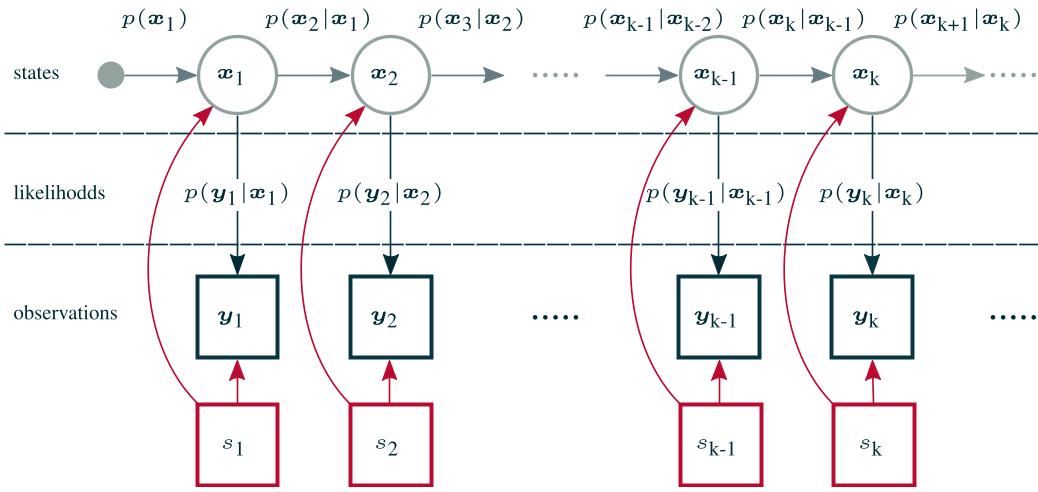 Caption: The SHMM framework where environmental classes (sk) determine the transition and measurement models for the vehicle state (xk).
Experimental Evidence
The study used 1500 km of real-world data from 8 subjects. The results were measured using NRMSE (Normalized Root Mean Square Error), where 1.0 is perfect prediction.
- Particle Smoother: 30.05% (The Winner)
- Traffic Speed Reference: 20.63%
- NARX Neural Network: 3.39% (Suffered heavily from instability/unseen data)
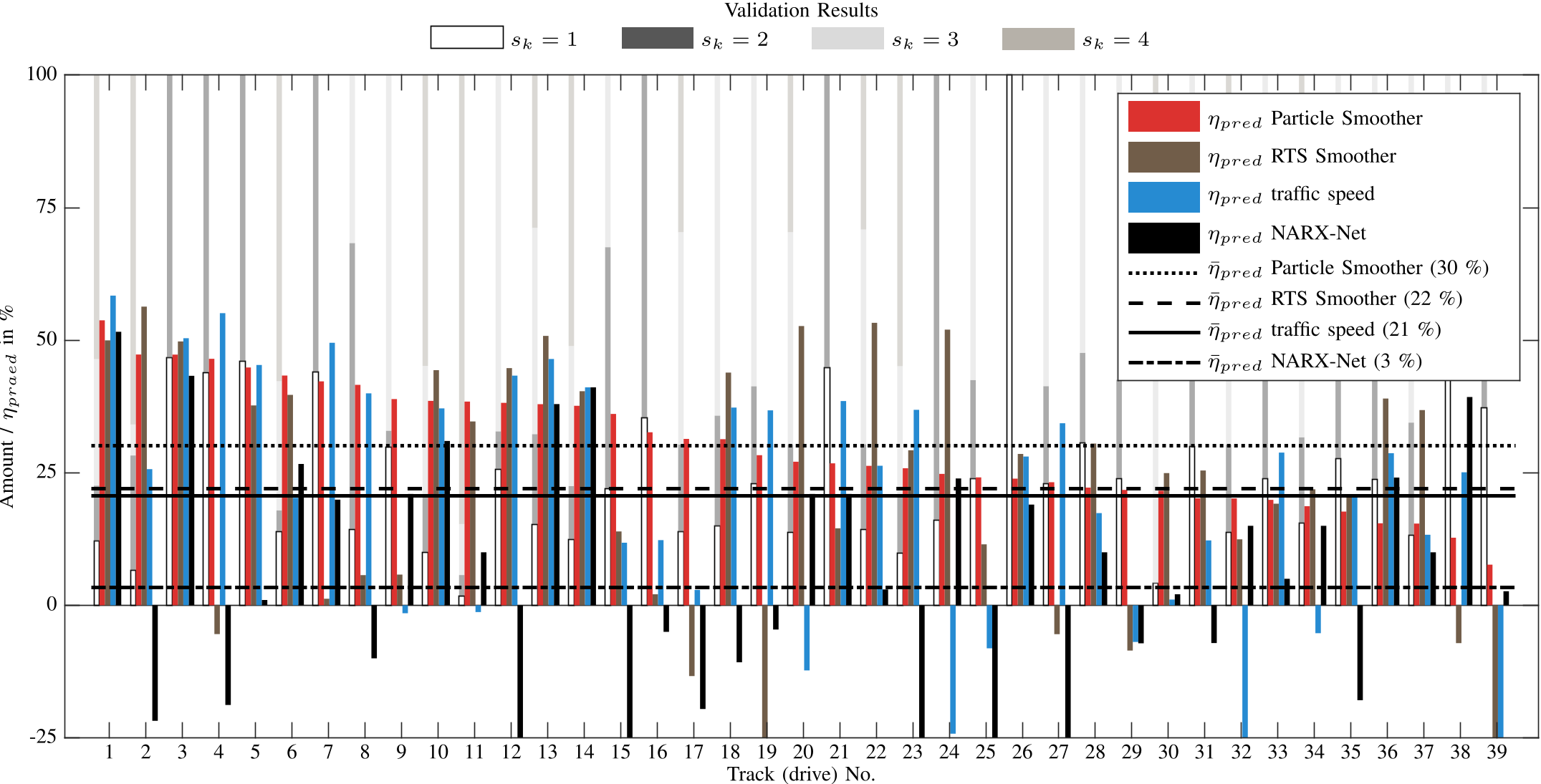 Caption: Comparison across 39 test tracks. Note how the Particle Smoother consistently outperforms the online traffic speed baseline, proving it captures individual driver "identity".
Critical Analysis & Insights
- Stability over Complexity: The NARX-Net failed significantly in this study. This highlights a common issue in automotive AI: deep learning models often overfit to training trajectories and "explode" when they encounter a road segment with slightly different features. The stochastic approach remains grounded in physical constraints.
- The Cost of Precision: The Particle Smoother is 300 times more computationally expensive than a Kalman Filter. While it offers superior accuracy, implementing this on edge hardware (automotive ECUs) requires significant optimization or hardware acceleration.
- Context is King: By studentizing data and categorizing by Functional Class (FC), the model reduces the search space, allowing a "driver-specific" profile to emerge from the noise.
Conclusion
This work demonstrates that for long-range automotive tasks, probabilistic modeling of the environment is more valuable than simply throwing more layers at a neural network. By using non-parametric distributions, the authors successfully captured the delicate "dance" between a driver's intent and the road's geometry.
Future Outlook: The next frontier involves Online Learning, where the model adapts to a new driver's style in real-time, and extending the framework to lateral dynamics (steering behavior) for full-vehicle trajectory prediction.