
Maximizing Healthcare Profits: The Power of Stochastic Overbooking
A Stochastic Mathematical Appointment Overbooking Model for Healthcare Providers to Improve Profits
This paper introduces the Stochastic Mathematical Overbooking Model (SMOM), a revenue management framework designed for healthcare providers to determine the optimal number of appointments. Unlike deterministic models, SMOM leverages full probability distributions of patient no-shows and walk-ins to maximize expected profits while balancing overtime and penalty costs.
TL;DR
No-shows are a billion-dollar drain on healthcare systems. This paper introduces the Stochastic Mathematical Overbooking Model (SMOM), which uses probability distributions of no-shows and walk-ins to find the "sweet spot" of overbooking. By moving beyond naive averages, the model boosted physician profits by over 43%, proving that sophisticated revenue management belongs in the clinic just as much as on the airplane.
The Problem: Empty Chairs and Lost Revenue
In the US healthcare system, revenue is often fixed by Medicare or HMO fee schedules. Physicians cannot simply raise prices to increase profit; they must either cut costs or see more patients. The biggest obstacle to the latter is the No-Show. Rates can range from 25% to 50%, leaving expensive staff and facilities idle.
Existing "Naive" solutions usually involve adding the average number of no-shows back into the calendar. However, this ignores the volatility of arrivals. If too many patients show up, clinicians face high overtime costs and "goodwill" penalties for turning patients away.
Methodology: The Stochastic Advantage
The researchers argue that overbooking in healthcare is a unique beast. Unlike airlines, clinics have flexible capacity (overtime) and must handle walk-ins (urgent cases).
1. The Profit Function
The SMOM defines a logic-driven expected profit equation that balances four key variables:
- Revenue (R): Generated for every patient seen.
- Fixed Cost (Y): Staff and facility costs regardless of patient volume.
- Overtime Cost (Co): The penalty for working beyond regular session hours.
- Emergency/Penalty Cost (Ce): The "Loss of Goodwill" cost when a patient must be sent home.
2. Probability Extrapolation
A major technical contribution is the method for estimating what happens when you overbook. If a doctor normally sees 12 patients (), they only have data for that limit. The authors developed a method to extrapolate the no-show probability density function to higher appointment counts (), ensuring the model accounts for the uncertainty of larger groups.
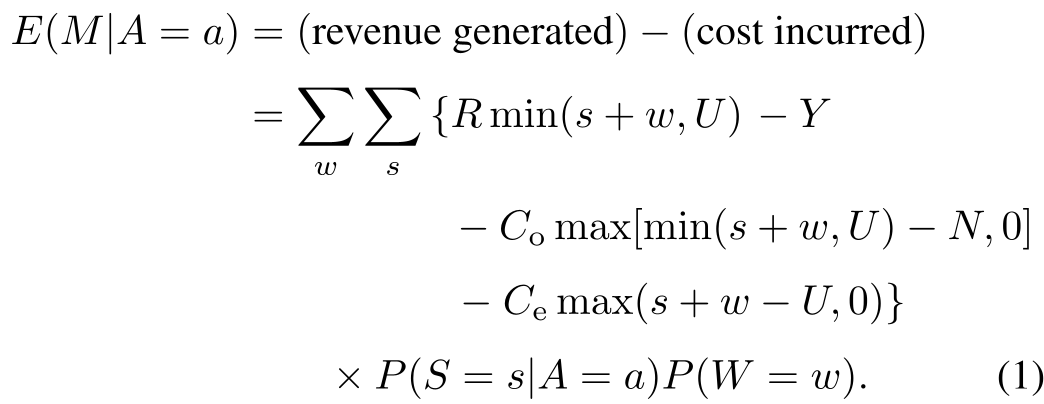 Figure 1: The core stochastic objective function used to calculate expected profit.
Experimental Results: SMOM vs. The World
The authors tested SMOM against two baselines using real-world data from 59 physicians:
- Base Case: No overbooking.
- NSOA (Naive Statistical Overbooking): Using simple averages.
| Strategy | Total Weekly Profit | Profit Increase |
|---|---|---|
| Base Case | $51,888 | - |
| NSOA (Naive) | $67,279 | + 29.66% |
| SMOM (Stochastic) | $74,573 | + 43.72% |
Robustness & Sensitivity
SMOM isn't just effective; it’s robust. Sensitivity analysis shows that SMOM maintains its advantage even when:
- Overtime costs fluctuate: Even at "time-and-a-half" pay, SMOM outperforms.
- Patient value changes: Whether it’s a low-margin Medicaid patient or high-margin cosmetic surgery, the model adapts.
- Capacity limits shift: The more flexibility a clinic has via overtime (), the more profit SMOM can extract compared to naive methods.
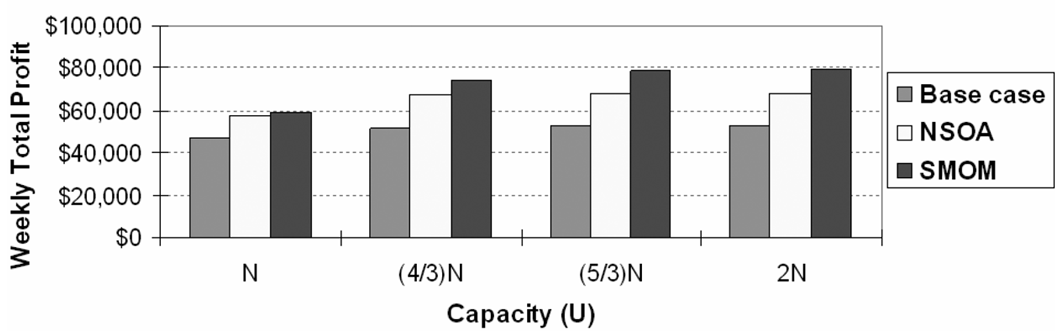 Figure 2: Performance comparison as the upper limit for overtime (U) increases.
Critical Insights: Is There a Catch?
While the financial gains are undeniable, the paper acknowledges a crucial trade-off: patient waiting time.
By eliminating the "slack" in the schedule created by no-shows, overbooking naturally increases the time a patient spends in the waiting room. The authors suggest that this is a fair trade for "continuity of care" and reduced waiting times for an initial appointment (e.g., getting in to see a doctor in 30 days instead of 50).
Conclusion
The SMOM represents a significant step forward in healthcare operations. It demonstrates that by applying Revenue Management principles and respecting the stochastic nature of human behavior, clinics can remain financially viable in an era of fixed reimbursements and high operating costs. For healthcare administrators, the takeaway is clear: stop counting averages and start modeling distributions.