
Deciphering Social Influence: Using Stochastic Optimization for Precision Service Pricing
Stochastic optimization on social networks with application to service pricing
This paper presents an integrated simulation-optimization framework using a stochastic quasi-gradient (SQG) algorithm to solve service pricing problems on complex, dynamic social networks. By modeling user behavior as a Discrete Event Dynamic System (DEDS), the authors demonstrate that differentiated pricing targeting influential "nodes" can significantly out-perform uniform pricing strategies in terms of total revenue and revenue per customer.
TL;DR
In the world of social networks, not all customers are created equal. This paper introduces a robust mathematical framework that combines Discrete Event Dynamic Systems (DEDS) with Stochastic Quasi-Gradient (SQG) algorithms to prove a counter-intuitive point: to maximize profit, you should give your most influential customers the service for free. By stimulating the "local network effect," providers can increase overall revenue by over 15% through strategic price differentiation.
The "Local" Friction in Global Markets
Most economic models for network effects (think: why everyone uses WhatsApp or LinkedIn) assume a "global" effect—if the total number of users goes up, the value goes up for everyone. But the authors of this paper argue that reality is far more granular. You don't care if a million strangers join a service; you care if your friends and your influencers join.
Existing optimization methods struggle with this because social networks are dynamic and stochastic. If you try to optimize pricing using standard "Sample Path Optimization" (simulating a fixed period and finding the max), you run into a nightmare of local optima and discontinuous "jitter" in the data.
Methodology: The Parallel Simulation Engine
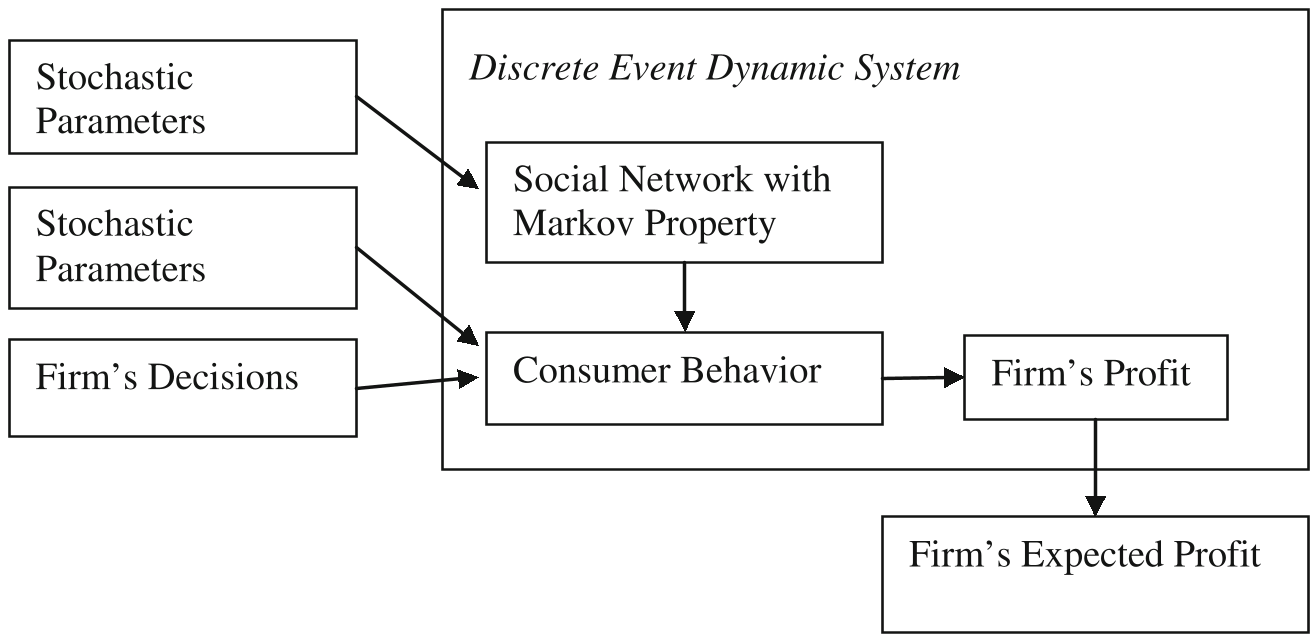
To solve the noise problem, the authors moved away from "simulating then optimizing" to a concurrent approach. They developed an integrated algorithm that maintains multiple versions of the "world" in parallel.
1. The Architecture of Influence
The model treats the social network as a graph where user ’s decision to subscribe () depends on their neighbors (). This creates a feedback loop:
- Base Process: Simulates the network under the current price .
- Derived Processes: Simulates the network with a tiny price shift () for each variable to estimate the gradient.
2. The SQG Algorithm
Instead of waiting for a simulation to finish, the Stochastic Quasi-Gradient (SQG) method updates the price at every few time steps. The "physical intuition" here is that by moving in the direction of the expected average revenue, the noise of individual "unsubscription events" gets filtered out over time.
Key Findings: The Power of the "Free" Leader
The most striking result comes from the comparison between Uniform Pricing (one price fits all) and Differentiated Pricing (prices based on network position).
1. Leader Discounts as Viral Marketing
As the network grows, the optimal price for "Global Leaders" (nodes with high centrality) rapidly drops to zero.
- Why? The revenue lost from the leader is dwarfed by the massive "subscription contagion" they trigger in their neighborhood.
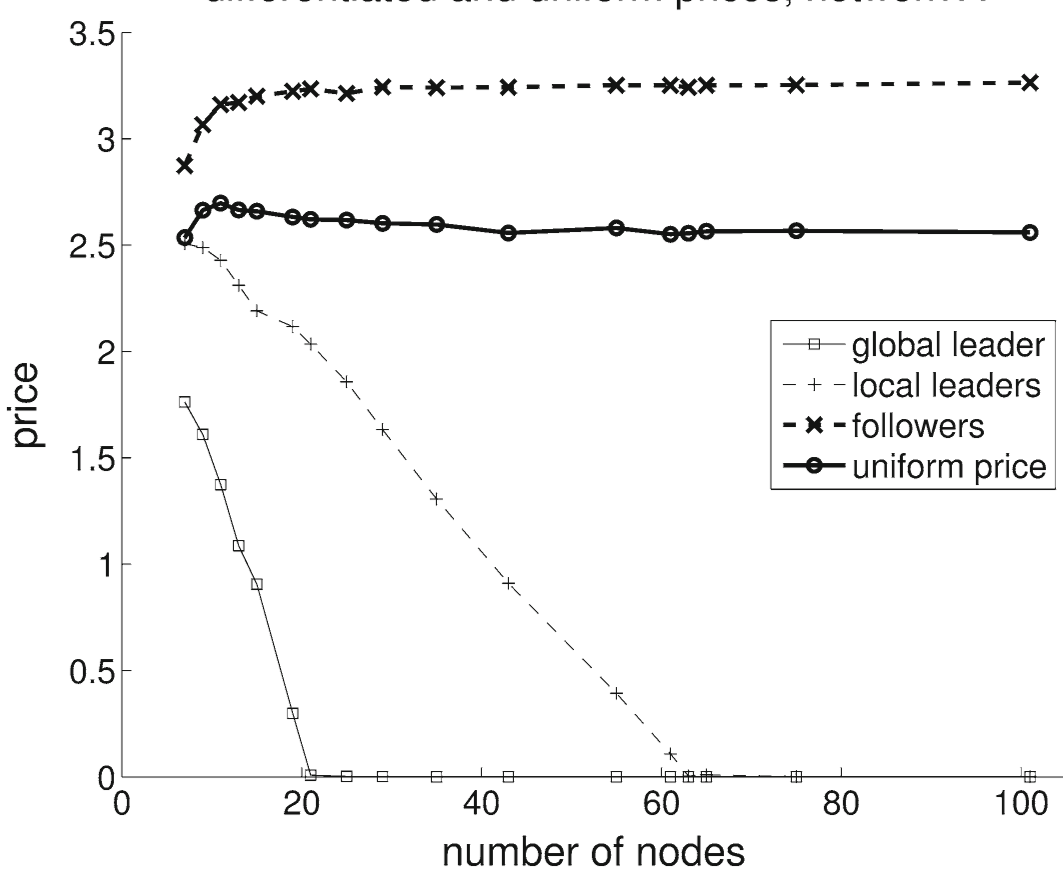 In the chart above, note how the Global Leader's price (x1) hits the zero-bound as the network size (N) increases.
2. Revenue per Customer (ARPU) Paradox
Under uniform pricing, as a network grows, the Average Revenue Per User (ARPU) often sinks. However, with differentiated pricing, the ARPU actually increases by ~12%. By "sacrificing" the leaders, the provider turns the followers into high-value, stable subscribers.
Critical Insight: Monitoring is Non-Negotiable
The authors performed a "Stress Test" on their model by introducing randomness:
- Uncertain Preferences: The model is surprisingly robust. Even if you don't know exactly how much a user likes a service, as long as you get the average right, the pricing holds.
- Changing Connections: This is the "Achilles' heel." If the social graph changes (new friends, lost connections) and the provider doesn't monitor it, the advantage of differentiated pricing vanishes. Once a leader loses their central position, the discount becomes a pure loss.
Conclusion
This work bridges the gap between complex network theory and practical revenue management. It moves the conversation from "How much should I charge?" to "Who am I charging?"
The takeaway for the AI and Tech industry is clear: Network topology is a first-class citizen in optimization. Whether you are pricing a SaaS product or allocating resources in a distributed mesh network, identifying the "hubs" and optimizing for their local influence is the key to global efficiency.