
Stop Anthropomorphizing LLMs: Why "Thinking Traces" are a Dangerous Illusion
Position: Stop Anthropomorphizing Intermediate Tokens as Reasoning/Thinking Traces!
This position paper challenges the prevalent "anthropomorphization" of intermediate token generation (ITG) in Large Reasoning Models (LRMs) like DeepSeek-R1. It argues that these tokens should be viewed as non-semantic "prompt augmentations" or structural scaffolds rather than human-like "thinking traces" or logical derivations.
TL;DR
The AI community has fallen in love with the metaphor of "thinking models," treating the long sequences of tokens generated by models like DeepSeek-R1 as internal reasoning steps. This position paper from Kambhampati et al. issues a sharp correction: those "Chain-of-Thought" (CoT) traces are likely just learned prompt augmentations with no necessary semantic link to the solution. Treating them as human-like reasoning engenders false trust and distracts from the core engineering challenge of verification.
The "Aha!" Moment that Wasn't
When DeepSeek-R1 outputs "Aha! I see it now," we tend to imagine a model having a sudden cognitive realization. But the model has no internal state change other than the addition of a new token to its context window. The authors argue that this anthropomorphization isn't just a harmless metaphor—it is a categorical error that leads to:
- False Confidence: Users trust wrong answers because the "reasoning" looks plausible.
- Resource Waste: Spending massive effort forcing models to produce "interpretable" traces (e.g., DeepSeek-R1's SFT phase to fix Chinese/English mixing) which can actually decrease performance.
- Tenuous Correlations: Measuring "thinking effort" by token length, when long traces often occur even for trivial problems.
Methodology: Probing the Semantics of Noise
The authors support their position through a series of "Intervention Experiments" designed to break the semantic link between the trace and the answer.
1. The Maze Stress Test
By training Transformers on A* search traces for maze-solving, the researchers could formally verify every step.
- The Finding: When tested out-of-distribution, models produce plausible-looking but logically invalid traces that still lead to correct answers.
- The Shock: Models trained on "swapped" traces (where the reasoning for Problem A is paired with the answer for Problem B) often maintained high solution accuracy.
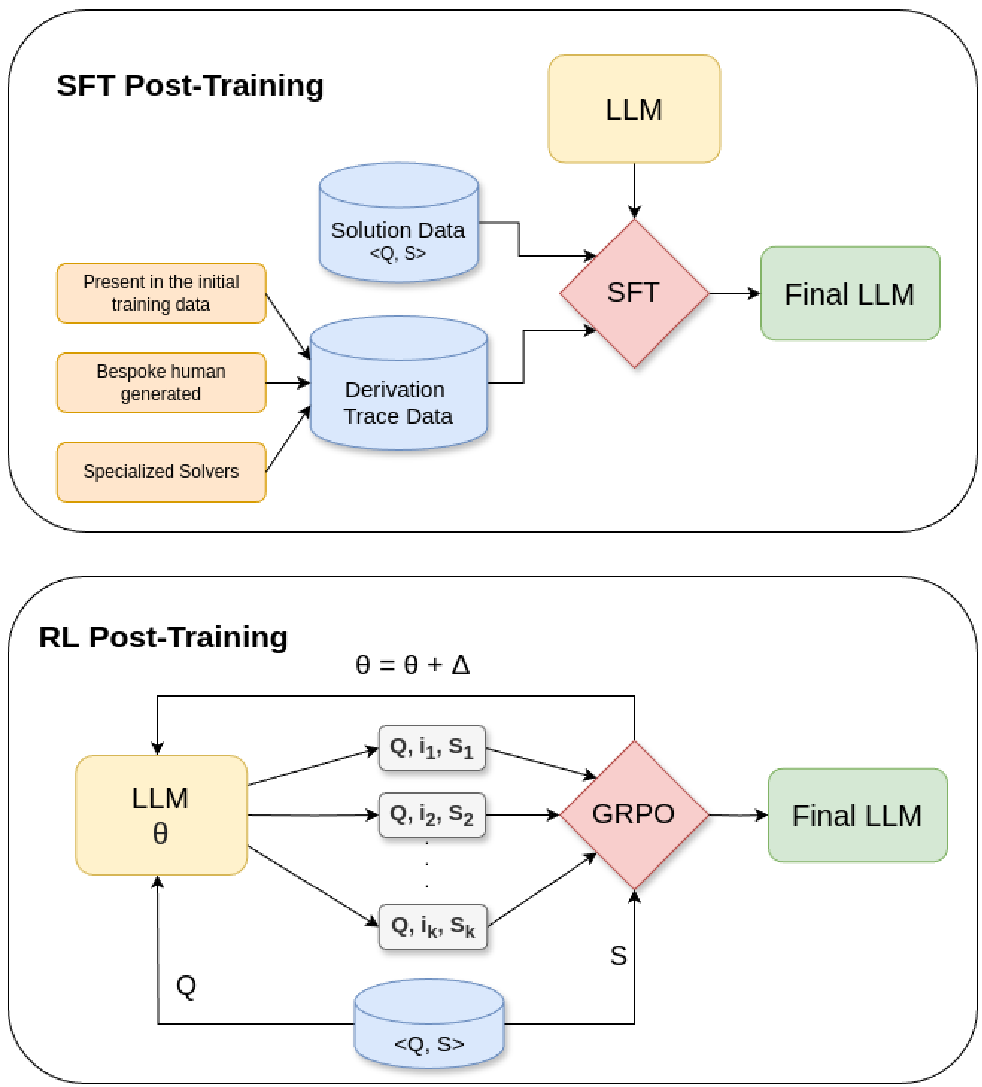 Figure: The standard pipeline for post-training reasoning models focus on verified rewards, often ignoring the trace content itself.
2. The Human Trust Trap
In human subject studies, the researchers found that providing a "reasoning trace"—even a summary of one—increased user trust regardless of whether the final answer was correct. This creates a "honesty" crisis in AI: we are optimizing models to sound convincing rather than to be correct.
Core Insight: "Reasoning" as Prompt Augmentation
If the tokens aren't "logic," what are they? Evaluation suggests we should view them through the lens of Prompt Augmentation.
Mathematically, the intermediate tokens (PA) serve as a function that modifies the task into an augmented prompt . This augmentation shifts the conditional distribution of the next-token prediction toward the correct solution. Since this is essentially a high-dimensional pattern-matching exercise, the "scaffolding" tokens don't need to be English—they could be random characters or even soft vectors in latent space.
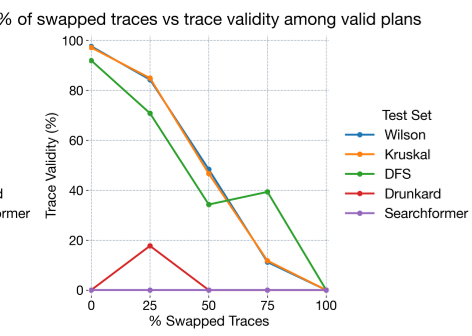 Figure: A typical DeepSeek-R1 trace—lengthy, repetitive, and difficult for humans to verify for absolute logical soundness.
A Call to Action for the AI Community
The paper concludes with three radical recommendations for the future of Large Reasoning Models (LRMs):
- Kill the Narrative: Stop using terms like "thinking" or "reasoning traces." Use neutral terms like "derivational traces" or "intermediate tokens."
- Externalize Verification: Reliability must come from external verifiers (code execution, formal logic checkers, or LLM-Modulo frameworks), not from the perceived "plausibility" of the model's internal monologue.
- Unlock Non-Linguistic Traces: If the tokens are just scaffolds, we should experiment with training models to "think" in non-human-readable embedding spaces, which might be far more efficient than generating thousands of English words.
Conclusion
We are currently in a phase of AI development where we are rewarding models for acting like humans. This paper reminds us that an LLM is a statistical predictor, not a digital soul. By stripping away the anthropomorphic mask, we can stop building "persuasive" machines and start building truly "verifiable" ones.