
Beyond the Single Profile: Reconstructing Life Stories via Social Metadata
Towards Storytelling by Extracting Social Information from OSN Photo's Metadata
The paper introduces a novel social storytelling framework that constructs a user's life narrative by extracting multimedia data and metadata from multiple Online Social Network (OSN) profiles. By utilizing a "Multimedia-based Relationship Strength Model," the system identifies close friends to retrieve co-present photos, events, and locations that are missing from the primary user's own timeline.
TL;DR
Our digital lives are scattered. A photo of your graduation might be on your sister's phone, while the check-in at your favorite restaurant exists only on a friend's timeline. This paper proposes a framework that builds a comprehensive Social Story by identifying your "inner circle" through multimedia metadata and mining their profiles to fill the gaps in your own digital history.
Academic Positioning: This work transitions social media mining from simple link prediction to contextual storytelling, representing an early but pivotal move toward decentralized personal data synthesis.
The "Lazy User" Problem and the Social Solution
Most OSN users are "intermittent contributors." We experience events but don't always document them ourselves. Prior work in digital storytelling (like early photo summarization) failed because it assumed the user's profile was a complete archive.
The authors' core insight is that social circles act as a distributed backup system. If you were at an event, your presence is likely captured in the metadata of a friend's upload. The challenge is identifying which friends among hundreds possess that data without brute-forcing the entire network.
Methodology: The Multimedia Relationship Strength Model
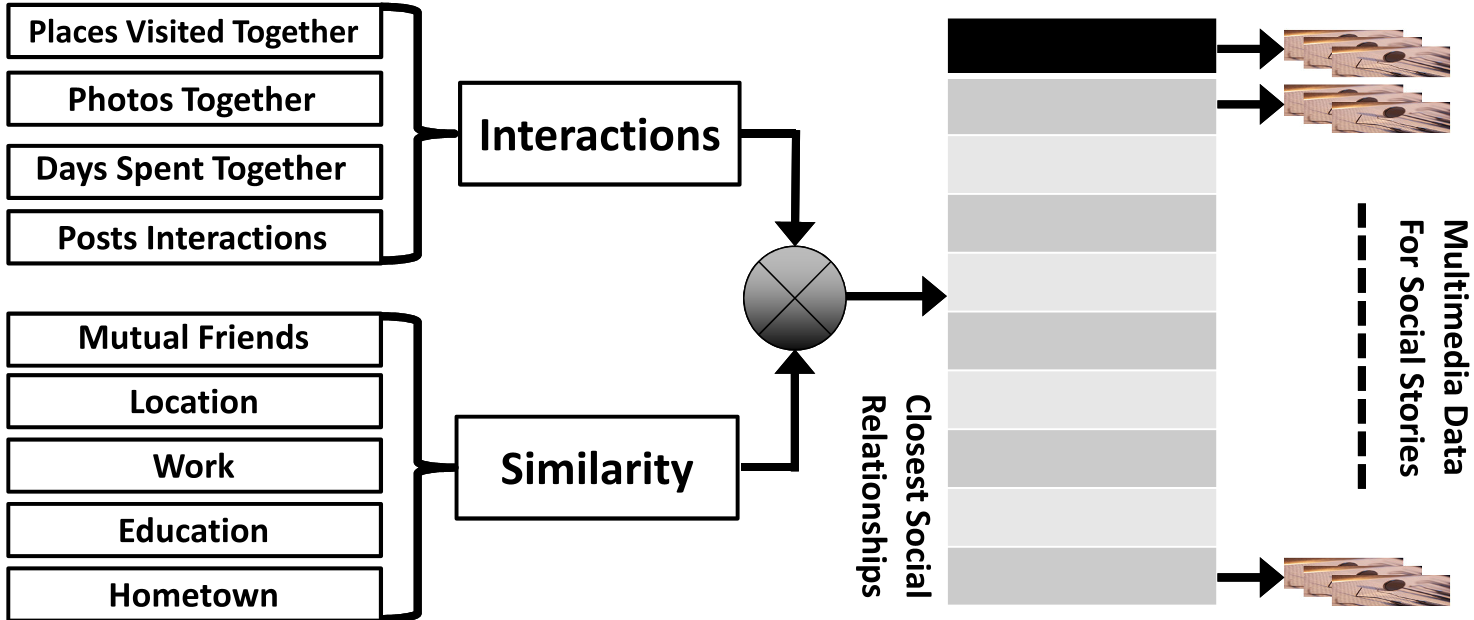
The authors move beyond binary "friend" status by calculating a weighted strength score based on two pillars:
1. Interaction Intensity ()
Instead of just counting "Likes," this model emphasizes physical co-presence derived from photo metadata:
- (Photos Together): Frequency of appearing in the same frame.
- (Days Spent Together): Overlapping timestamps in photo captures.
- (Locations Visited): GPS proximity at the time of capture.
2. Profile Similarity ()
For friends who are less active online but possess a strong offline bond (the "silent best friend" problem), the model uses static features:
- Mutual Friends Clique: The overlap in social clusters ().
- Life Context: Shared hometowns, employers, or schools ().
Experimental Proof: Turning Friends into Data Sources
The study evaluated 1,252 Facebook users. By selecting only the Top 10 ranked friends based on the proposed model, the system was able to reconstruct a significantly more detailed timeline than traditional methods.
Key Performance Metrics:
- Information Volume: On average, the framework retrieved 200% to 300% more photos than were available on the primary user's profile.
- Event Recovery: The number of detectable life events (trips, gatherings) more than doubled for the years 2013 and 2014.
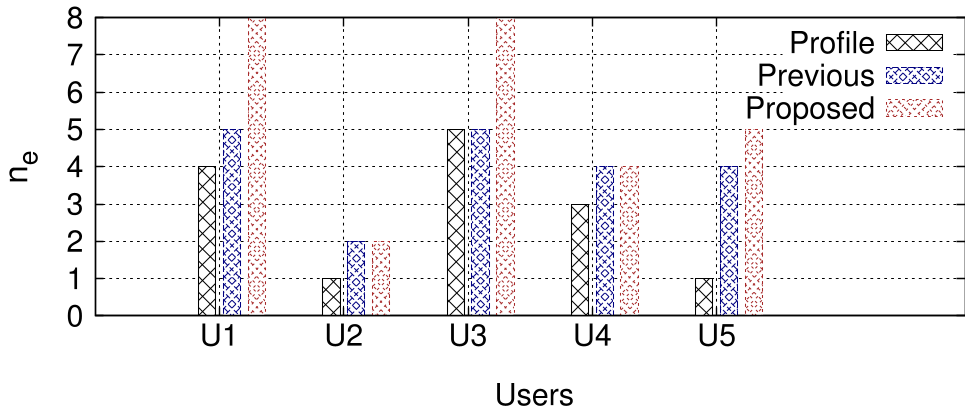 Figure: Comparison of events, locations, and photos retrieved via the Proposed method vs. Profile alone.
Critical Insight & Future Outlook
While the paper demonstrates a clear technical win for data retrieval, it touches on a profound shift in data ownership. If my "story" is built using your "photos," who owns the resulting narrative?
Limitations:
- Privacy Constraints: The 2014-era Facebook API allowed significantly more cross-profile crawling than today's "walled garden" privacy standards (like GDPR).
- Scaling: The study used a small primary user pool (); however, the depth of the friend-network analysis () provides a statistically significant look at local social clusters.
Conclusion
The value of this research lies in its multimodal approach to social ties. It proves that the "metadata trail" left by our social interactions is more descriptive of our actual lives than our self-curated profiles. For future AI-driven journals or "Time Capsules," the social graph isn't just a list of names—it's the primary architecture for memory.