
The Portrait of a Stranger-Seeker: Why Some Users Hunt for New Connections on SNS
Who Are Seeking Friends? The Portrait of Stranger-Seeker in Social Network Sites
This study investigates the psychological profile of "stranger-seekers" on Social Network Sites (SNSs) through two comprehensive surveys. It identifies that frequent stranger-seeking behavior is driven by a combination of high Extraversion, Narcissism, and poor family relationship quality, using instruments like the Big Five Inventory and Narcissism Personality Inventory.
TL;DR
Who are the people constantly hitting "add friend" on strangers in social networks? This research reveals that stranger-seekers are typically extroverted, narcissistic individuals struggling with poor family relationships. Interestingly, despite their efforts, they don't actually end up with more friends, pointing toward a significant gap in their social effectiveness.
Background: Beyond the Inner Circle
Social Network Sites (SNSs) like Facebook, WeChat, or Renren were traditionally built to maintain existing relationships. However, a specific subset of users utilizes these platforms primarily to find strangers. This study moves beyond general SNS usage to create a "psychological portrait" of the stranger-seeker, identifying the personal and interpersonal drivers behind this behavior.
The "Why": Motivation and Pain Points
The researchers hypothesized that online behavior serves as a compensation for reality. The study identifies two primary motivations:
- Personal Traits: Do certain personalities naturally crave more "new" connections?
- Interpersonal Deficit: Does a lack of intimacy at home (low family relationship quality) drive people to seek emotional support from the digital unknown?
Methodology: Mapping the Mind of the Seeker
The research utilized two surveys targeting users of major SNS platforms. They employed standardized psychological metrics:
- Big Five Personality Inventory: To measure traits like Extraversion and Neuroticism.
- NPI-16: A short-form Narcissism scale to see how self-view affects social seeking.
- Relationship Quality Scale: Focused on family dynamics and attachment.
The Statistical Portrait
The analysis revealed clear correlations between seeking behavior and psychological states.
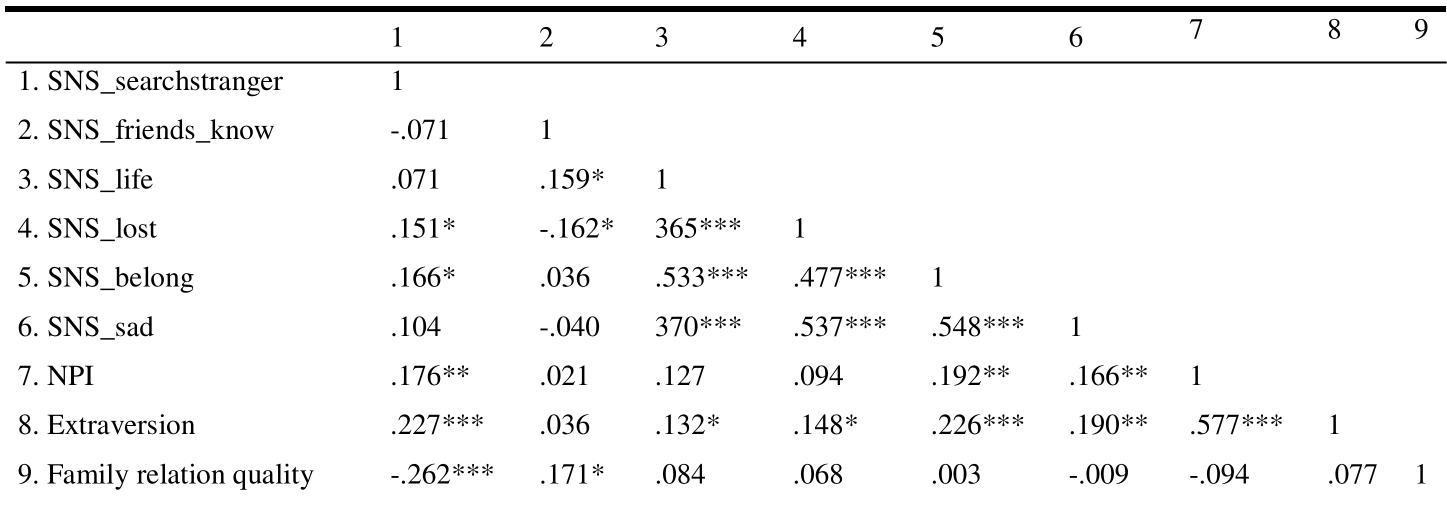 Figure 1: Correlation matrix showing the relationship between stranger-seeking (SNS_searchstranger), NPI, Extraversion, and Family Relation Quality.
Key Insights: The Stranger-Seeker Profile
1. The Extroverted Narcissist
Data showed that Extraversion (r = 0.227) and Narcissism (r = 0.176) are significant predictors. While extroverts use SNS for its communicative functions, narcissistic individuals use it to validate their high self-evaluation through the attention of new "audiences." Contrary to the popular belief that narcissists are self-centered and isolated, they show a high interest in others—likely as targets for their self-display.
2. Seeking as an Emotional Escape
One of the most profound findings was the negative correlation with family relationship quality (r = -0.262). When family interactions fail to meet the need for intimacy and dependence, individuals turn to the internet. Stranger-seekers reported a higher "identification" with the SNS and a genuine fear of losing their online connections.
3. The Paradox of the "Empty Basket"
Perhaps the most striking result is that stranger-seekers do not have a larger proportion of stranger-friends. Despite the constant searching, the actual conversion to a "friend" is low.
- The Attraction Gap: Users from dysfunctional families often struggle with social skills, making them less "attractive" or prone to rejection in the digital space.
- Passive Interaction: Many may be "scanning" or "lurking" on stranger profiles without ever hitting the "Add" button, driven by a need for belongingness that they are too socially anxious to fulfill.
Conclusion and Product Implications
The "Stranger-Seeker" is an extroverted individual looking for the belongingness they lack at home, yet they are trapped by their own social ineffectiveness.
Takeaway for Designers: For SNS developers, this research suggests that simply providing a "Search Nearby" or "Add Stranger" button isn't enough. To truly serve this user base, platforms should:
- Incentivize social attractiveness: Helping users present their best selves.
- Reduce interaction friction: Creating "ice-breaking" tools for those with low social self-esteem.
- Focus on quality over quantity: Transitioning "seekers" into "sharers" to build meaningful long-term connections.
Limitations
The study relies on self-reported data and focuses primarily on Chinese SNS platforms (Renren, QQzone). Future work could explore how these dynamics shift in the era of short-video social media (TikTok) where the "stranger" is the default interaction partner.