
Digital Identity Under Siege: The Tug-of-War Between Self and Audience in Social Networks
Strategic self-presentation online: A cross-cultural study
This cross-cultural study explores how social networking site (SNS) users manage their digital identity amidst diverse audiences and "Other-Provided Information" (OPI). Comparing Singaporean and American samples (N=411), it identifies significant cultural and gendered variations in both acquisitive (sharing content) and protective (managing unwanted tags/posts) self-presentation strategies.
TL;DR
In the digital age, your online identity isn't just what you post—it’s what others post about you. This study reveals that as our online audiences grow more diverse, we shift from "acquisitive" self-presentation (showing off) to "protective" maneuvers (damage control). Cultural identity plays a massive role: Americans prioritize text-based updates and individual image control, while Singaporeans rely more on visual sharing and localized relationship maintenance.
Context Collapse and the "Other-Provided Information" (OPI) Problem
In a face-to-face setting, you can act differently with your boss than you do with your college friends. On Social Networking Sites (SNS), these boundaries vanish—a phenomenon known as Context Collapse.
The authors argue that two major threats undermine your "idealized" digital self:
- Multiple Audience Problem: Different groups (family, employers, friends) have conflicting expectations of you.
- OPI (Other-Provided Information): Friends can tag you in unflattering photos or post comments on your wall. Because this information is "third-party," it has higher warranting value (credibility) than what you say about yourself.
Methodology: Mapping the Digital Self
The researchers surveyed 411 students from Singapore (Collectivistic) and the U.S. (Individualistic). They focused on two dimensions of behavior:
- Acquisitive Self-Presentation: Boosting one's image through Self-Provided Information (SPI) like status updates and photo uploads.
- Protective Self-Presentation: Reactive behaviors like untagging photos or deleting wall posts to avoid disapproval.

Key Insights: Culture, Gender, and the "Promiscuous Friend"
1. The Photo vs. Text Divide
The study found a fascinating cultural split. Americans update their "walls" (text statuses) more frequently, matching the individualistic drive to express personal thoughts. Conversely, Singaporeans share more photos. This suggests that in collectivistic cultures, visual storytelling may serve as a more "benign" tool for relationship maintenance without triggering the risks of controversial text-based opinions.
2. The Defensive Female Persona
The data showed that females are significantly more likely to share photos and more likely to engage in "protective" behaviors like untagging. The authors suggest this is due to heightened vulnerability to social criticism and physical appearance norms:
"Females are more vulnerable to criticism... they are more concerned about violations of privacy online and use more strategies to manage their self-disclosure."
3. Management of the "Unwanted"
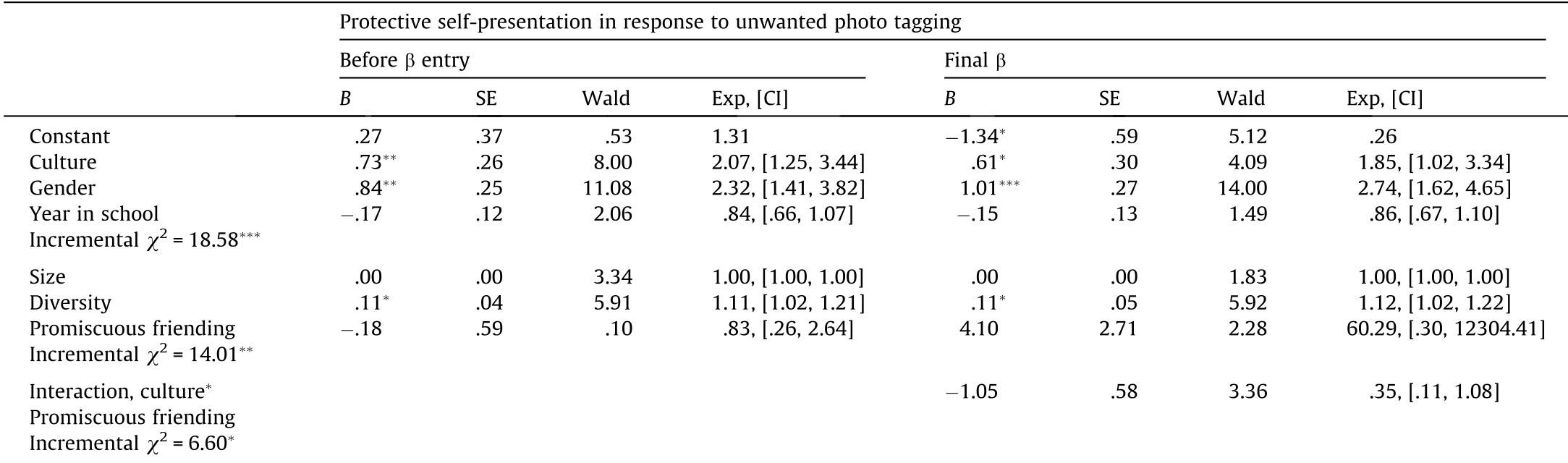
Audience diversity was the strongest predictor of whether someone would untag a photo or delete a post. When your network includes both your grandmother and your "party friends," the "Lowest Common Denominator" rule applies: you must prune your profile to keep it safe for the most conservative segment of your audience.
The "Promiscuous Friending" Interaction
One of the most nuanced findings involves "Promiscuous Friending"—adding strangers to inflate audience size.
- For Americans, those who add many strangers (attention-seekers) actually care less about wall-post management. They trade an idealized image for maximum exposure.
- For Singaporeans, even those seeking attention (via promiscuous friending) remain cautious, managing their images more strictly to avoid social disharmony.
Critical Analysis & Conclusion
Takeaway
Self-presentation online is no longer a solo performance; it is a collaborative (and sometimes combative) negotiation. If you have a diverse network, you spend less time "creating" and more time "curating" or "cleaning."
Limitations
The study was conducted in 2012. In the decade since, features like "Stories" (ephemeral content) and "Close Friends" lists have emerged specifically to solve the "Multiple Audience Problem." Furthermore, the use of nationality as a proxy for culture is a coarse measurement that might miss sub-cultural nuances.
Future Outlook
As algorithms increasingly push our content to "strangers" (the TikTok model), the "Promiscuous Friending" logic may become the default. We are moving toward a world where attention is the primary currency, potentially at the expense of the carefully curated "ideal self" of the early Facebook era.