
Strategic Social Team Crowdsourcing: Solving the Honesty Gap in Collaborative Networks
Strategic Social Team Crowdsourcing: Forming a Team of Truthful Workers for Crowdsourcing in Social Networks
This paper introduces a strategic framework for social team crowdsourcing, proposing two truthful mechanisms (OPT-Tree and Greedy) to form professional, socially connected teams. It successfully optimizes social welfare while ensuring workers report their true costs and skills, significantly outperforming traditional heuristics in both efficiency and welfare.
TL;DR
In modern crowdsourcing, tasks are no longer just about labeling images; they require professional teams with diverse skills who can collaborate effectively. This paper introduces a Strategic Social Team Crowdsourcing framework that ensures workers stay honest about their costs and skills while the system forms optimal, socially connected teams. By leveraging Dynamic Programming on tree structures and greedy heuristics for large networks, the authors provide a roadmap for building trustworthy and efficient labor markets.
The Problem: The High Cost of Selfishness
Most existing "team formation" algorithms assume workers are selfless agents who report their true capabilities and costs. In reality, workers are strategic: they may overstate their costs to get a higher payout or lie about their skills to squeeze into a team.
The challenge is twofold:
- Social Connectivity: A team isn't just a list of people; they must be connected in a Social Network (SN) to communicate.
- Truthfulness: We need a mechanism where the best strategy for a worker is to be honest (Dominant Strategy Incentive Compatibility).
Standard solutions like the VCG mechanism are NP-hard in this context, requiring exponential time that effectively breaks as the number of skills grows.
Methodology: A Two-Pronged Attack
The authors recognize that "one size doesn't fit all." They split the problem based on the scale of the task's skill requirements.
1. Small Scale: OPT-Tree Mechanism
For tasks requiring fewer skills (k ≤ 12), the authors use a clever approximation:
- Tree Extraction: They convert the complex social network into a tree that preserves maximum "closeness."
- Binary Transformation: This tree is further simplified into a binary tree to keep the search space manageable.
- Dynamic Programming: An optimal DP algorithm finds the best connected sub-team within the tree.

2. Large Scale: Greedy Social Mechanism
When skill requirements are high, DP is too slow. The authors introduce a Greedy Monotone Algorithm:
- Marginal Contribution-per-Cost: Workers are selected based on how many new skills they bring to the team relative to their cost.
- Connectivity Constraint: A worker can only join if they are neighbors with an existing team member, ensuring the final team is always a connected component.
Experimental Proof: Honesty is the Best Policy
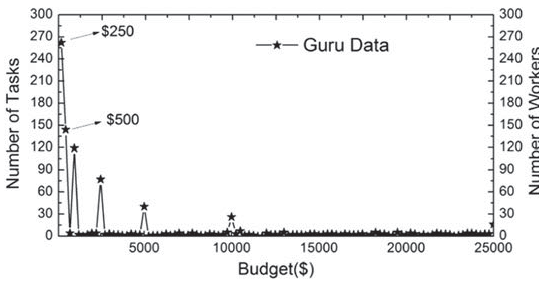
The authors validated their models using real-world data from Guru, a professional crowdsourcing platform.
Key Findings:
- Efficiency vs. Welfare: The OPT-Tree mechanism produced social welfare results nearly identical to the "perfect" (but slow) VCG mechanism but at a fraction of the time.
- Greedy Superiority: In large-scale tests, the Greedy mechanism outperformed existing Steiner-tree-based methods.
- Incentive Alignment: As seen in Fig. 7, workers who lied (untruthful) consistently ended up with lower utility compared to those who were honest, due to the "Threshold Payment" rules that penalize over-reporting.
Critical Insight: Why This Matters
The brilliance of this work lies in how it handles the "social" aspect. By treating the social connection as a prerequisite for selection, the algorithm naturally prunes the search space.
Limitations: The current model assumes costs are fixed regardless of which skills are used. Future iterations would need to handle "cost-skill interdependence," where a worker might charge differently for a coding task versus a testing task.
Conclusion
This paper bridges the gap between Algorithmic Game Theory and Social Network Analysis. It proves that we can build platforms where collaboration is encouraged, and honesty is mathematically enforced, even when the underlying problem is computationally daunting.
Referenced Paper: Wanyuan Wang et al., "Strategic Social Team Crowdsourcing: Forming a Team of Truthful Workers for Crowdsourcing in Social Networks", IEEE Transactions on Mobile Computing (2018).