
Designing for Trust: Why Users Misunderstand Reputation in Crowdsourcing Apps
Strategies for Communicating Reputation Mechanisms in Crowdsourcing-Based Applications
This paper investigates the communicative strategies of reputation mechanisms in crowdsourcing applications (e.g., Waze, TripAdvisor). Using Semiotic Engineering and the Semiotic Inspection Method (SIM), it identifies how designers communicate reliability and how users often misinterpret these signals, leading to communication breakdowns.
TL;DR
In the world of crowdsourcing, reputation is the currency of reliability. However, this paper reveals a startling "communication gap": while designers use complex systems of badges, scores, and avatars to signal digital producer quality, end-users often treat these as mere decoration or assume the app itself is verifying the data. By applying Semiotic Engineering, the authors expose why your UI might be lying to your users—and how to fix it.
The "Invisible Designer" Problem
The core motivation behind this research stems from a fundamental challenge in Human-Computer Interaction (HCI): Communicability. In crowdsourcing apps like Waze or TripAdvisor, the designer isn't there to explain why a specific piece of traffic data or a hotel review is trustworthy. The interface must act as the "designer's deputy."
The authors argue that reputation isn't just a back-end calculation; it is a semiotic sign that must be correctly interpreted. If a user sees a "Seal" on a profile but doesn't know it signifies 500+ verified reviews, the reputation mechanism has failed its primary purpose.
Methodology: The Semiotic Lens
The study utilizes the Semiotic Inspection Method (SIM), which categorizes interface elements into three types of signs:
- Metalinguistic: Tutorials, help systems, and explicit rules.
- Static: Icons, labels, and layout (the "snapshot" of the UI).
- Dynamic: How the system responds to user actions (e.g., a "thanks" extending the life of a report).
The Research Workflow
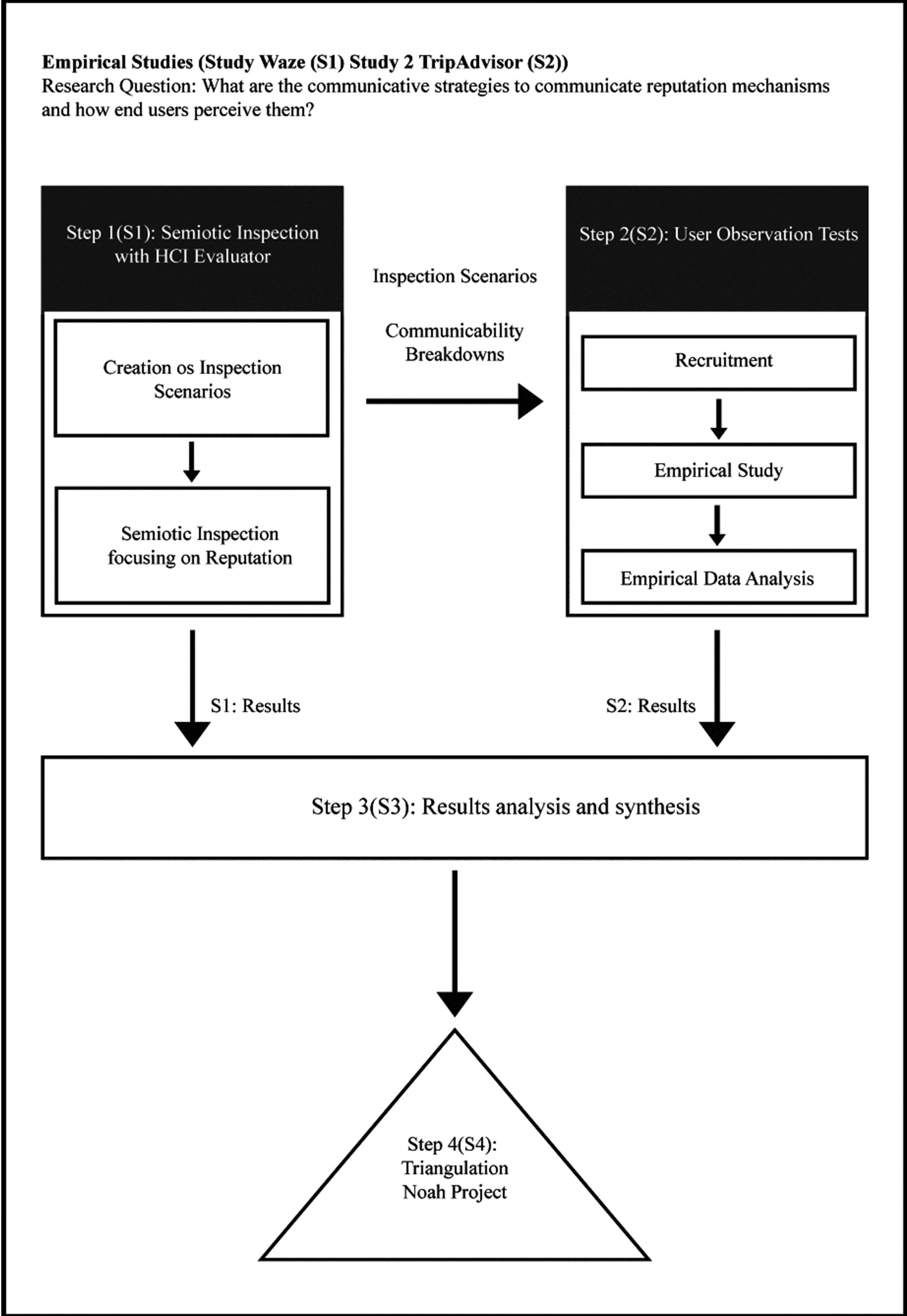
The researchers compared Waze (fast-paced, high-stakes traffic data) with TripAdvisor (long-term, review-based planning) and eventually Project Noah (scientific biodiversity data) to find universal patterns in trust communication.
5 Core Strategies for Communicating Reputation
The authors distilled five dominant strategies used by designers to establish trust:
- Social Connectivity: Linking to Facebook/Contacts to leverage "offline" reputation.
- Contribution Visualization: Showing avatars, levels, and engagement history.
- User Categorization: Using "expert" tags or specialized seals.
- Fraud Prevention: Implementing "No Exists" buttons and blocking malicious accounts.
- Community Confirmation: "Thanks" or "Helpful" buttons that act as peer-review.
Critical Insight: The "Like" Trap
One of the most profound findings is the Semantical Confusion caused by common icons.
- The Problem: Waze uses a "heart/thanks" icon; TripAdvisor uses a "thumbs-up."
- The Breakdown: Users often click these because they liked the comment or felt polite, not because they verified the information.
- The Consequence: In Waze, "liking" a fake traffic alert (because it was funny or well-written) keeps that false alert on the map longer, potentially misdirecting thousands of drivers.
Experimental Results & User Perception
The user observation phase highlighted a "Naive Trust" in the system:
- The System as Authority: Many users in the Waze study believed that all alerts were provided/verified by "the system" (Waze itself) rather than other fallible human beings.
- Avatar Ambiguity: In Waze, beginners saw changing avatars (from "Baby Wazer" onwards) as simple customization rather than a "level-up" system indicating the reliability of the producer.
- The Minimum Threshold: On TripAdvisor, users have a subjective "reliability floor"—rejecting any place with fewer than a certain (undefined) number of reviews.
Conclusion: Rethinking Crowdsourcing Design
The research concludes that reputation is domain-dependent. In traffic apps, reputation must be communicated instantly and subconsciously. In travel apps, it can be more granular and explicit.
Future Outlook: For researchers and developers, the takeaway is clear: stop assuming users understand your badges. If a reputation mechanism is critical for safety or decision-making, it needs to be supported by dynamic metalinguistic signs—the interface should actively explain why a piece of information is being shown and how the sender earned their trust.
Final Takeaway
The success of a crowdsourcing app depends less on the accuracy of its reputation algorithm and more on the communicability of that algorithm to the end-user.