
Triad.Net: Bridging Static Analysis and Dynamic Simulation for Real-World Social Networks
Study of Strategies for Disseminating Information in Social Networks Using Simulation Tools
The paper introduces Triad.Net, a simulation framework designed to analyze information dissemination in social networks by integrating both static structural metrics and dynamic simulation-driven behavior. It features a specialized software agent and an ontological approach to bridge the gap between virtual random graphs and real-world network data (e.g., VKontakte).
TL;DR
Understanding how fake news or marketing campaigns spread requires more than just a snapshot of a network; it requires a living laboratory. This paper presents Triad.Net, a tool that extracts real data from social networks like VKontakte using intelligent agents, stores it in ontologies, and runs dynamic simulations to test strategies for information promotion or blocking.
Context & Motivation: Why Static Metrics Aren't Enough
In the realm of Social Network Analysis (SNA), we often focus on "Static modeling"—calculating centrality, transitivity, and degree. While these metrics tell us who is important, they don't explain the process of influence.
The authors argue that social networks are inherently dynamic. To truly understand information dissemination, we need to observe behavioral changes over time. The challenge is the data gap: how do we transition from a real-world API (like VK or Facebook) to a structured simulation where we can "kill" a node or "change" a user's behavior to see what happens?
Methodology: The Three-Layer Architecture
Triad.Net utilizes a sophisticated hierarchical model to define simulations:
- STR (Structure Layer): Represents users and communities as nodes in a graph.
- ROUT (Routine Layer): The "brain" of the agent. It defines the sequence of events (e.g., logging in, liking a post, sharing).
- MES (Message Layer): Handles the complex data structures passed between agents.
Data Collection Agent
To populate these layers with real data, the authors developed a Python-based agent. This agent builds an OWL (Web Ontology Language) structure that categorizes users (Person), their interests (Activity), and their groups (Community).
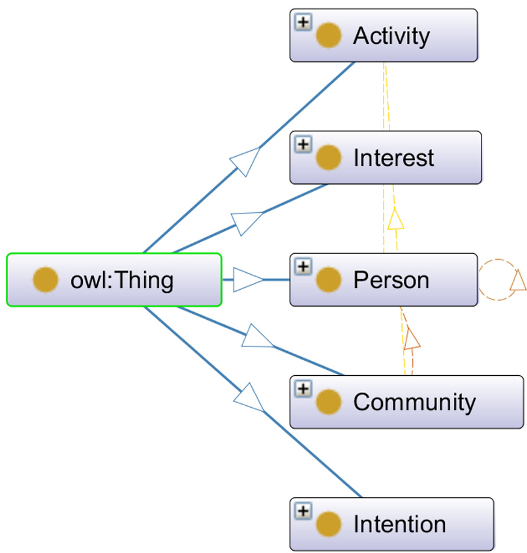 Figure 1: The ontological schema used to map real-world relationships into the simulator.
Experiments: Testing Information Blocking
The researchers tested their framework on a real dataset of students and community groups. They focused on the Independent Cascade (IC) model to simulate how a single post spreads.
Key Experiment: Node Exclusion
A critical test involved identifying the "most influential" user (highest centrality) and removing them from the network.
- Baseline: With the influential user, a post reached most nodes in 1-5 steps.
- Intervention: Removing the central user caused a "dissemination collapse." For many users, the time to receive the information became infinite (it never reached them).
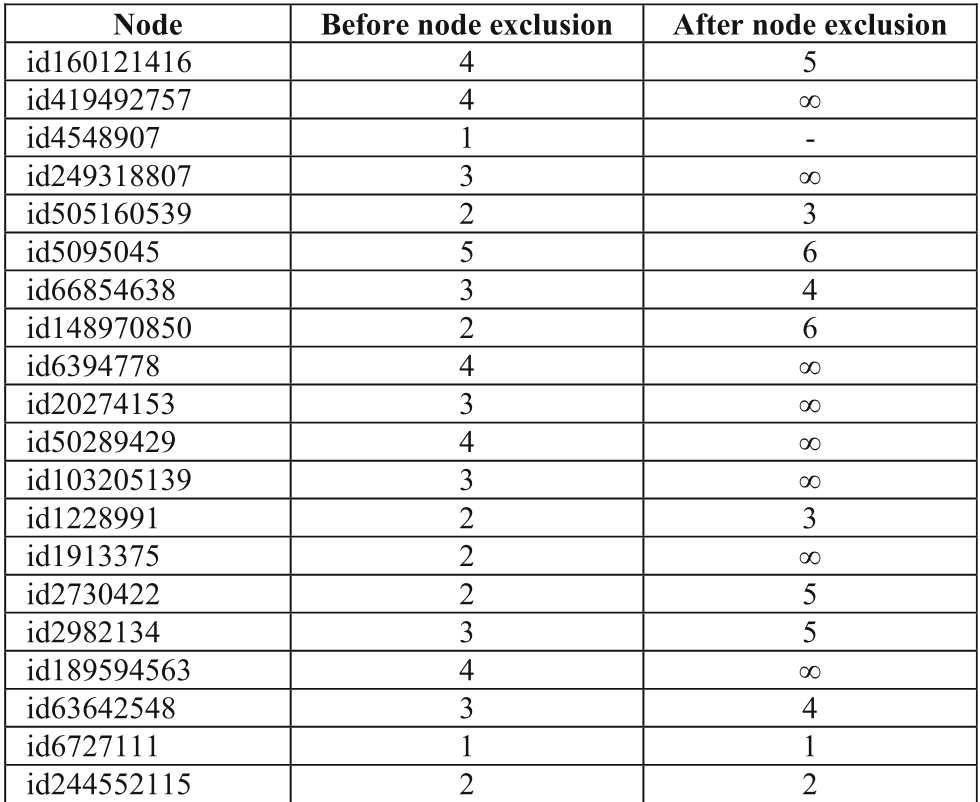 Figure 2: Comparative analysis showing dissemination steps before and after node exclusion.
Deep Insight & Conclusion
The true value of this work lies in its hybridity. By using Process Mining (via ProM) to generate event logs, the simulation isn't just a mathematical abstraction; it's grounded in the actual temporal habits of real users.
Limitations & Future Work
While powerful, the current simulation speed (3,431 seconds for 8,434 events) suggests that scaling to millions of nodes will require more optimized distributed computing. The authors envision a "multi-model" approach in the future, likely blending different dissemination theories (like SIR or NSRL) within the same environment.
Triad.Net provides a vital toolkit for those fighting "malicious information" (fake news/scams) by allowing them to test "immunization strategies" in a risk-free, virtualized version of the real web.