
Strategy Evolution in Generalized Networks: How Time-Varying Interests Shape Global Information Flow
Strategy evolution of information diffusion under time-varying user behavior in generalized networks
This paper proposes a graphical evolutionary game theory (EGT) framework to model information diffusion strategies in multi-layer generalized networks (GNs). It introduces time-varying fitness values to reflect fluctuating user interests and identifies Evolutionary Stable States (ESS) across both physical and social network layers.
TL;DR
Information doesn't just spread; it evolves through a series of strategic choices made by users. This paper redefines information diffusion as a Graphical Evolutionary Game played across multi-layer "Generalized Networks" (GN). By introducing time-varying payoffs, the authors show how shifting user interests create a dynamic "ESS curve" that predicts whether a message will go viral or vanish.
Problem & Motivation: Beyond Static Epidemics
Classic models treat information like a biological virus—once you "catch" it, you're infected. However, human information sharing is deliberate. You might share a vacation ad in June but ignore it in December.
The authors identify two fatal flaws in existing literature:
- Static Fitness: Most models assume the "utility" of sharing information is constant.
- Single-Layer Bias: They ignore the fact that we exist in a "Generalized Network," where our social ties (Social Layer) are constrained by our physical connectivity (Physical Layer, e.g., Device-to-Device or WiFi).
Methodology: The Graphical EGT Framework
The core innovation lies in applying Graphical Evolutionary Game Theory (EGT) to a two-layer structure.
1. The Strategy Space
Users choose between two strategies:
- (Forward): Share the message.
- (No-Forward): Ignore the message.
2. Time-Varying Payoff Matrix
The payoff matrix is not a fixed table but a dynamic function: This allows the model to simulate periodic trends (like seasonal marketing) or decaying interest (the tail-end of a news cycle).
3. The Modified Birth-Death Rule
The authors adapt the Birth-Death (BD) update rule. In this GN context, a node is chosen to "reproduce" its strategy based on its fitness, and a neighbor in either the social or physical layer is chosen to adopt that strategy.
 Figure 1: Illustration of a two-layer Generalized Network where social interactions sit atop a physical substrate.
Experiments & Results: Navigating the ESS Loci
The research translates these dynamics into ESS Curves—the set of stable points over a timeline.
Key Finding 1: The Impact of Periodicity
When user interest is sinusoidal, the percentage of "Forwarders" () follows a similar but shifted oscillatory path. Interestingly, the "Social Layer" acts as an amplifier. If the social degree distribution is scale-free (like most real networks), the system reaches the forwarding tipping point much faster.
Key Finding 2: Simulation vs. Theory
The authors validated their mean-field differential equations against randomized agent-based simulations. The high degree of overlap confirms that the mathematical model accurately predicts cumulative network behavior without needing to simulate every individual packet.
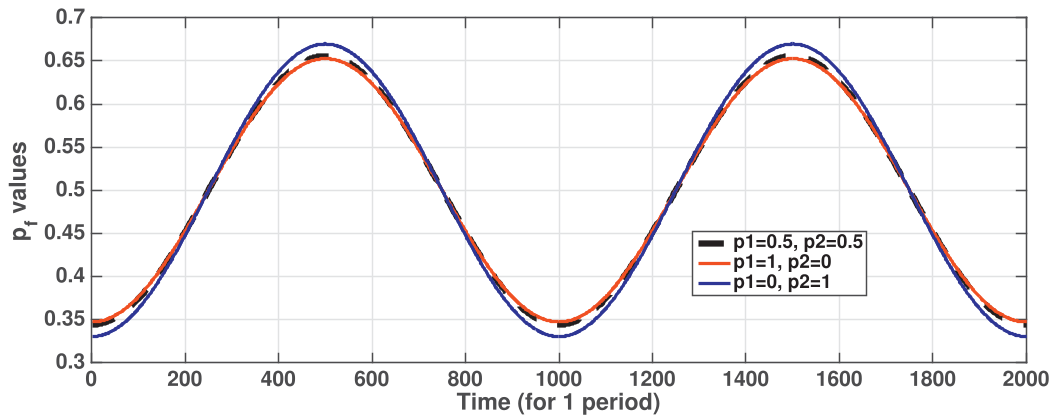 Figure 2: Theoretical ESS curves vs. Simulation results for logarithmic/exponential fitness forms.
Critical Analysis & Conclusion
The "Sequential" Insight
One of the most profound insights in the paper is the link between EGT and Epidemic Modeling. The authors argue that EGT determines the rate of infection (), which can then be fed into traditional SIS/SIR models. This "sequential" view bridges the gap between individual psychology (Game Theory) and population-level statistics (Epidemiology).
Limitations
While the model is robust, it assumes that users are "behaviorally indistinguishable" except for their strategy. In reality, "influencers" have different baseline fitnesses than "lurkers." Future work would need to incorporate heterogeneous baseline fitness to truly capture the nuances of platforms like X (Twitter) or LinkedIn.
Final Takeaway
This work moves us from "guessing" virality to "engineering" it. By monitoring the ESS of a network, campaign managers can identify the exact windows of time where the network is most "fertile" for information propagation.