
Beyond the Average Student: What Stratification Reveals About AI Skill Assessment
What different kinds of stratification can reveal about the generalizability of data-mined skill assessment models
2013-04-08
Summary
Problem
Method
Results
Takeaways
Abstract
This study evaluates the generalizability of data-mined assessment models for scientific inquiry skills across different topics and student cohorts. Using J48 decision trees, the authors tested if models trained on "Phase Change" data could accurately predict skill demonstration in a "Free Fall" simulation.
## TL;DR
Researchers tested whether AI models trained to assess science skills in one topic could "transfer" to another. While standard tests suggested high success, a more granular "run-level" check revealed that some models only worked well when students performed a specific number of experiments, highlighting a hidden fragility in automated educational assessment.
## The Problem: The Generalizability Illusion
In Educational Data Mining (EDM), we often build "detectors"—models that can tell if a student is actually learning or just "gaming the system." The standard way to prove these models work is **Student-level Cross-Validation**: train on one group of kids, test on another.
However, this paper argues that student-level testing is a "blunt instrument." It masks the fact that a model might be over-reliant on certain patterns—like how many times a student clicks "Run" on a simulation—rather than the actual scientific logic the student is using. If a new science topic naturally encourages more or fewer trials, a model that seemed "SOTA" might suddenly collapse.
## Methodology: Stress-Testing the Detectors
The authors took two models previously trained on a **Phase Change** (physics) simulation and applied them to a **Free Fall** simulation with 292 new students.
They used two distinct lenses to view the results:
1. **Student-Stratified:** Each student is represented once. This is the industry standard.
2. **Run-Stratified:** Ensures the test set has an equal number of clips where students ran 2, 3, 4, or 5+ trials.
### The "Inq-ITS" Environment
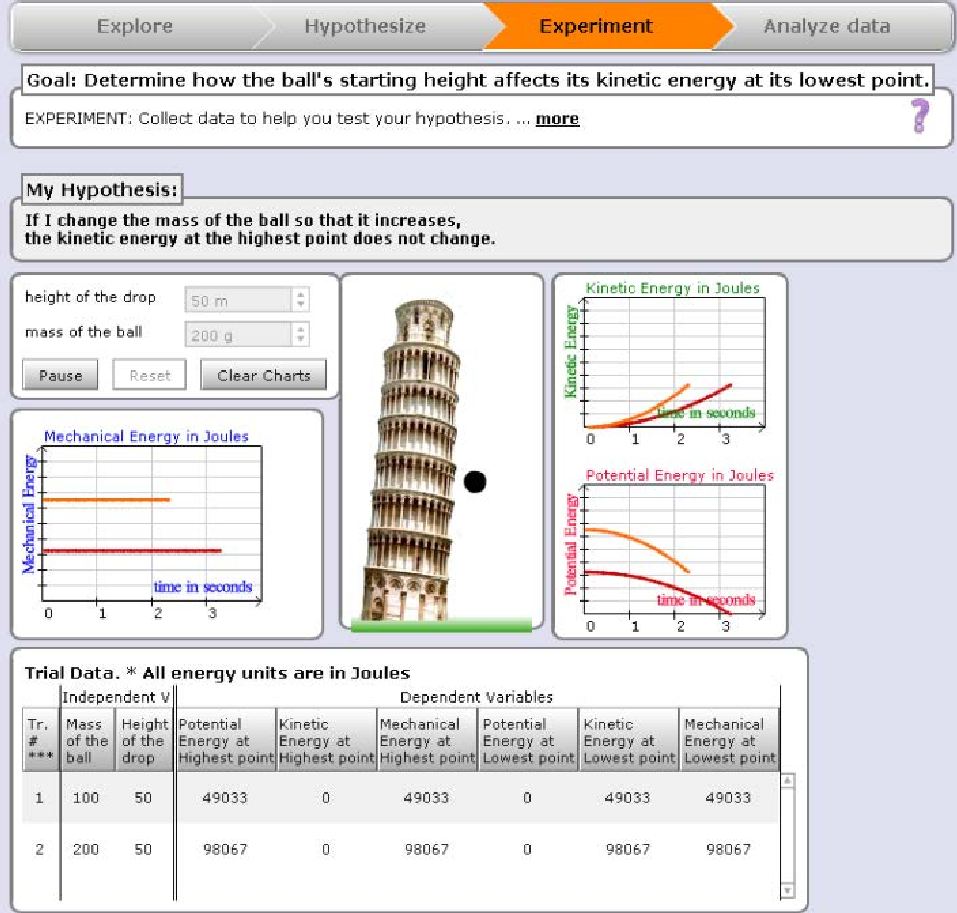
The data came from the Inq-ITS (Inquiry Intelligent Tutoring System), where students manipulate variables in microworlds. The AI must judge two specific skills:
* **Designing Controlled Experiments:** Can the student vary one factor while keeping others constant?
* **Testing Hypotheses:** Does the data they collect actually address the hypothesis they stated?
## Results: The Hidden Performance Drop
The results were a wake-up call for educational practitioners.
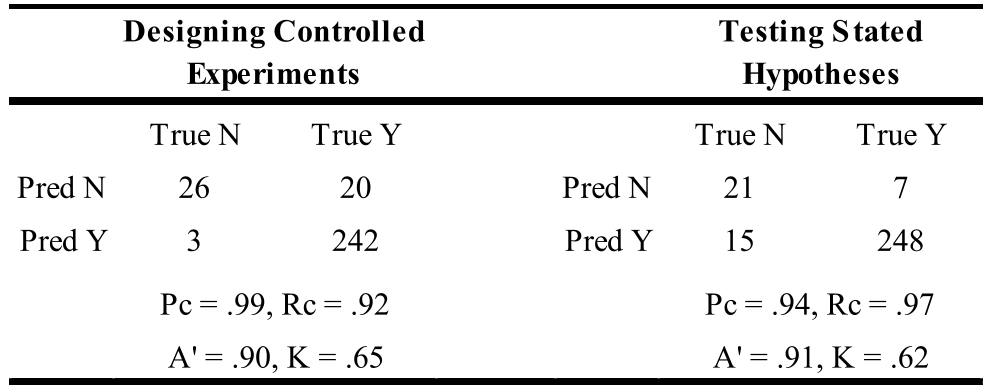
When looking at the **Student-Stratified** data, everything looked great:
* Designing Experiments: A' = .90, Kappa = .65
* Testing Hypotheses: A' = .91, Kappa = .62
But when they switched to **Run-Stratified** data, the "Designing Experiments" model's Kappa plummeted to **.26**.
**Why did this happen?**
The "Designing Experiments" model was accidentally optimized for the "most common" behavior (exactly 3 simulation runs). When students ran 2 or 5 trials, the model's ability to agree with human experts (Kappa) stayed near zero. It was "topic-transferable" only if the students' behavior didn't change too much.
## Critical Insight: Raw Counts vs. Ratios
The authors identified a key technical flaw: the models used **raw count features** (e.g., "number of simulation pauses"). In a more complex domain where more pauses are natural, these features lead the AI astray.
**The Solution?** Moving forward, models should prioritize **ratio-based features** (e.g., "percentage of controlled trials over total trials") to ensure the math holds up even when the simulation complexity changes.
## Conclusion
This paper serves as a vital reminder that **validity is not a single number.** For AI to be truly useful in the classroom—triggering real-time help for students—it must be robust across the wide variety of ways students actually use software. If our validation only looks at "new students" and ignores "new behaviors," we are only seeing half the picture.