
Stream-CQSA: Breaking the Billion-Token Barrier on a Single GPU
Stream-CQSA: Avoiding Out-of-Memory in Attention Computation via Flexible Workload Scheduling
Stream-CQSA is a memory-adaptive scheduling framework for exact self-attention that prevents Out-of-Memory (OOM) failures by decomposing attention into independent subsequence tasks. Utilizing "CQS Divide," an operation based on Cyclic Quorum Sets (CQS) theory, it enables exact attention scaling to 1-billion-token sequences on a single GPU through workload streaming and recursive partitioning.
TL;DR
Stream-CQSA is a paradigm shift in long-context processing. By mathematically decomposing the "monolithic" attention operation into independent, schedulable tasks using Cyclic Quorum Sets (CQS), it allows for exact attention computation on sequences as long as 1 billion tokens on a single 80GB GPU. It essentially exchanges peak memory usage for computation time, providing a "guardrail" against Out-of-Memory (OOM) errors without sacrificing model accuracy.
Context: Why "IO-Awareness" is No Longer Enough
Since the inception of the Transformer, the memory wall has been the primary antagonist of long-context scaling. While FlashAttention revolutionized the field by optimizing IO-access and kernel fusion, it still operates under a critical assumption: the full , , and tensors must reside in device memory.
When we approach the "billion-token" regime, even the storage of these tensors exceeds the 80GB capacity of high-end GPUs. We have reached a point where the bottleneck isn't just the intermediate attention matrix—it's the input data itself.
The "CQS Divide": Attention as a Steiner System
The core innovation is CQS Divide. The authors leverage combinatorial design theory to partition a sequence of tokens into chunks. These chunks are then grouped into subsequences of length .
The genius lies in the selection: if , one can construct subsequences such that every pair of chunks is interacted with exactly once. This is mathematically equivalent to a Steiner system .
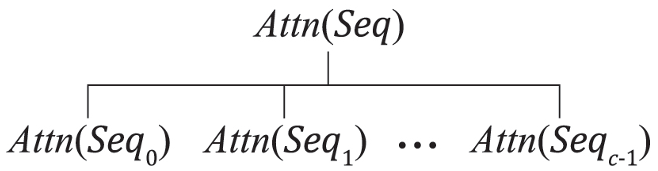 Figure 1: The CQS Divide mechanism partitioning sequence interactions.
The Recursive Benefit
This decomposition is recursive. If a subsequence is still too large for the GPU, you apply CQS Divide again. This allows it to fit into arbitrary memory budgets, whether you are running on an H100 or a consumer-grade laptop.
Implementation: From High-Level Logic to GPU Kernels
Stream-CQSA operates as a wrapper. It partitions the workload, generates a CQS Mask to prevent redundant calculations in overlapping chunk regions, and streams the tasks to an underlying attention kernel (like FlashAttention).
- Decompose: Break the 1B tokens into manageable subsequences.
- Stream: Move to the GPU.
- Compute: Calculate local Numerators and Denominators of the softmax.
- Aggregate: Accumulate results in host memory (CPU) to avoid GPU bloat.
Precise Scaling
The authors demonstrated that at a division granularity of , even a massive sequence only requires ~1.43 GiB of peak memory for the backward pass.
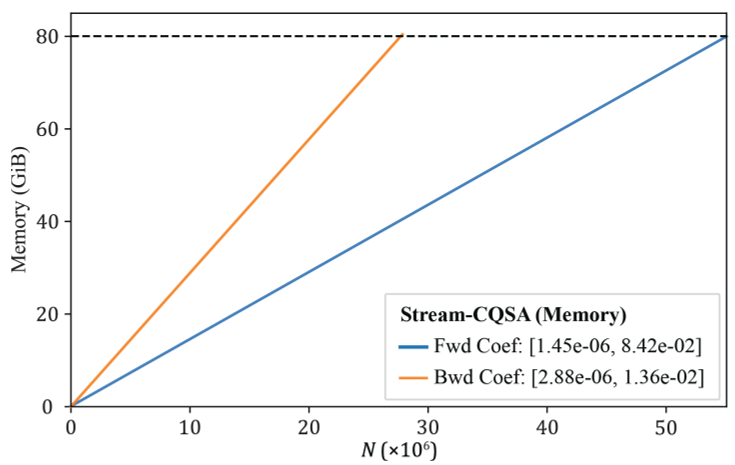 Figure 2: Memory vs. Sequence Length for Forward and Backward passes.
Performance: The Memory-Latency Trade-off
Is there a catch? Yes: Runtime. By decomposing the problem, we incur overhead from host-device transfers (H2D/D2H) and redundant memory gathering. However, the authors argue that this is a "graceful degradation." Instead of the program crashing with an OOM error, it simply takes longer to run.
In their 1B token simulation (Table 1), they estimated that while a single A100 could technically perform the backward pass, it would take several thousand GPU hours. This highlights that Stream-CQSA is currently kernel-bound, not memory-bound.
Deep Insight: A New Distributed Paradigm
The most profound takeaway from this paper is the independence of the tasks. Because each CQS-divided subsequence is mathematically independent:
- Zero Inter-device Communication: You can spread these tasks across 1,000 GPUs without them ever needing to "talk" to each other until the final aggregation step.
- Heterogeneous Execution: You could run some tasks on a powerful H100 and others on a smaller L40, dynamically balancing the workload.
Conclusion
Stream-CQSA effectively "decouples" the logic of attention from the physical constraints of the hardware. While the current implementation faces overhead challenges, the theoretical framework provides a roadmap for Billion-Token context lengths that were previously deemed impossible on single-node systems. Future hardware-aware kernels optimized for this specific streaming dataflow could make "infinite context" a practical reality.