
Stream-T1: Mastering Long-Video Consistency via Test-Time Scaling
Stream-T1 is a novel Test-Time Scaling (TTS) framework designed for streaming video generation that achieves state-of-the-art performance in long-form synthesis. It introduces a chunk-level scaling strategy using reward-guided search to significantly improve temporal consistency and visual quality in videos up to 30 seconds.
TL;DR
Stream-T1 is the first comprehensive framework to bring Test-Time Scaling (TTS)—the "o1-style" reasoning for vision—into the realm of Streaming Video Generation. By shifting from global video search to an efficient chunk-by-chunk optimization, it achieves industry-leading temporal consistency and motion smoothness in 30s+ videos, outperforming traditional diffusion baselines by massive margins in motion quality.
The Problem: The High Cost of "Thinking" in Video
Traditional video diffusion models are context-constrained. To generate longer videos, researchers turned to Test-Time Scaling (TTS), which uses extra computation at inference (like search or multiple candidates) to boost quality.
However, previous TTS methods encountered a "dimension wall":
- Exorbitant Costs: Searching in the high-dimensional space of an entire video sequence is computationally ruinous.
- Lack of Control: Denoising all frames simultaneously prevents the model from fixing a specific temporal artifact without discarding the whole video.
- Memory Corruption: Existing streaming models often "forget" the beginning of the video (sliding windows) or "blur" features together (EMA updates), leading to subject morphing.
Methodology: The Three Pillars of Stream-T1
Stream-T1 transforms the generation process into a "shallow search tree with wide branches" by focusing on chunk-level autoregression.
1. Stream-Scaled Noise Propagation
Instead of starting each video chunk with random Gaussian noise, Stream-T1 uses spherical interpolation to link the current noise latent to the "historically proven" high-quality noise of the previous chunk. This creates a hidden "thread of continuity" that anchors the exploration space.
2. Stream-Scaled Reward Pruning
The model generates candidates for each chunk and keeps the top (Beam Search). The "compass" for this search is a dual-reward system:
- Short Score: Evaluates frame-level aesthetics (spatial quality).
- Long Score: Uses a sliding window to evaluate motion coherence and text alignment over an extended duration.
- Dynamic Weighting: As the video progresses, the model intelligently shifts focus between perfecting local details and maintaining global narrative flow.
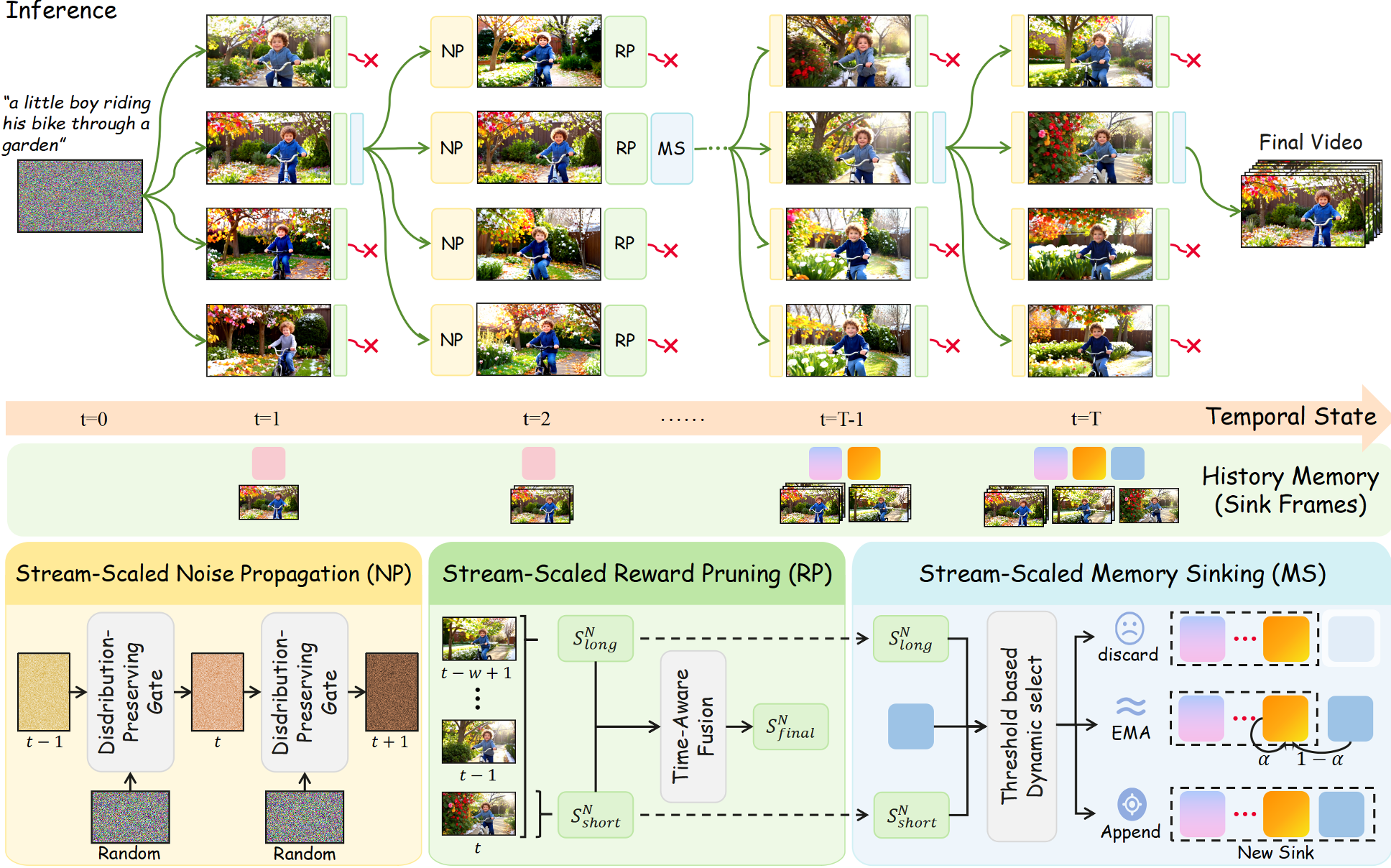 Figure 1: The Stream-T1 pipeline showing Noise Propagation, Reward Pruning, and Memory Sinking.
3. Stream-Scaled Memory Sinking: The "Smart" KV-Cache
This is perhaps the most significant innovation. Instead of blindly discarding old KV-cache data, Stream-T1 uses its reward signals to decide the fate of "evicted" memory:
- Discard: If the chunk was low quality, kill it to prevent "error accumulation."
- EMA-Sink: If the chunk is smooth and consistent, compress it into the existing memory to save space.
- Append-Sink: If a semantic boundary is detected (a scene change), save the chunk as a new "anchor." This prevents the "semantic blurring" that plagues other models during transitions.
Experimental Triumphs
Stream-T1 was tested on 5-second (VBench) and 30-second (MovieGen prompts) benchmarks. The results confirm that "thinking longer" leads to "seeing clearer."
Quantitative SOTA
In the 30s long-video generation task, Stream-T1 dominated the baselines:
- Subject Consistency: Improved to 98.43.
- Motion Quality (VideoAlign): Jumped from -0.002 to 0.226. This 114x relative improvement demonstrates that the model finally "understands" how objects should move over long horizons.
 Table 1: Performance comparison on 30s video generation.
Qualitative Stability
Visual comparisons show that while models like Self-forcing or CausVid begin to "deform" subjects or lose background stability after 10-15 seconds, Stream-T1 maintains a sharp, consistent identity for characters and environments throughout the full 30s duration.
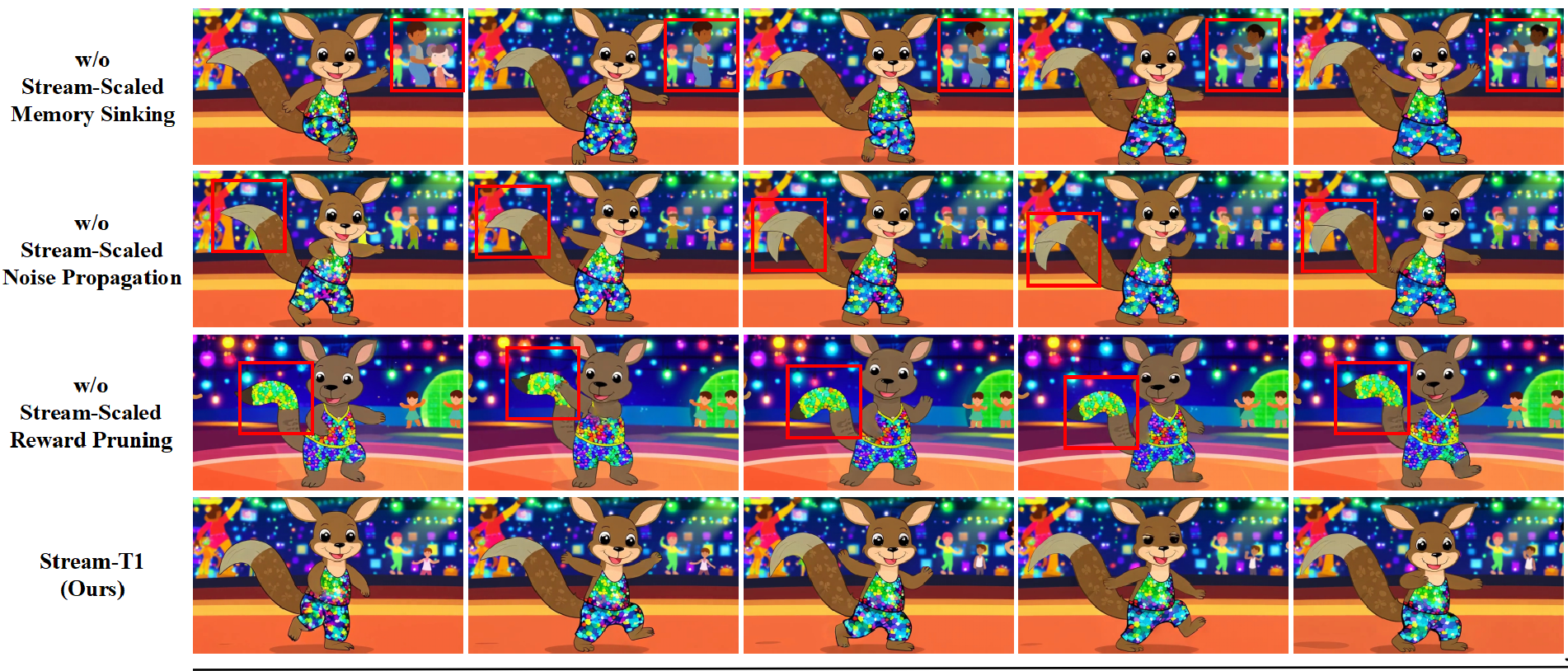 Figure 2: Ablation showing how Memory Sinking preserves background stability and Noise Propagation prevents structural artifacts.
Critical Insight & Conclusion
Stream-T1 proves that the "Scaling Law" isn't just about more GPU hours during training—it's about Inference-Time Intelligence. By treating video generation as an autoregressive search problem with a "smart" memory, the researchers have mitigated the two biggest killers of AI video: computational explosion and temporal amnesia.
Future Outlook: The logic of Stream-Scaled Memory Sinking could potentially be applied to AR-based LLMs or World Models, where the ability to distinguish between "noise to discard" and "semantic anchors to keep" is the difference between a coherent agent and one that hallucinates.
Takeaway: Stream-T1 sets a new standard for how we should handle context in streaming generative AI—don't just store everything; store what matters.