
StreamingTalker: Enabling Real-Time, Infinite-Length 3D Talking Avatars via AR Diffusion
StreamingTalker: Audio-driven 3D Facial Animation with Autoregressive Diffusion Model
StreamingTalker is a real-time speech-driven 3D facial animation framework that utilizes an autoregressive (AR) diffusion model. It achieves state-of-the-art performance in lip-synchronization and temporal stability by generating motion in a streaming manner, overcoming the latency and length limitations of traditional full-sequence diffusion models.
TL;DR
StreamingTalker is a breakthrough in speech-driven 3D facial animation. By shifting from full-sequence processing to an Autoregressive (AR) Diffusion approach, it solves the "training horizon" problem and slashes inference latency to 25ms. Whether the audio is 5 seconds or 5 minutes, it maintains stable, expressive 3D lip-sync in real-time.
The Problem: The "Long Audio" Wall
Generating 3D facial animation from speech isn't new, but doing it with high fidelity and zero latency is. Previous state-of-the-art methods using Diffusion Models (like FaceDiffuser) had a fatal flaw: they were "Batch" thinkers. They needed the entire audio clip before they could start denoising the facial mesh.
This led to:
- Massive Latency: Processing a 30-second clip might take seconds of compute—unacceptable for a real-time digital human.
- Horizon Drift: Since models were trained on 4-5 second clips, they often "forgot" how to move correctly when presented with longer audio, leading to unnatural jitter or frozen expressions.
Methodology: The Autoregressive Insight
The core innovation of StreamingTalker is treating diffusion as a streaming task. The architecture is split into three main components:
1. The VQ-VAE Latent Space
Instead of predicting raw 3D vertex coordinates (which is computationally expensive), the model learns a Discrete Motion Prior. It uses a VQ-VAE to encode complex 3D facial movements into a compact latent space.
2. AR Condition Predictor
This is the "brain" of the system. It looks at a fixed window of historical motion (past frames) and the current audio (extracted via HuBERT). By using an ALiBi-based biased causal attention mechanism, it merges these modalities into a dynamic condition.
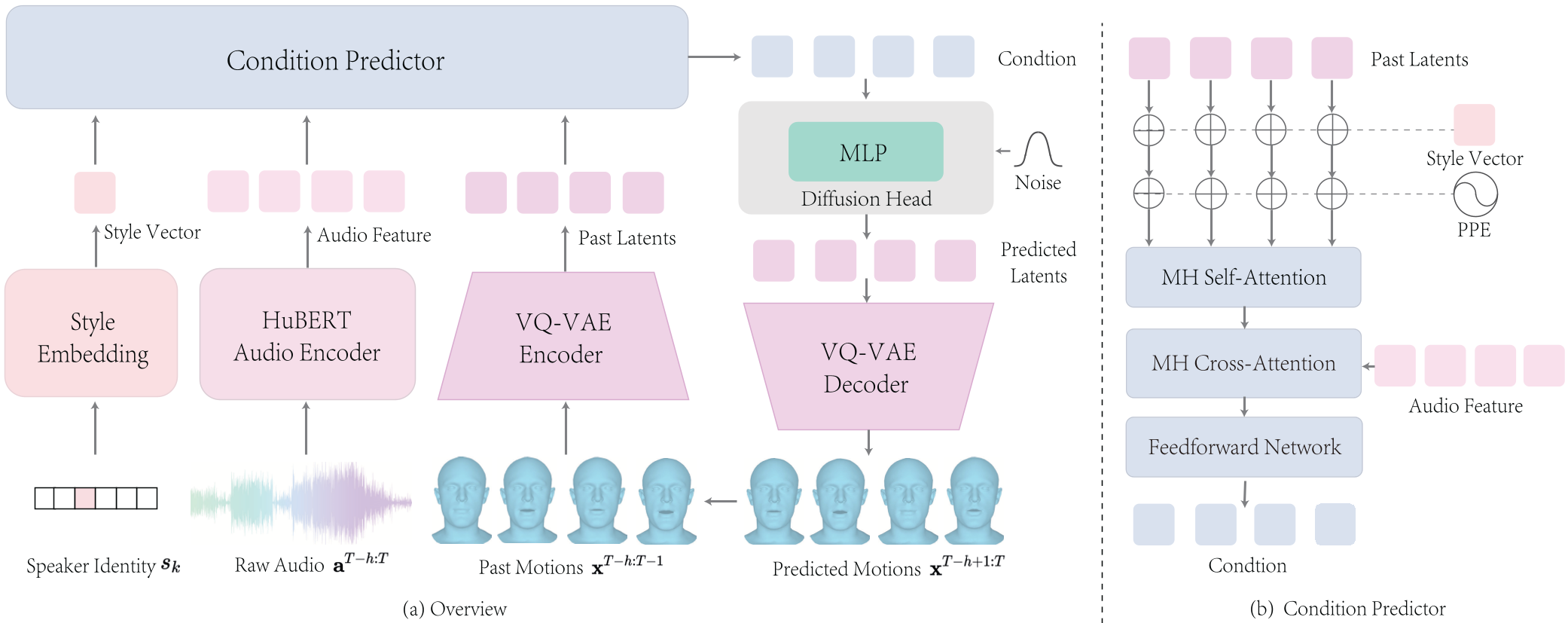 Figure 1: The StreamingTalker pipeline, showing the fusion of audio and historical motion to guide the diffusion head.
3. Lightweight Diffusion Head
Because the "Condition Predictor" does the heavy lifting, the actual denoising can be handled by a lightweight MLP-based head. This allows the model to perform 50-step DDIM sampling in just 12ms per frame, ensuring the output stays well above the standard 30 FPS requirement.
Performance & Results
StreamingTalker was tested against powerhouses like FaceFormer and DiffSpeaker on the VOCASET and BIWI datasets.
- Accuracy: It achieved the lowest Lip Vertex Error (LVE) in almost all categories.
- Stability: On extremely long sequences (2000+ frames), while other models' accuracy fell off a cliff, StreamingTalker remained steady due to its fixed-window history strategy.
- Speed: As seen in the figure below, while other full-sequence models see latency grow linearly with audio length, StreamingTalker remains constant at 25ms.
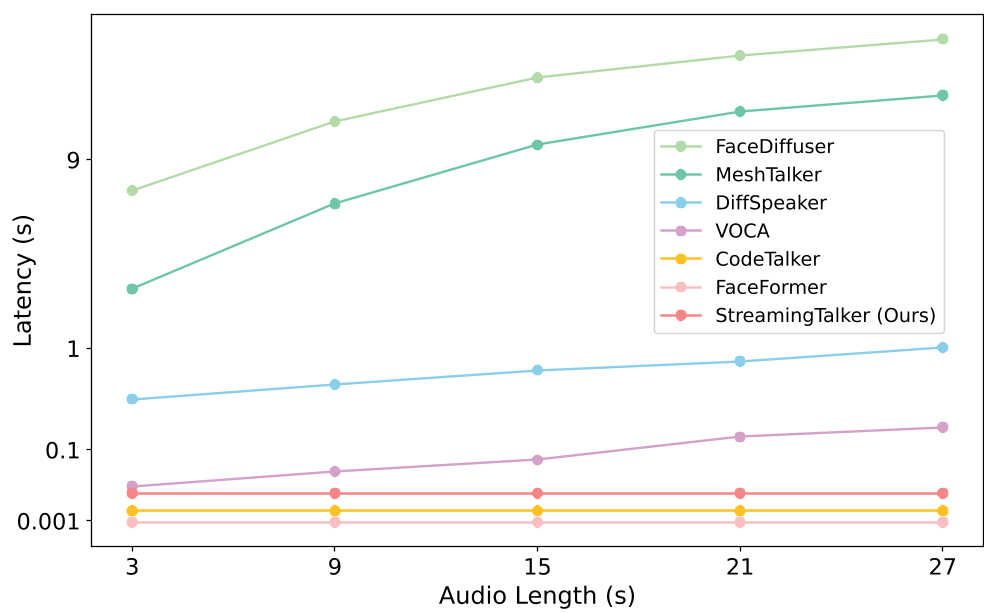 Figure 2: Inference latency analysis—StreamingTalker maintains low, constant latency regardless of audio duration.
Qualitative Superiority
Beyond numbers, the visual results show clearer articulation. The model handles "bilabial consonants" (like /p/, /b/, /m/) significantly better, ensuring lips completely close when they should—a common failure point for deterministic models that tend to produce "mushy" mouth movements.
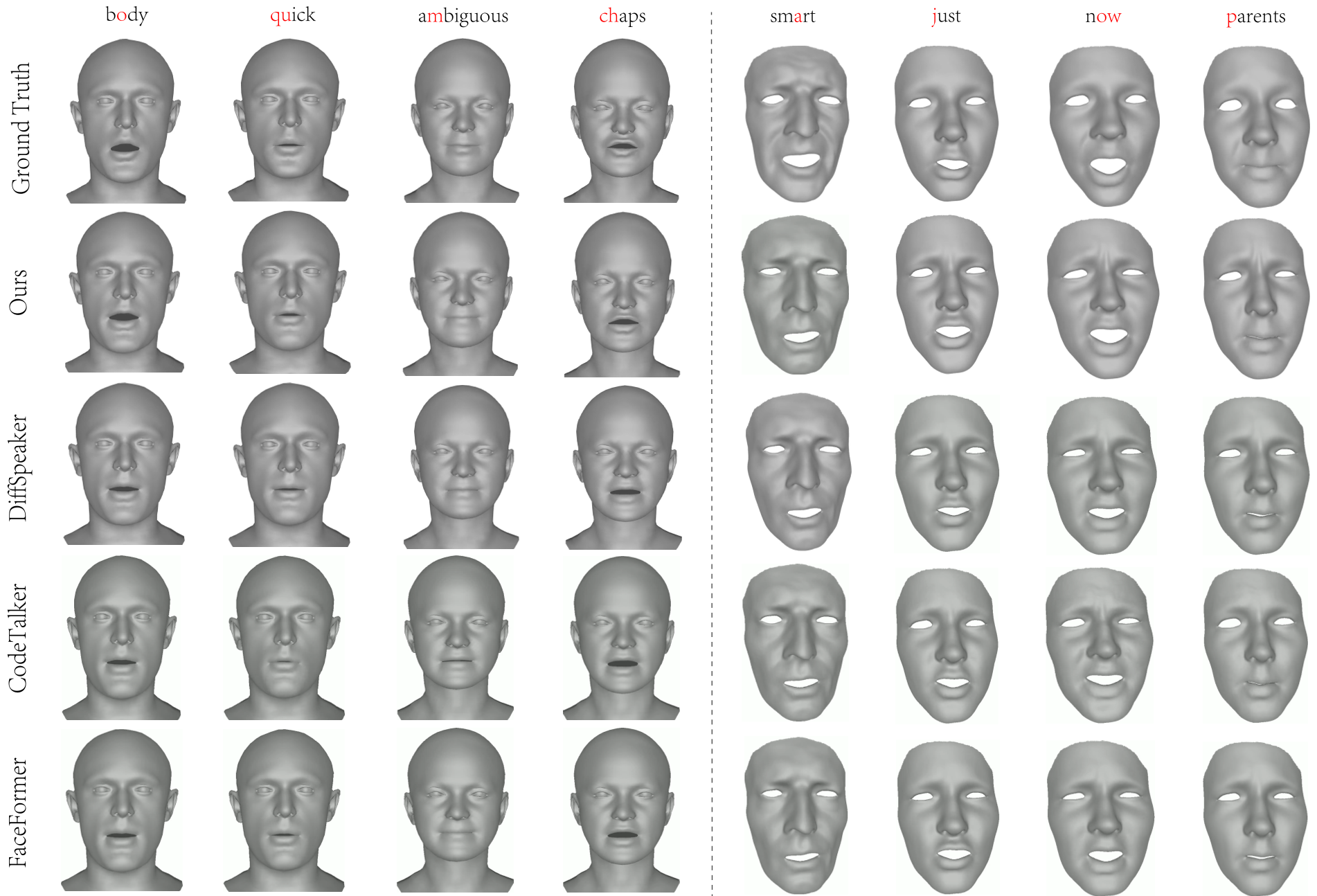 Figure 3: Comparison demonstrating more natural mouth shapes and rounded vowels compared to previous SOTA.
Final Thoughts: The Future of Digital Humans
StreamingTalker isn't just an academic exercise; the authors demonstrated its utility by building a real-time demo integrated with an LLM (Large Language Model) and TTS (Text-to-Speech).
While it currently lacks generalized "emotions" (a limitation the authors acknowledge), it provides the robust, low-latency backbone necessary for the next generation of AI-driven virtual assistants. The switch from global batch diffusion to local autoregressive diffusion is officially the new "gold standard" for real-time 3D animation.