
StreamingTalker: Enabling Real-Time, Infinite 3D Talking Heads via AR Diffusion
StreamingTalker: Audio-driven 3D Facial Animation with Autoregressive Diffusion Model
StreamingTalker is a novel speech-driven 3D facial animation framework that utilizes an Autoregressive (AR) Diffusion Model to generate realistic, synchronized facial motions. It achieves SOTA performance on benchmarks like BIWI and VOCASET while significantly reducing latency to 25ms, enabling real-time streaming applications.
TL;DR
StreamingTalker is a breakthrough in speech-driven 3D facial animation. By replacing the standard "one-pass" diffusion process with an Autoregressive (AR) Diffusion mechanism, the authors achieved two major milestones: the ability to generate infinitely long, stable facial motions and a massive reduction in latency to just 25ms. It establishes a new SOTA on the BIWI and VOCASET benchmarks while supporting real-time streaming.
The "Horizon" Problem in 3D Diffusion
In the quest for realistic 3D digital humans, Diffusion Models have become the preferred choice due to their ability to capture the "one-to-many" mapping—the reality that the same syllable can be pronounced with varying facial nuances. However, current leaders like FaceDiffuser or DiffSpeaker suffer from a "Training Horizon" limitation. Because they are trained on fixed-length snippets, their performance degrades when they encounter longer audio. Furthermore, they require the entire audio clip to be present before they begin denoising, making them useless for live, interactive scenarios.
Methodology: The Autoregressive Pivot
The core insight of StreamingTalker is to treat the diffusion process as a streaming task. Instead of denoising a whole sequence, the model generates one frame at a time, conditioned on a sliding window of the past.
1. The AR Condition Predictor
The architecture uses a VQ-VAE to map raw 3D meshes into a compact latent space. The AR Condition Predictor (a Transformer Decoder) then takes:
- Past Motion Context: A fixed history (e.g., 60 frames).
- Audio Features: High-level acoustic features from a pre-trained HuBERT model.
- Speaker Identity: A one-hot embedding to maintain personal style.
This predictor uses an ALiBi-based attention mechanism, which is mathematically robust for extrapolating beyond seen sequence lengths.
2. The Lightweight Diffusion Head
Most diffusion models use heavy U-Nets or Large Transformers. StreamingTalker employs a single-layer MLP as its diffusion head. Because the AR condition is already so "informed" by the history and audio, a lightweight head is sufficient to recover the clean latent from noise, ensuring the 20ms per-frame inference speed.
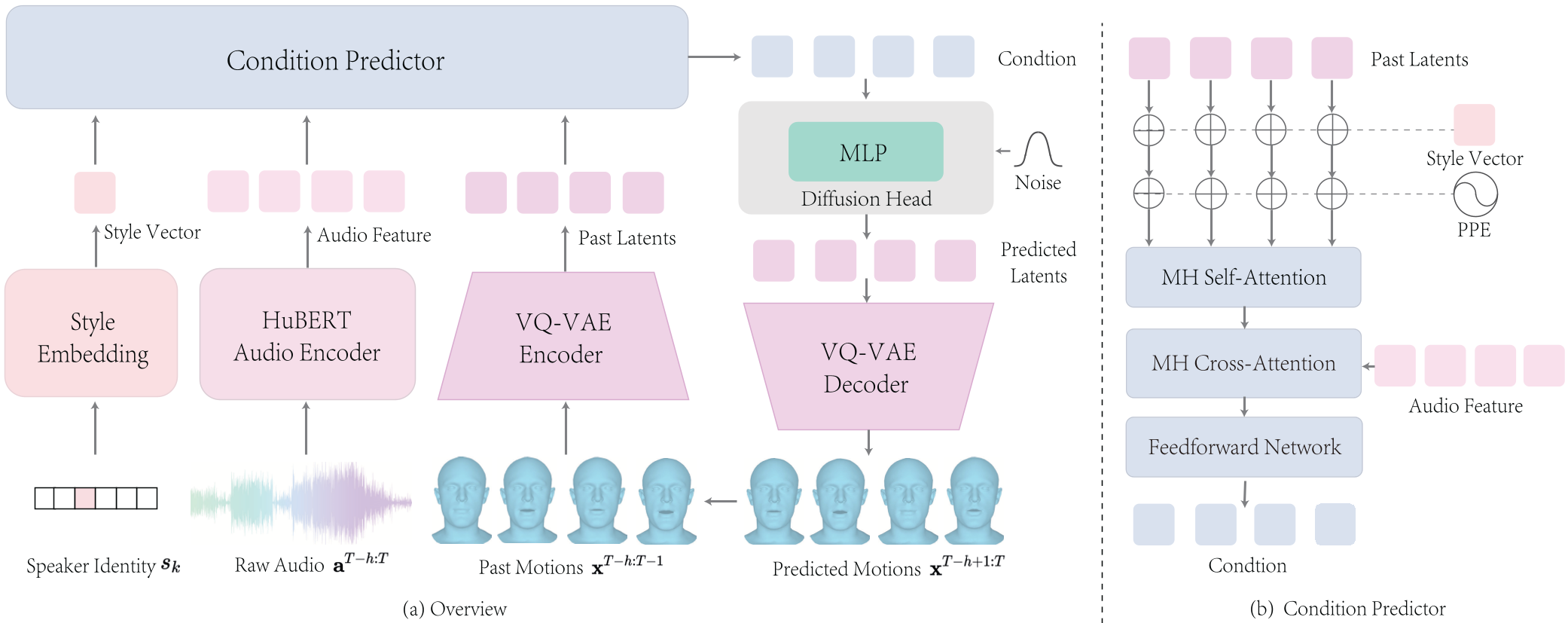 Figure 1: The dual-stage pipeline featuring the AR Condition Predictor and the MLP Diffusion Head.
Performance & Long-Sequence Stability
Quantitatively, the model shines in Lip Vertex Error (LVE), outperforming deterministic models (like FaceFormer) and diffusion models (like DiffSpeaker).
The real stress test was the "Long Sequence" evaluation (2000 frames / 60+ seconds). Previous models showed significant jitter and drift as time passed. StreamingTalker remained stable, proving that the fixed-history window prevents the distribution shift that usually plagues long-context transformers.
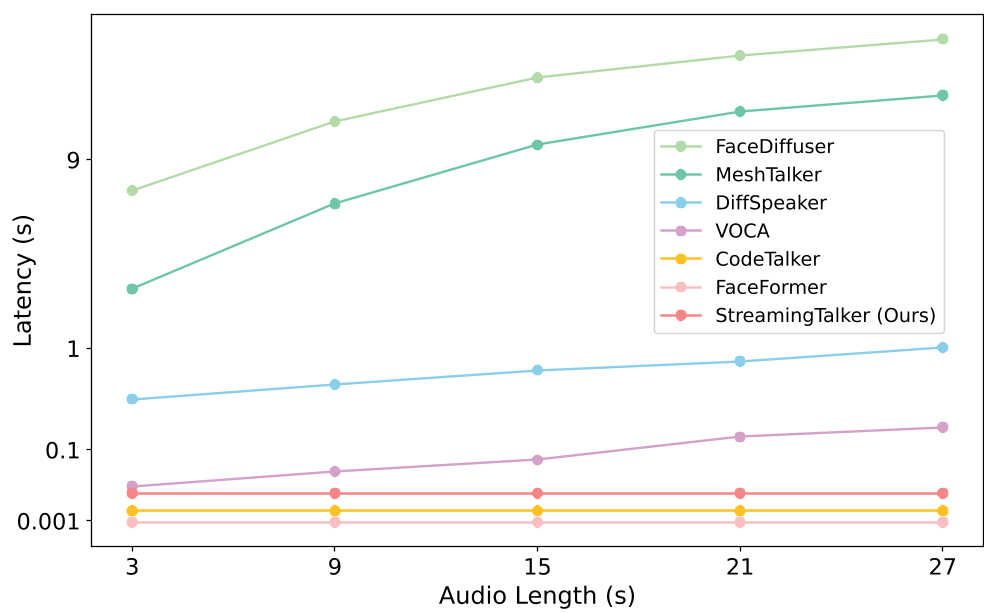 Figure 2: Latency comparison. While full-sequence models see latency grow with audio length, StreamingTalker stays constant at ~25ms.
Qualatitive Excellence
Visually, the model captures fine-grained articulatory details that others miss. It handles "bilabial consonants" (m, p, b sounds requiring full lip closure) and rounded vowels (o, u) with much higher fidelity.
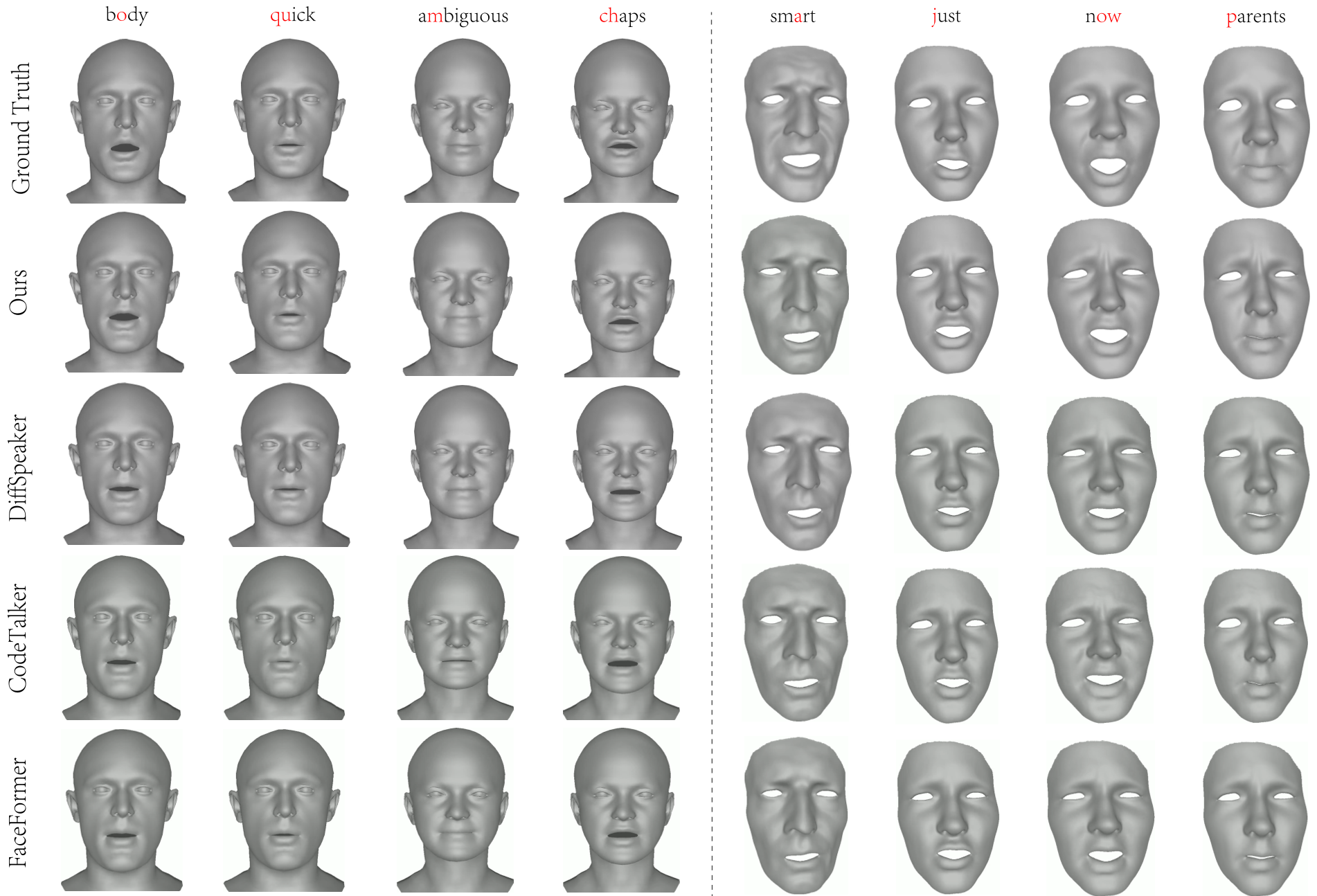 Figure 3: Comparisons against CodeTalker and DiffSpeaker show superior lip shapes and closure.
Critical Insight & Future Directions
The researchers have effectively solved the latency and sequence-length issues in 3D talking faces. However, the model currently focuses on the lower face (lips/jaw).
- Limitation: It lacks deep emotive control (e.g., sadness, anger) and doesn't yet model complex upper-face movements (eyebrows/eyes) or head poses natively.
- Future: Integrating models like EMOCA for emotion or scaling the dataset to include diverse expressions could turn this into the ultimate real-time digital human engine.
StreamingTalker sets a new standard for efficiency in generative AI for graphics, proving that autoregressive structures and diffusion models are not mutually exclusive, but rather a powerful duo for temporal tasks.