
Streamlining Code Smells: Using Collective Intelligence and Visualization
Streamlining code smells: Using collective intelligence and visualization
This paper introduces "Crowdsmelling" and "Smelly Maps," a combined approach to automate code smell detection in Java via collective intelligence and multi-level visualization. Built as an Eclipse plugin (IDE 2.0), it achieves a self-improving detection cycle by aggregating global developer feedback to calibrate machine learning models.
TL;DR
Code smell detection has long been hindered by human subjectivity and the "false positive" trap of static rules. This paper proposes a dual-force solution: Crowdsmelling, which uses collective intelligence to calibrate detection algorithms on the cloud, and Smelly Maps, which provides high-level "heat maps" of technical debt to guide refactoring in massive legacy systems.
Problem & Motivation: The Subjectivity Trap
While refactoring operations (the "cure") are well-integrated into modern IDEs, identifying the "smells" (the "symptoms") remains an artisanal task. Software engineers face three major hurdles:
- Subjectivity: An "experienced" developer might flag a complex smell like Feature Envy, while a novice misses it entirely.
- Calibrated Precision: Static metric-based tools often produce too much noise, leading developers to ignore them.
- Abstraction Gap: Understanding a specific bad line of code is easy, but understanding the distribution of decay across a 1-million-line system is nearly impossible without visualization.
The authors argue that the missing link is Collective Intelligence. If thousands of developers tag false positives, the underlying machine learning model (Binary Logistic Regression) can learn and adapt.
Methodology: The "Crowdsmelling" Ecosystem
The proposed architecture shifts detection from a local, static event to a global, dynamic one.
1. The Crowdsmelling Feedback Loop
The workflow follows a "Positive Feedback Cycle":
- Detection: Users trigger local detection in their IDE.
- Verification: Users accept, reject, or suggest new code smells.
- Calibration: Feedback (dependent variables) and metrics (independent variables) are sent to a cloud server.
- Synchronization: The server re-calibrates the machine learning model and pushes updated parameters back to all users.
2. Smelly Maps: Visualizing the Decay
Instead of just highlighting lines of text, the authors introduce Smelly Maps integrated into the SourceMiner framework. This allows developers to see "intensity" (via color saturation) and "distribution" across packages and classes.
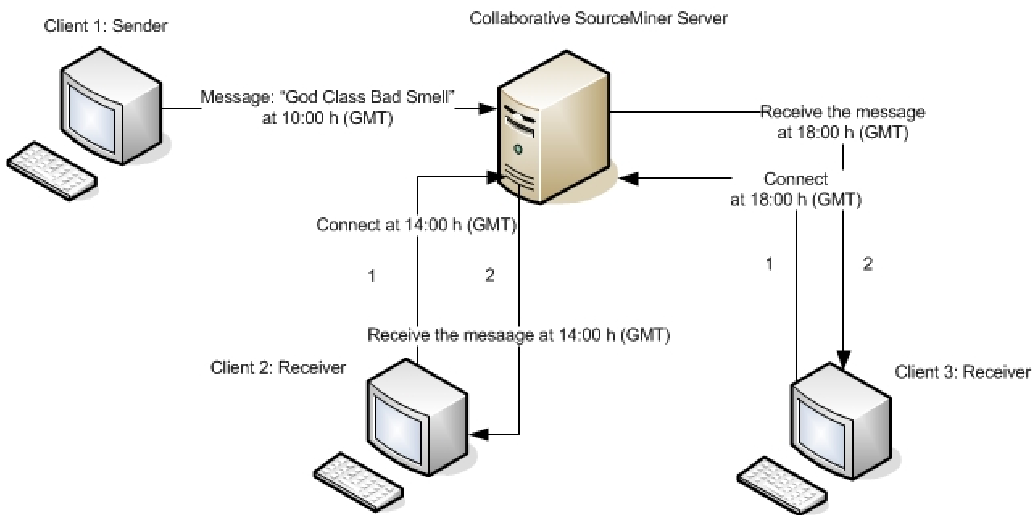 Figure 1: The Collaborative SourceMiner Architecture, bridging local IDEs with cloud-based intelligence.
Experiments & Preliminary Results
The authors leverage past work on the Smellchecker plugin. In initial tests focusing on the Long Method smell, the tool used Binary Logistic Regression (BLR) to significantly reduce subjectivity.
By using the Graph View, developers can identify "candidate" elements for refactoring. For example, a "God Class" isn't just a list of metrics; it becomes a glowing node in a dependency graph, making the urgency of refactoring visceral.
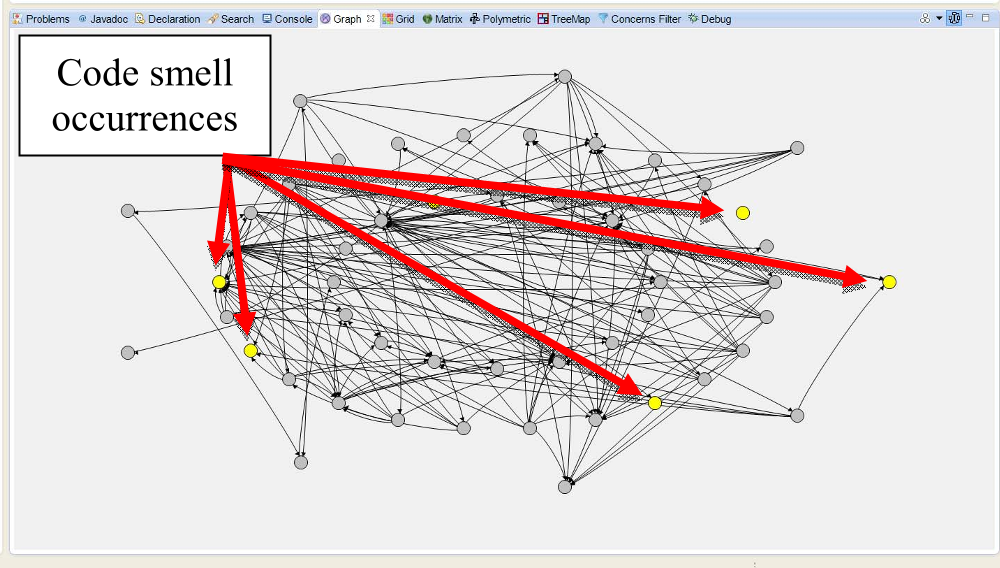 Figure 2: Smelly Maps in action – Highlighting code smell intensity within a dependency graph.
Critical Analysis & Conclusion
Takeaway
The shift towards IDE 2.0—where tools learn from the "Wisdom of the Crowd"—is inevitable. By combining the statistical rigor of machine learning with human intuition (via visualization), we can finally move code smell detection from a subjective opinion to a data-driven science.
Limitations
- Cold Start Problem: The system requires a significant initial "crowd" to become more accurate than traditional static analysis.
- Model Complexity: While BLR is effective for simple smells, more complex architectural smells might require deep learning or graph neural networks.
Future Outlook
The authors plan to extend this with longitudinal studies to track how "detection accuracy" and "precision/recall" improve as the database grows. For practitioners, this means a future where your IDE doesn't just tell you your code is "bad," but tells you why 80% of top-tier developers agree it's a smell.