
From Viral Exposure to Precision Gains: Mastering the Positive Effect in Social Networks
Strengthening the Positive Effect of Viral Marketing
This paper introduces the "Strengthening the Positive Effect" (SPE) problem, a variation of influence maximization that accounts for negative user responses in social networks. The authors propose a modified Independent Cascade (IC) model to maximize the net benefit (positive hits minus negative hits), and introduce the BM (Benefit Maximization) algorithm using reverse reachable sets to handle the non-submodular objective function.
TL;DR
In the world of social media marketing, more reach isn't always better. Indiscriminate "viral" spreading can reach "negative users" who tank product ratings—a phenomenon known as the Groupon Effect. This paper defines the Strengthening the Positive Effect (SPE) problem, proves it is theoretically "harder" than standard Influence Maximization (IM), and provides a scalable, mathematically-backed algorithm to maximize net influence while avoiding the "haters."
The "Hater" Problem: Why Traditional Viral Marketing Fails
Most prior work in Influence Maximization (IM) operates on a simple assumption: every person who sees your product is a win. However, empirical evidence from Yelp, Goodreads, and Amazon suggests otherwise. When a product is pushed to a broad, mismatched audience, the average rating often drops because the "negative utility" brought by disinterested users offsets the gains from core fans.
The authors argue that we can identify these negative clusters (e.g., parents are negative targets for high-performance two-seater sports cars). The challenge is that once you introduce "negative nodes" into the math, the nice properties of the Independent Cascade (IC) model—namely monotonicity and submodularity—vanish. We are left with an objective function that is non-monotone and non-submodular, making it (theoretically) impossible to solve with a constant approximation ratio in the general case.
Methodology: Pruning and Reverse Reachability
The authors attack this problem from two angles:
1. The Pruned Graph (Undirected Networks)
For simpler, unweighted networks, the authors propose a Pruning Algorithm. By contracting positive connected components and focusing only on the "border" nodes that touch negative users, they transform the network into a bipartite Pruned Graph.
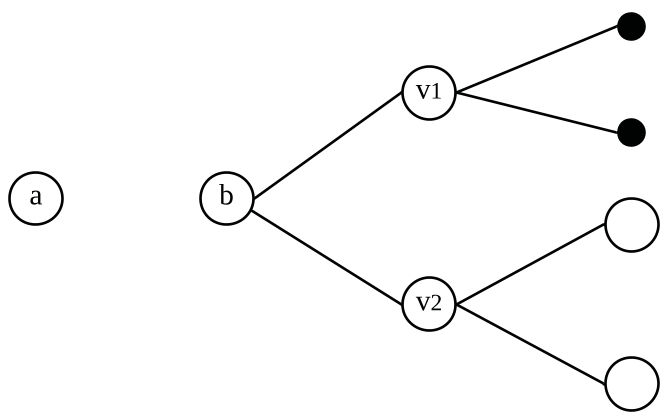 Figure: The Pruned Graph approach helps isolate how seeds (u) reach negative nodes (black), turning the problem into a set cover variant.
2. BM Algorithm: Thinking in Reverse
For massive, directed graphs (like Orkut with 117M edges), the authors extend the state-of-the-art Reverse Reachable (RR) set method. They define:
- RR+: Nodes that can reach a positive user.
- RR-: Nodes that can reach a negative user.
The algorithm, BM (Benefit Maximization), samples these sets to find seeds that appear frequently in RR+ sets but rarely in RR- sets. This balancing act allows the greedy algorithm to work despite the lack of submodularity.
Performance: Beating the Scalability Wall
The real-world value of this work lies in its ability to handle massive graphs. Traditional Monte Carlo (MC) simulations are painfully slow for this task because they require thousands of simulations per seed selection.
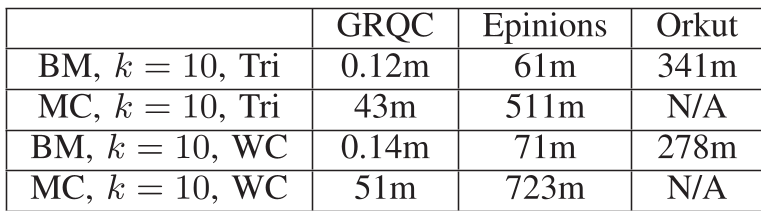 Table: BM vs. MC. On the Orkut dataset, BM finds optimal seeds in under 6 hours, while Monte Carlo fails to complete (N/A).
The experimental results show that in citation networks (GRQC) or review sites (Epinions), a small, well-chosen seed set (k=1 to 10) captures the vast majority of the possible benefit. Adding more seeds beyond a certain point yields diminishing returns as the risk of hitting negative patches increases.
Critical Insight: The Supermodular Curvature
The paper’s theoretical heavy lifting relies on Supermodular Curvature (). Essentially, this metric measures "how far" a function is from being submodular. The authors prove that as long as the negative set isn't overwhelmingly large, the BM algorithm achieves a performance ratio of: This provides a rare "traceable guarantee" for an optimization problem that is technically NP-hard to approximate.
Conclusion & Future Outlook
This work marks a shift from the "Growth at all costs" mentality of the early 2010s to the "Targeted Precision" required in today’s fragmented social landscape. While the authors assume the negative set is known, future work could integrate active learning to identify negative clusters on the fly during the cascade.
The takeaway for practitioners is clear: Before you launch a viral campaign, check your "Reverse Reachable" sets—otherwise, your brand might be a victim of its own reach.