
SFMN: Strengthening Social Analysis through Multi-Source Network Fusion
Strengthening social networks analysis by networks fusion
This paper introduces SFMN (Semi-supervised Fusion for Multiple Networks), a framework that leverages Gradient Boosting Decision Trees (GBDT) to integrate multi-source social networks into a unified structure. By fusing semantically rich "acknowledgment networks" with traditional "co-authorship networks," the authors achieve a more accurate representation of academic social structures and community detection.
TL;DR
Researchers from BUPT have proposed SFMN (Semi-supervised Fusion for Multiple Networks), a framework that uses Gradient Boosting Decision Trees (GBDT) to merge disparate social graphs—such as co-authorship and academic acknowledgments. By moving fusion from the data level to the feature level, the method achieves a 10% boost in community detection accuracy while being significantly faster than traditional SOTA methods.
The Limitation of "Single-Source" Truth
In social network mining, we often treat one type of interaction (like co-authoring a paper) as the definitive link between two people. However, real human relationships are multi-faceted. A professor and a student might share a co-authorship, but their deeper academic bond, mentorship, and emotional support are often hidden in the "Acknowledgment" section of a dissertation.
The authors argue that relying on single-source data creates a "noisy" and incomplete picture of the social landscape. The challenge lies in how to align and fuse these different "layers" of reality without losing structural precision or drowning in computational complexity.
Methodology: Feature-Level Fusion via SFMN
The SFMN framework operates through a sophisticated pipeline designed to transform raw text into a unified graph.
1. Network Construction & Alignment
The authors build two distinct networks:
- Network 1 (Acknowledgment): Extracted from dissertation texts, capturing the emotional and mentor-student relationships.
- Network 2 (Co-authorship): Extracted from ArnetMiner, reflecting formal research collaborations.
To bridge these, they perform Cross-lingual Entity Identification (Chinese to Pinyin) and utilize K-Nearest Neighbor (KNN) for entity disambiguation, ensuring that "Zhang San" in one network is the same entity as "张三" in the other.
2. The SFMN Framework
Instead of simply averaging adjacency matrices, SFMN extracts four key topological features for every potential edge:
- & : Edge and node weights.
- EJC: Extended Jaccard Coefficient (neighborhood overlap).
- EAAC: Extended Adamic/Adar Coefficient (log-frequency of shared neighbors).
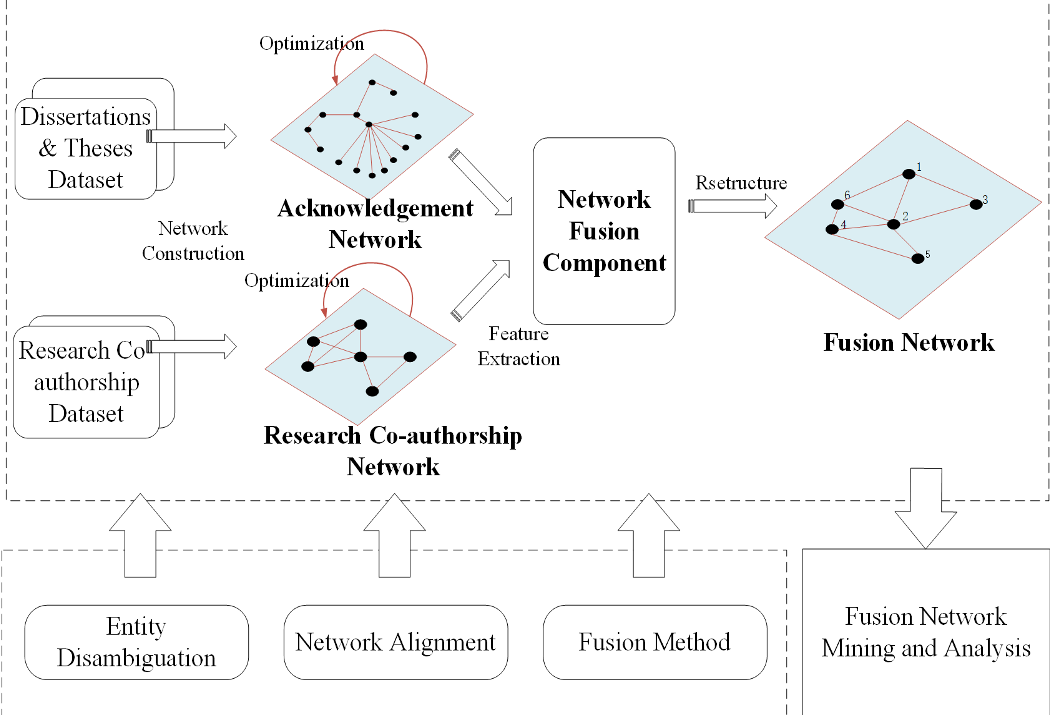
These features are fed into a GBDT model, which learns to predict whether a "fused" relationship should exist between two nodes based on training labels from the Ground Truth group information.
Experimental Performance: Efficiency Meets Accuracy
The authors compared SFMN against SNF (Similarity Network Fusion) and Multi-Louvain. The results highlight a clear advantage for feature-level fusion.
| Algorithm | NMI (Accuracy) | Time (Seconds) |
|---|---|---|
| Network 1 (Single) | 0.678 | - |
| SNF (Data-level Fusion) | 0.726 | 187.727 |
| SFMN (Proposed) | 0.783 | 3.365 |
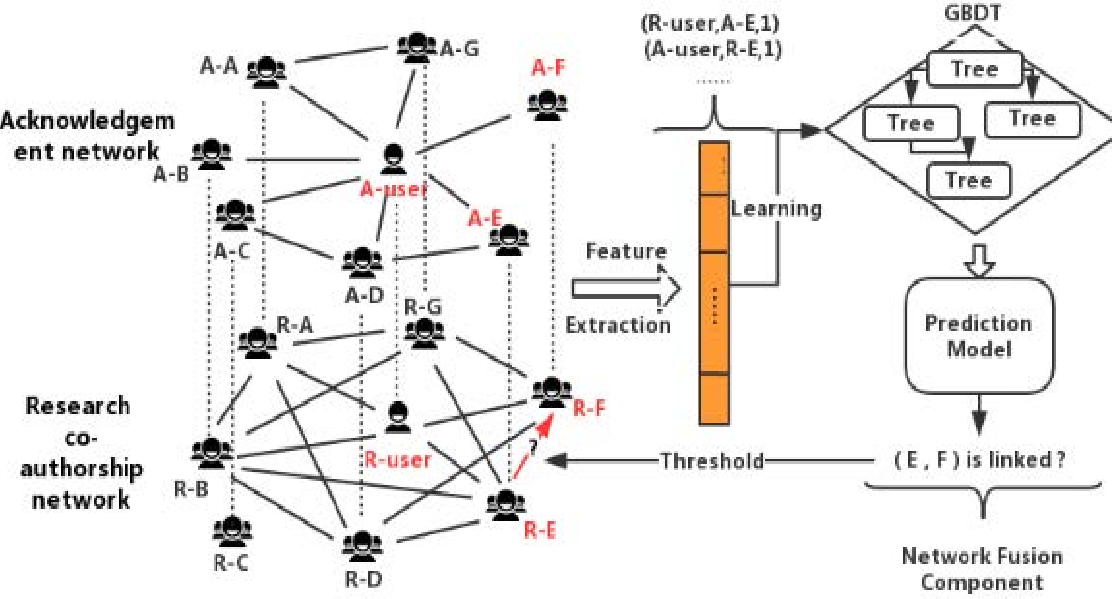
- Accuracy: SFMN achieved the highest NMI (0.783), proving that the fused network better matches the real-world teacher-student groupings.
- Efficiency: Because SFMN uses GBDT on extracted features rather than iteratively computing large-scale similarity matrices at the data level (like SNF), it is over 50 times faster.
Case Study: Visualizing the Fusion
The paper provides a compelling visual case study of a specific research lab. In the single-source networks (a and b), many true lab members (green nodes) are incorrectly excluded or isolated. In the Fusion Network (c), the community detection algorithm successfully groups the majority of valid members together, demonstrating the "strengthening" effect of the fusion.
 (a) Acknowledgment, (b) Co-authorship, (c) Fused Network.
Conclusion & Insights
The SFMN framework demonstrates that:
- Semantic data (Acknowledgments) is a goldmine for social network analysis that has been largely untapped.
- Feature-level fusion using supervised/semi-supervised learning is the path forward for combining heterogeneous networks efficiently.
- Loss function matters: The authors found that Cross-Entropy loss provided the best convergence for predicting social links.
While this study focused on academic authors, the implications extend to any domain where multiple interaction types exist—from e-commerce (viewing vs. buying) to security (financial links vs. communication links).