Designing for the Silver Tsunami: How Older Adults Annotate Stress for Future AI
Stress Annotations from Older Adults - Exploring the Foundations for Mobile ML-Based Health Assistance
This paper explores stress annotation behaviors in older adults (aged 66-81) through a four-week field study using a multimodal approach. By combining a wearable sensor (Microsoft Band 2) for physiological data tracking with paper-based diaries, the authors establish a foundation for personalized Machine Learning (ML) models in health assistance, achieving high compliance rates and identifying key physiological markers like Heart Rate (HR) and Galvanic Skin Response (GSR) that correlate with self-reported stress.
TL;DR
As the global population ages, AI-driven health assistants offer a path to improved autonomy. However, AI is only as good as its data. This study investigates how older adults (66-81) interact with stress-tracking technology, revealing that while they are highly compliant with wearables, their stress patterns and heart rate markers differ significantly from younger cohorts, necessitating a rethink of how we build "personalized" health ML.
Background: The Annotation Bottleneck in Mobile Health
The promise of "Personal Informatics" is simple: sensors track your life, and ML models tell you when you're at risk. In the health domain, Stress Detection is a holy grail. But there is a massive gap: most ML models are trained on college students in controlled labs. For seniors—the group that stands to benefit most—we lack the "Ground Truth" (labeled data) to make these models work.
The authors tackle a fundamental question: Will older adults actually use smart devices to label their emotions, and does that data align with their physiological reality?
Methodology: High-Tech Meets Pen-and-Paper
The researchers deployed a dual-track data collection strategy over 28 days with 16 participants:
- Digital Track: A Microsoft Band 2 tracked Galvanic Skin Response (GSR), Heart Rate (HR), and Skin Temperature. It vibrated every hour to ask a simple binary: "Were you stressed in the last 60 minutes?"
- Analog Track: A traditional paper diary where participants recorded stressors (e.g., technology, health, traffic), feelings, and coping strategies.
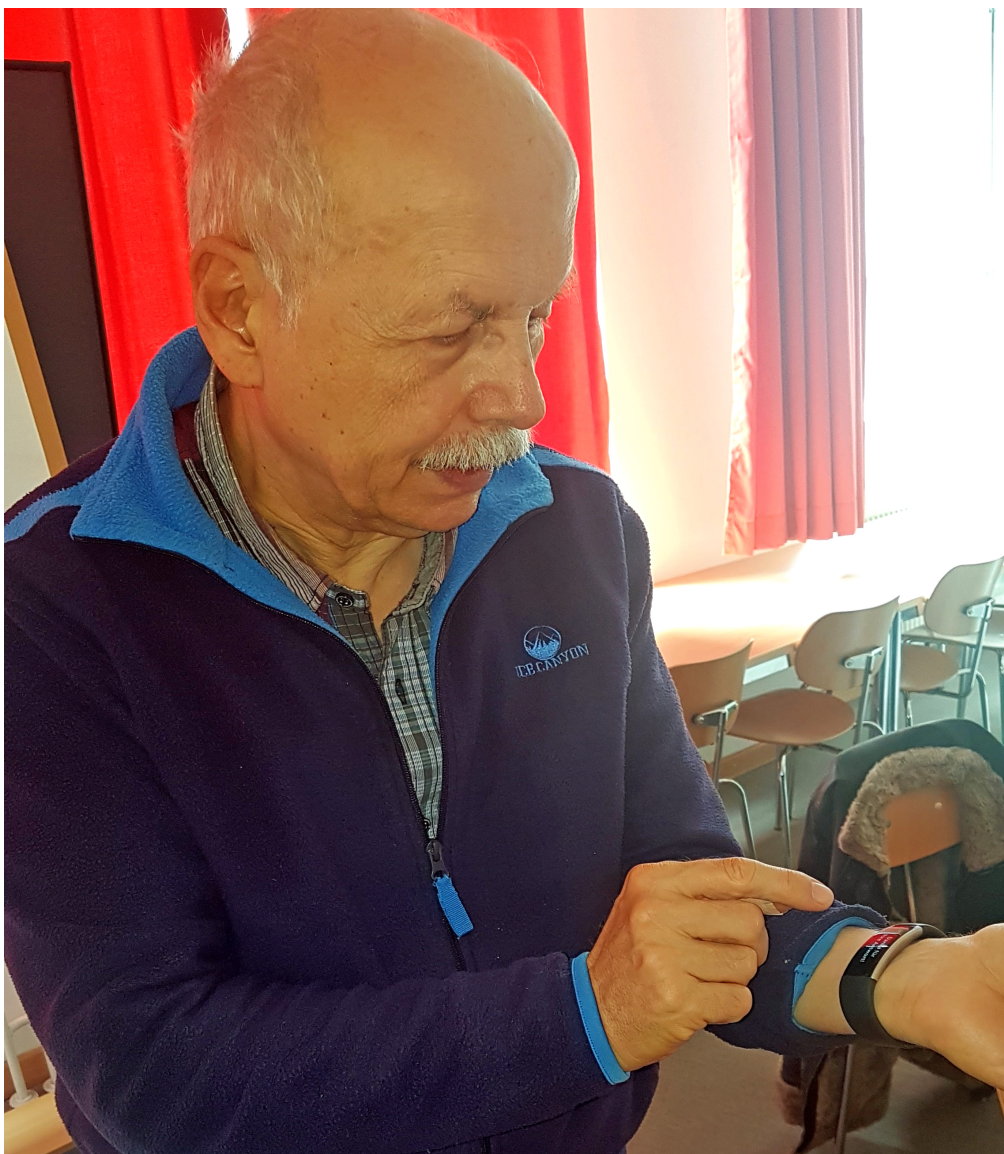
The technical backbone used the SSJ (Social Signal Processing for Java) Framework, allowing real-time synchronization between the wearable and a smartphone for later ML feature extraction.
Key Findings: The "Thursday Peak" and Heart Rate Realities
The study yielded several "Aha!" moments that challenge standard assumptions in affective computing:
1. Habitual Stress Rhythms
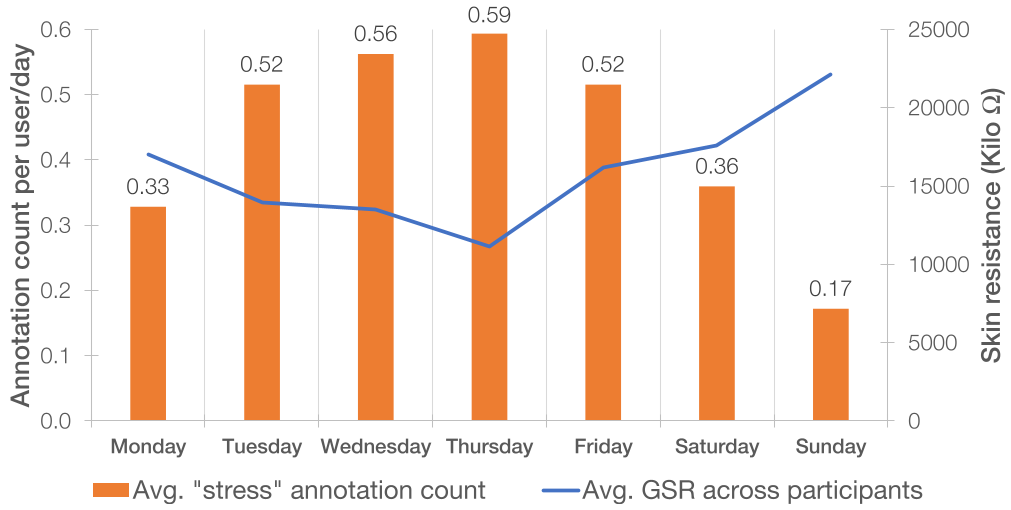
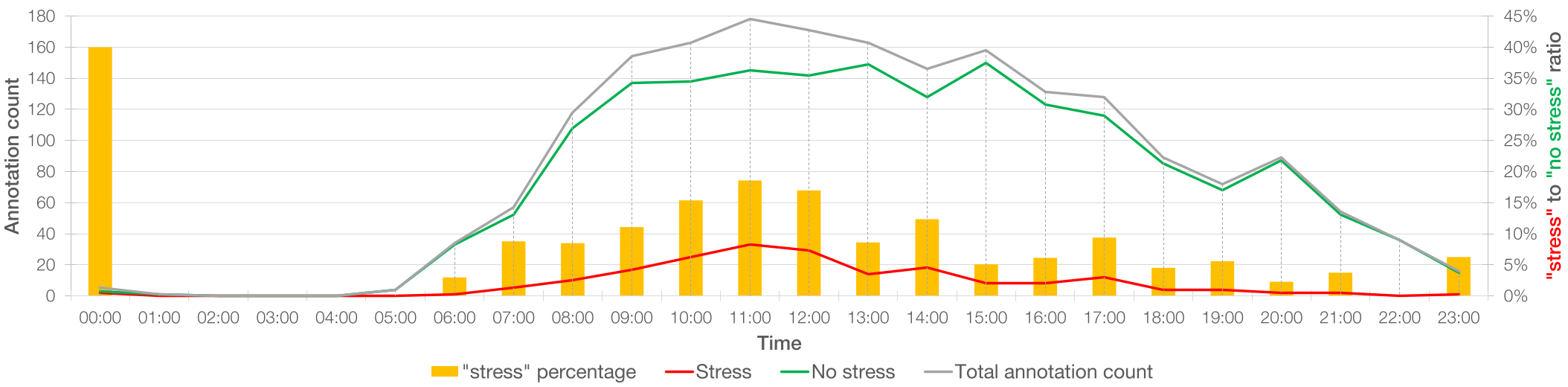
Even though the participants were retired, their stress levels followed a "work-week" pattern. Stress peaked on Thursdays and hit a minimum on Sundays. In terms of daily distribution, stress peaked around 11:00 AM, contrasting with younger adults who typically peak in the late afternoon.
2. Physiology vs. Self-Perception
The study confirmed that heart rate is a viable feature for stress classification in this group. There was a significant difference between stress states (73.7 bpm) and non-stress states (72.2 bpm). Furthermore, GSR (measured as skin resistance) showed a near-perfect inverse correlation with reported stress, validating that seniors have highly accurate self-assessment abilities—a crucial requirement for Active Learning systems.
3. The "Technostress" Irony
In a meta-twist, the technology intended to track stress actually caused it. 58.9% of stressors in the "Technology" category were caused by the wearable's short battery life. For designers, this is a loud warning: Low-maintenance hardware is more important than high-frequency sampling.
Critical Insight: Why Paper Still Beats Digital
Interestingly, participants recorded more stress events in paper diaries (259) than on the watch (195). This suggests that "immediate" ESM (Experience Sampling) can be intrusive during the actual stressful event. Seniors often preferred reflecting retrospectively.
The Takeaway for Developers: Future health AI shouldn't just prompt for "Right Now." It should allow users to look back at their heart rate spikes at the end of the day and say, "Yes, that's when the printer broke," or "That was my doctor's appointment."
Conclusion and Future Directions
This work provides a baseline for Human-Centered AI. It proves that seniors are willing partners in data science, provided the tools respect their routines. The next step in this research lineage is moving from "Data Collection" to "Closed-Loop Intervention"—where the ML model doesn't just detect the 11:00 AM stress peak but offers a personalized coping strategy (Active Solving) in real-time.