
Stress Sensing in HCI: Does Gender Change the Signal or Just the Report?
Stress recognition in human-computer interaction using physiological and self-reported data: a study of gender differences
This paper investigates gender differences in stress recognition during subtle Human-Computer Interaction (HCI) tasks using skin conductance (GSR) and self-reported Valence-Arousal (VA) scales. It achieves high stress detection accuracy—up to 98.9% for females and 94.8% for males—using Linear Discriminant Analysis (LDA) across five common yet stressful computing scenarios.
CL;DR
Building an "affective" computer requires understanding how users experience and communicate stress during mundane interactions—like a slow network or a missing file. This research investigates whether gender affects the objective physiological markers (Skin Conductance) and subjective reports (Self-assessment) during these "subtle" HCI stressors. The verdict: Our bodies react similarly regardless of gender (achieving up to 98.9% detection accuracy via LDA), but our verbal reports of "arousal" vary significantly.
Problem & Motivation: The Subtle Stress Gap
Most emotion recognition research relies on "high-activation" stimuli: horror movie clips, loud noises, or extreme gaming scenarios. However, the frustration felt when a mouse cursor lags or a website's information architecture is confusing is much more subtle.
The authors identify two major gaps:
- Ecological Validity: Previous datasets don't reflect typical office-based stressors.
- The Gender Variable: There is conflicting evidence on whether women and men "feel" differently or just "report" differently. If we are to build tools like PhysiOBS (the authors' evaluation software) to automatically detect user frustration, we need to know if we need separate models for different genders.
Methodology: Simulating Real-World Frustration
The researchers didn't just guess what was stressful; they interviewed 15 users to find the top stressors in daily computing. They selected five scenarios:
- Missing File: Remotely deleting a file the user just downloaded.
- Hardware Failure: Artificially slowing down the mouse cursor.
- Slow Network: Capping speeds at 56kbps.
- Ad Popups: Randomly triggering screen-interrupting ads.
- Information Seeking: Navigating a notoriously poorly designed library website.
The Pipeline
- Data Collection: GSR recorded at 5Hz using a Mindfield eSense sensor.
- Preprocessing: Smoothing via a Hanning window with a dynamic window width based on a root mean square error (RMSE) goal.
- Feature Engineering: 21 features (Mean, Std Dev, Min/Max ratios) extracted from raw signals and their first/second derivatives.
- Classification: Testing seven models, including SVMs, k-NN, and LDA.
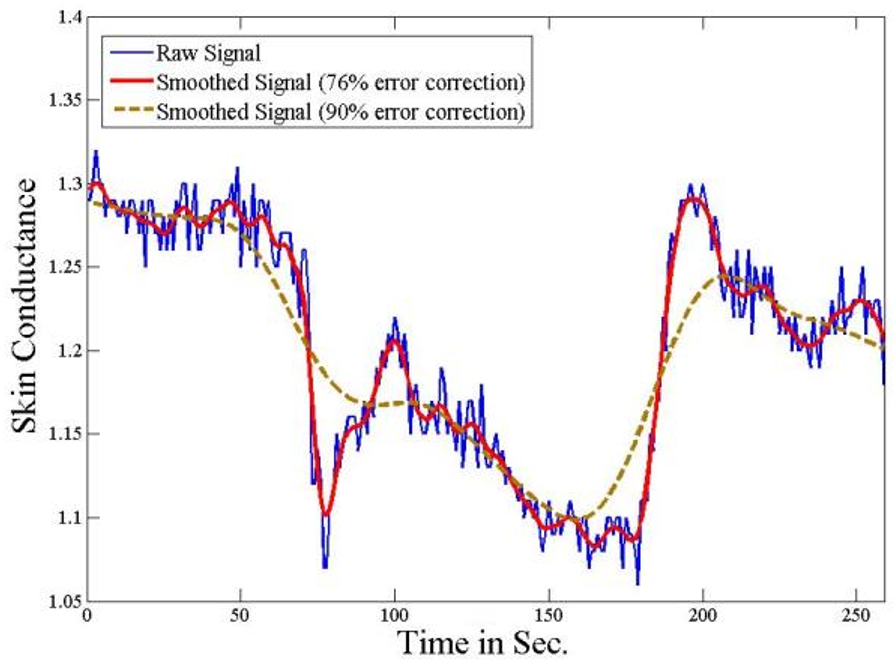 Figure: The effect of the smoothing process on raw skin conductance data to isolate the stress response from noise.
Experiments & Results: LDA Takes the Lead
The results provide a fascinating look at the intersection of physiology and classification.
1. Physiological Consistency
Contrary to some social theories, physiological data was highly consistent across genders. Linear Discriminant Analysis (LDA) outperformed complex models like Cubic-SVM, reaching a staggering 98.85% accuracy for female participants and 94.8% for males. This suggests that the "fight or flight" response triggered by a lagging mouse is biologically similar across the board.
2. The Subjective Divergence
While the sensors said one thing, the users said another. Using MANOVA, the researchers found a significant statistical difference (p < .05) in how genders used the Arousal scale. Females tended to report their emotional intensity (arousal) differently than males, despite having nearly identical physiological profiles during the tasks.
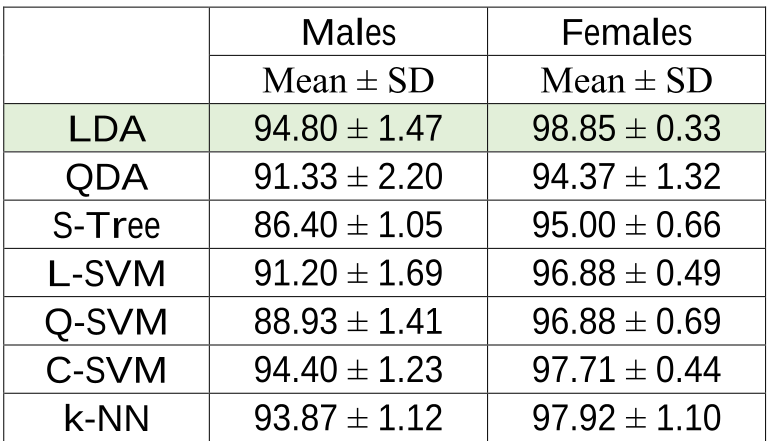 Table: Comparison of ML classifiers. Note the consistently high performance of LDA across both gender groups.
Critical Insight & Conclusion
This paper provides a strong argument for Physiological Computing. If we only relied on what users said (subjective reports), we might conclude that one gender is "more stressed" than the other by a certain task. By looking at the skin conductance, we see that the internal autonomic nervous system response is remarkably stable across genders.
The Takeaway: Machine learning models for stress detection in software don't necessarily need "gender-specific" architectures, but UI designers should be skeptical of subjective questionnaires alone. The next step for this field is integrating these "subtle" stress detectors into real-time adaptive interfaces—software that notices you're frustrated and perhaps offers help or simplifies the layout before you even realize you're stressed.
Limitations
- Sample Size: 31 participants is respectable but small for broad demographic generalizations.
- Signal Depth: Using only GSR is effective for arousal but less so for valence (positive vs. negative emotion). Future work should include Heart Rate Variability (HRV) to gain a 360-degree view of the user's state.