
SSG-MGPM: Balancing Trust and Efficiency in Dynamic Social Graph Matching
7870_Strong Social Graph Based Trust-Oriented Graph Pattern Matching With Multiple Constraints.
This paper introduces a Multi-Constrained Graph Pattern Matching (MC-GPM) framework for social networks, utilizing a novel "Strong Social Graph" (SSG) concept and an incremental indexing algorithm (INC-SSG). The proposed SSG-MGPM algorithm achieves significantly higher efficiency than the state-of-the-art HAMC by avoiding full index rebuilds during dynamic graph updates.
TL;DR
Matching patterns in social networks is hard; doing so while satisfying multiple constraints (trust, role, distance) in a dynamic environment is even harder. This paper introduces SSG-MGPM, a framework that identifies "Strong Social Graphs" (SSGs) and uses a clever incremental indexing strategy to update results in real-time. Compared to previous state-of-the-art methods, it reduces processing time by up to 90%.
Executive Summary
Graph Pattern Matching (GPM) is the engine behind expert finding and community detection. However, real-world social networks are not static—they are "Contextual Social Graphs" (CSG) where users join and leave every second. Previous methods struggled with the computational overhead of updating indices. This work treats graph matching as a Multi-Constrained Simulation (MCS) and provides an incremental solution that targets only the "Strong" parts of the network, ensuring both speed and relevance.
The Core Friction: Trust vs. Scale
Traditional GPM relies on subgraph isomorphism, which is NP-Complete and too rigid. Bounded simulation relaxed this by looking at paths instead of exact edges, but it still ignored the "social flavor"—the trust between users or their specific roles.
The authors identify a critical gap: Prior work assumed graphs were static. In an online environment like Facebook or Twitter, rebuilding an index after every new "Follow" action is catastrophic for performance.
Methodology: Strong Social Graphs and Incremental Maintenance
The innovation lies in two parts: defining what matters (SSG) and updating it efficiently (INC-SSG).
1. The Strong Social Graph (SSG)
Not all nodes are equal. An SSG is a cluster where participants have:
- High Role Impact Factors.
- Intimate social relationships.
- Strong trust levels.
Instead of indexing the billion-node ocean, the authors index these meaningful "islands."
2. Multi-Tier Indexing
The index stores three layers of information:
- Reachability: Can Node A reach Node B?
- Graph Patterns: What is the shortest path length?
- Social Contexts: What is the maximum aggregated trust/impact along the path?
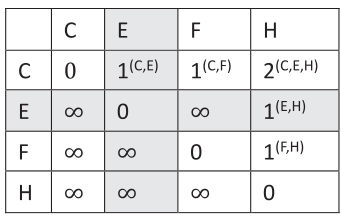 Fig 1: The matrix M records reachability and patterns within an SSG to avoid redundant pathfinding.
3. Incremental Update (INC-SSG)
When an edge is deleted or added, the algorithm doesn't panic. It identifies an Affected Set (AFF). For a single edge deletion, it only updates vertex pairs whose shortest paths were dependent on that edge. This reduces complexity from a full rebuild to a localized update.
Performance Benchmarks
The authors tested their approach against the HAMC algorithm using massive datasets like Twitter (2.4M edges) and LiveJournal.
- Efficiency: In some cases, SSG-MGPM was 10x faster than HAMC.
- Dynamics: When edges were inserted, HAMC’s time spiked because it had to rebuild, while SSG-MGPM stayed relatively stable.
- Scalability: The gap between the methods widened as the graph grew, proving the superiority of the incremental approach.
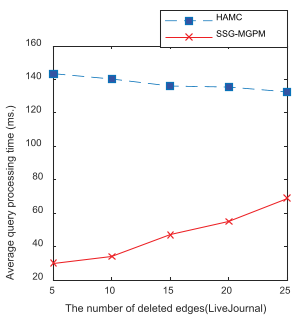 Fig 2: Average query processing time showcasing the efficiency gap between HAMC and SSG-MGPM.
Critical Insight & Future Outlook
The brilliance of this work is the Objective Function (). It aggregates path length, trust, and role impact into a single value. By using a bidirectional search and a heuristic guided by this , the algorithm can "prune" low-quality paths early.
Limitations: The "K-Seed" selection for SSGs is currently random. A more strategic seed selection (based on centrality) might further improve the coverage of the Strong Social Graphs.
Conclusion
SSG-MGPM moves graph matching from a static academic problem to a dynamic, real-world utility. By combining social science intuition (the stability of strong ties) with advanced data structures, the authors have provided a viable roadmap for real-time social search.