
Strong Teacher Not Needed? Re-aligning the Intuition of LLM Distillation
Strong Teacher Not Needed? On Distillation in LLM Pretraining
This paper systematically re-evaluates knowledge distillation (KD) in LLM pretraining, demonstrating that effective distillation depends on teacher-student compatibility rather than absolute teacher strength. Using Llama3 architectures, the authors achieve SOTA-level improvements in generalization, showing that small or same-level teachers can significantly enhance larger students.
TL;DR
The academic community has long equated "Knowledge Distillation" with "Model Compression," assuming a strict hierarchy where only a genius teacher can educate a novice student. This paper from Princeton University shatters that assumption. Findings show that weak teachers can improve strong students, same-level models can coach each other, and surprisingly, an overly powerful teacher can actually "overwhelm" and degrade a student.
Problem & Motivation: The "Strong-to-Weak" Fallacy
In the race to scale LLMs, we often assume that to train a 1.7B model better, we must distill from a 70B or 400B giant. However, this creates two major issues:
- Inaccessibility: Not everyone has the compute to run inference on a 400B model during the pretraining of a smaller one.
- Architectural Mismatch: A teacher that is too complex might have a probability distribution that the smaller student simply lacks the capacity to "mimic," leading to poor optimization.
The authors ask: Can a smaller, less-trained model still provide a useful signal?
Methodology: The Spectrum of Compatibility
The researchers tested 24 different teacher models (varying size from 0.7B to 8.0B and training from 10B to 300B tokens) to distill a single 1.7B student. They used a mixed objective:
Where acts as the "trust" parameter for the teacher.
The Core Insight: Hard Tokens vs. Label Smoothing
A breakthrough in this paper’s analysis is the dismissal of the "Regularization Hypothesis." Critics often argue KD is just fancy label smoothing. By binning tokens by entropy (difficulty), the authors found that KD's benefits are monotonically concentrated on hard tokens.
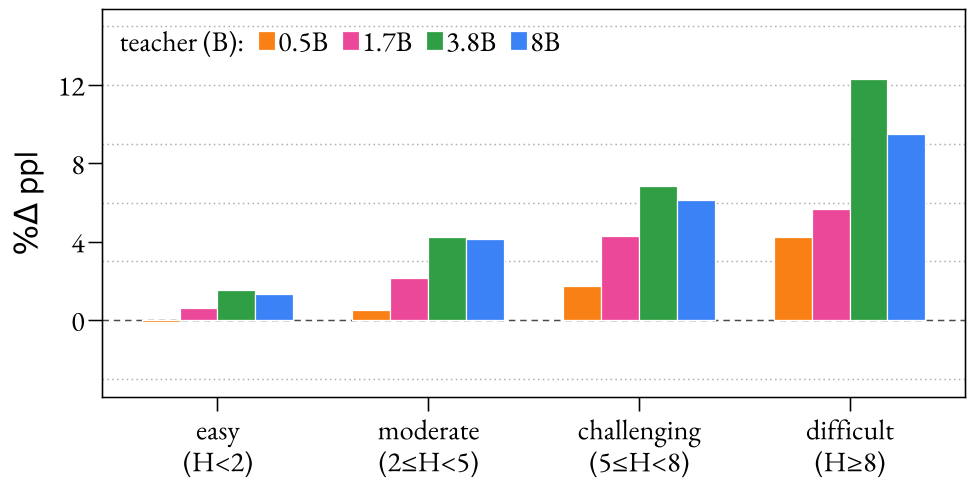 Figure: Distillation specifically helps where the student is most uncertain, providing "novel information" that standard cross-entropy misses.
Key Results: More is Not Always Better
The most striking evidence against the "stronger is better" rule appears in the comparison of teacher training duration.
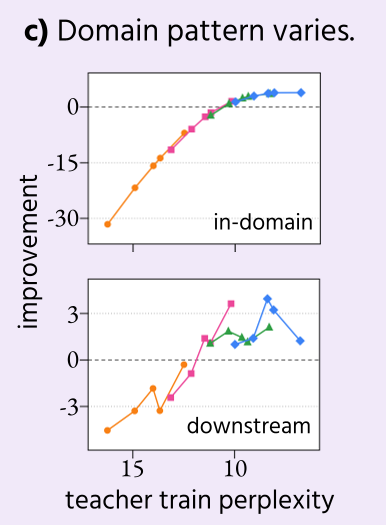 Table: An 8.0B teacher trained on 300B tokens actually produced a WEAKER student (+2.8% acc) than an 8.0B teacher trained on only 30B tokens (+4.3% acc).
Why does "Strong-to-Strong" fail?
When a teacher becomes "too strong" (e.g., via overtraining), its output distribution becomes highly peaked (delta-function-like). This removes the "dark knowledge" (the relative probabilities of the second and third most likely tokens) that distillation relies on.
The "Same-Level" Miracle
Even when the teacher and student are identical (1.7B each), distillation provides a +1.5% accuracy boost. This suggests that different random seeds explore different parts of the data manifold, and KD allows one model to "inherit" the successful pathways found by its twin.
Distillation vs. Label Smoothing
The paper provides a definitive "crossing profile" between KD and Label Smoothing. While smoothing helps on "easy" tokens by preventing overconfidence, KD does the heavy lifting on "hard" tokens.
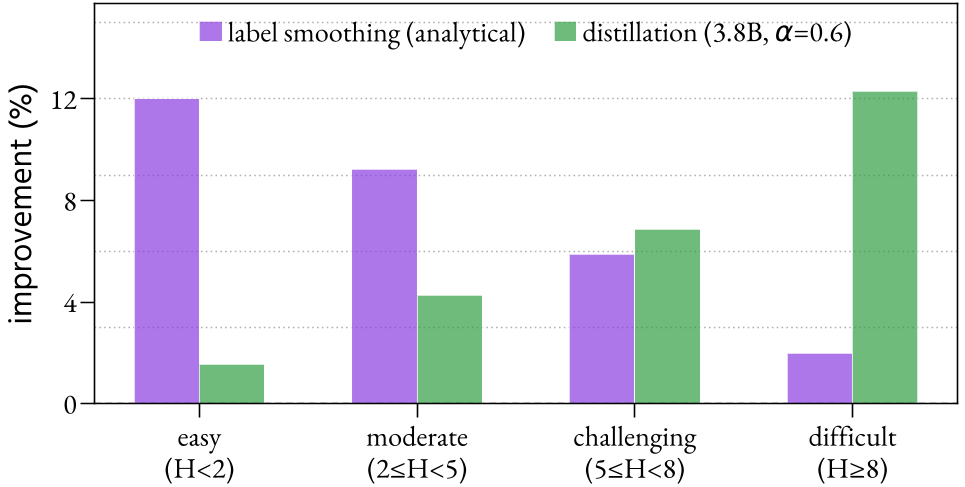 Figure: The inverse relationship proves KD is a unique mechanism of knowledge transfer, not just a regularizer.
Critical Analysis & Future Outlook
Takeaways:
- tuning is mandatory: Weaker teachers need a "distrustful" (0.2), while strong, compatible teachers can be trusted with higher (0.8).
- OOD Generalization: Distillation helps more with "Out-of-Distribution" tasks than it does with "In-Domain" fitting. It makes models more robust, not just better memorizers.
Limitations: The study primarily focuses on logit-level distillation. It remains to be seen if these "weak-to-strong" benefits hold as strongly for synthetic data distillation (like the R1 or Llama 3 pipelines), where the student trains on the teacher's text rather than its probabilities.
Conclusion: The "Strong Teacher" is a myth. In the future of AI scaling, we may see a "circular ecosystem" of models where small, specialized models distill specific "hard" logic back into the frontier giants, changing distillation from a top-down hierarchy to a collaborative network.