
This paper investigates Strong-to-Weak Spontaneous Symmetry Breaking (SWSSB) in a (2 + 1)D Transverse-Field Ising Model (TFIM) under Z2-symmetric decoherence. Using a newly developed Quantum Monte Carlo (QMC) framework to evaluate nonlinear Rényi-2 correlators, the authors map a rich mixed-state phase diagram achieving quantitative agreement with an effective 2D Ashkin-Teller field theory.
TL;DR
Decoherence is usually seen as the enemy of quantum order, but this paper reveals it as a "phase architect." By developing a sign-problem-free Quantum Monte Carlo (QMC) framework, the authors uncovered a hidden landscape of mixed-state phases in the (2+1)D Transverse-Field Ising Model (TFIM). They demonstrated that strong Z2 symmetry can be partially broken while maintaining weak symmetry—a phenomenon known as Strong-to-Weak Spontaneous Symmetry Breaking (SWSSB)—governed by the elegant mathematics of the 2D Ashkin-Teller model.
The "Why": Beyond the Pure-State Paradigm
In the classical world, symmetry breaking is simple. In the quantum world, it gets complicated when systems leak information to the environment (decoherence). Current research distinguishes between strong symmetry (fixed charge) and weak symmetry (mixed charges).
The mystery lies in the "middle ground": Can a system lose its strong symmetry but keep its weak symmetry? This is SWSSB. Until now, we lacked the numerical tools to see this clearly in 2D systems because the necessary "probes" (nonlinear Rényi-2 correlators) were too complex for standard simulations.
Methodology: A "Figure-Eight" Solution
The technical breakthrough is a new QMC algorithm. Standard QMC struggles with the "sign problem" when dealing with decoherence operators like $Z_i Z_j$.
The authors bypassed this by:
- Choi-Jamiołkowski Isomorphism: Mapping the mixed density matrix $\rho$ onto a pure state $|\rho\rangle\rangle$ in a doubled Hilbert space ($a$ and $b$ replicas).
- Topological Sampling: They represented the decoherence channel as a figure-eight temporal loop. By jumping between different "sectors" (sampling $ ext{Tr}(\rho)$ or $ ext{Tr}(\sigma_1\sigma_2)$), they could measure nonlinear observables as easily as diagonal ones.
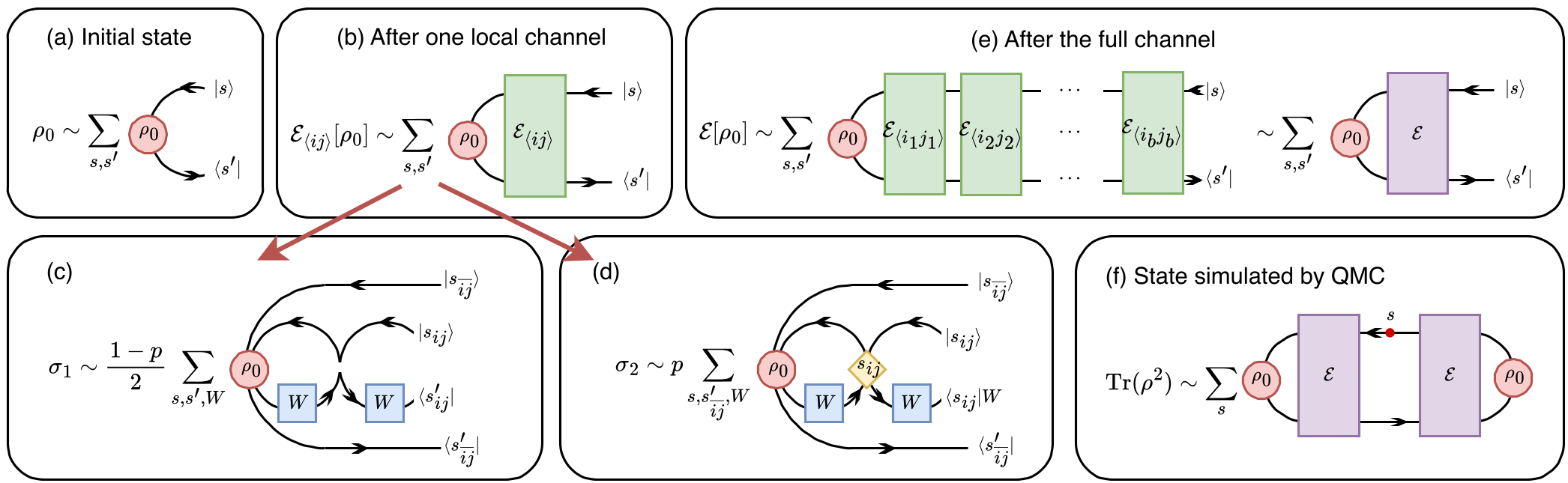 Caption: The graphical representation of the QMC evolution, showing the complex boundary conditions required to sample the Rényi-2 correlator.
The Mixed-State Phase Diagram
The researchers mapped the interaction $J$ against decoherence strength $p$. They found that the system doesn't just "melt" into a vacuum; it passes through a Baxter phase (R2-SWSSB).
- The Field Theory Connection: They integrated out the bulk fields to show that the decoherence defect acts exactly like a 2D Ashkin-Teller model. This allowed them to predict that the phase boundaries would behave like 2D Ising transitions.
 Caption: The mapped phase diagram showing the convergence of R2-SWSSB and R2-SSB phases at a 4-state Potts tricritical point.
Quantitative Triumphs
The QMC results were remarkably precise:
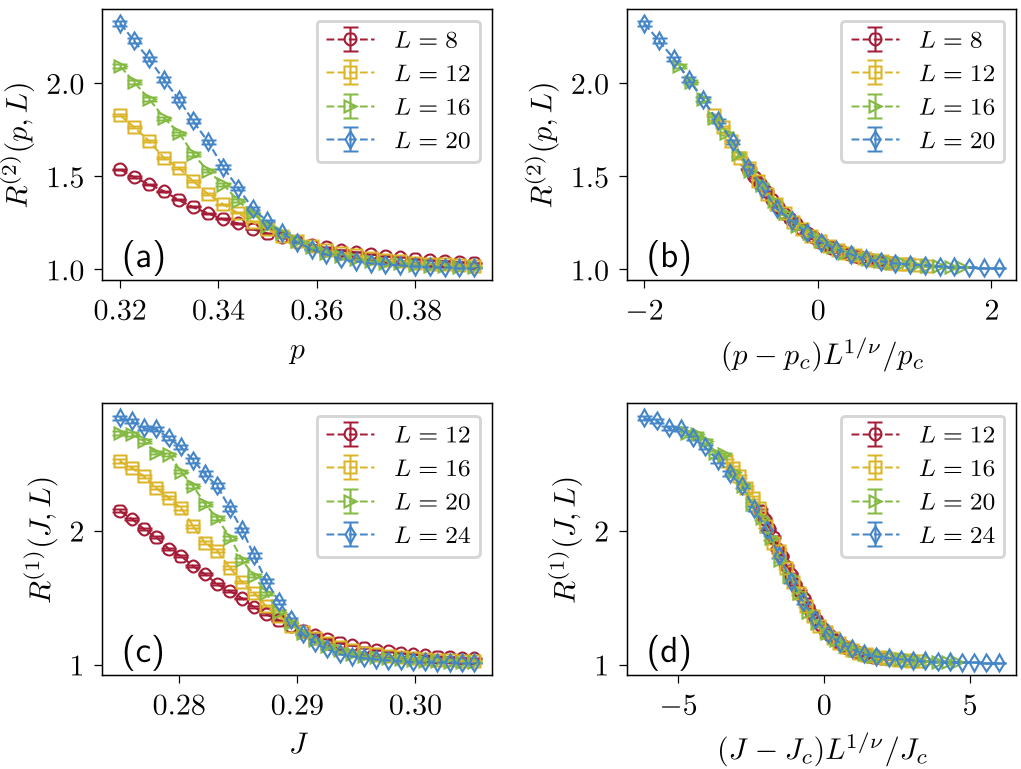
- Critical Exponents: For the transition at $J=0.1$, they found $ u \approx 0.998$, nearly a perfect match for the 2D Ising value ($ u=1$).
- Tricritical Point: They identified the point where the three phases meet, confirming it follows the 2D 4-state Potts CFT with $ u \approx 2/3$.
- Efficiency: The algorithm's complexity remains polynomial, proving that we can now simulate large-scale mixed-state transitions (up to $32 imes 32$ lattices) that were previously "off-limits."
Critical Insight: The Value of "Nonlinear Probes"
The paper highlights a crucial lesson: linear order parameters ($C^{(0)}$) are "blind" to SWSSB. You must use nonlinear probes like $C^{(1)}$ and $C^{(2)}$ to see the symmetry breaking in the Choi doubled space. This "hidden order" is what defines modern mixed-state physics.
Conclusion & Future Outlook
This work is a milestone. It doesn't just solve one model; it provides the blueprint for using QMC to study topological order, frustration, and continuous symmetries under decoherence. For the future of quantum computing (NISQ era), understanding how these phases stabilize or fail under noise is not just academic—it's essential for building robust quantum memories.