
Structural and Cognitive Bottlenecks: Why More Friends Don't Mean More News
Structural and cognitive bottlenecks to information access in social networks
This paper investigates information access on the social news aggregator Digg, analyzing how network structure and user activity drive the flow of novel information. It validates the "diversity-bandwidth trade-off" in an online context, revealing that structural diversity and friend activity are distinct levers for accessing topical variety versus high volumes of novel stories.
TL;DR
In the digital age, we assume that a broader social network equals better information. This research proves otherwise. Using data from Digg, the authors demonstrate a "diversity-bandwidth trade-off": while diverse networks provide different kinds of news, they often deliver less of it. Furthermore, human cognitive limits create a saturation point at approximately 200 friends, beyond which our ability to process and "seed" new information actually begins to decline.
Problem & Motivation: The Myth of the Infinite Feed
Social science has long championed the "strength of weak ties"—the idea that acquaintances from different social circles provide us with the most novel information (like job leads). However, online social networks differ from traditional ones in two ways: links are often asymmetric (you follow them, they don't follow you) and the volume of information is overwhelming.
The authors set out to answer: Does the "brokerage" position (linking different communities) actually work on social media, or does the sheer noise of the digital stream break the traditional model?
Methodology: Decoupling Novelty from Diversity
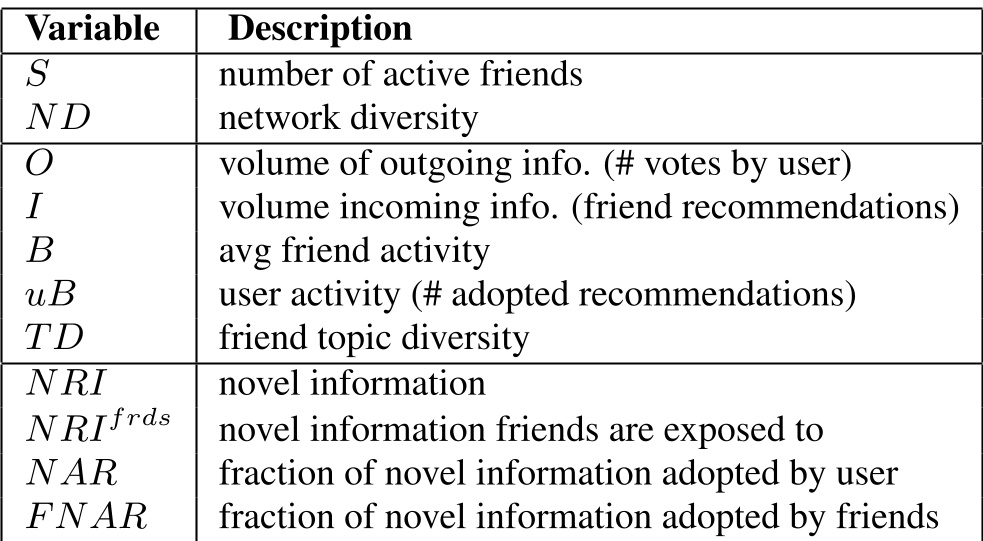
The researchers analyzed two Digg datasets containing millions of votes. To get a precise view of information flow, they defined two critical but distinct metrics:
- Topic Diversity (TD): How different the subject matters (Tech, Sports, Politics) are in your feed.
- Novel Information (NRI): The raw number of unique, non-redundant stories you are exposed to.
They also measured Channel Bandwidth (B)—not just having a friend, but how many stories that friend actually "recommends" via their voting activity.
The Core Finding: The Diversity-Bandwidth Trade-Off
The paper confirms a sobering reality: You can't have it all.
- The Structure Advantage: If you place yourself in a "structurally diverse" position (connecting to people who aren't friends with each other), you get Topic Diversity. You see a wider range of subjects.
- The Activity Advantage: If you want a high volume of Novel Information, you shouldn't look for diversity; you should look for "active" friends (high bandwidth).
The conflict arises because users in diverse positions tend to have lower bandwidth ties. Their friends have such different interests that they don't vote on the same things, leading to a "bottleneck" where the potential information exists in the network, but it never reaches the user.
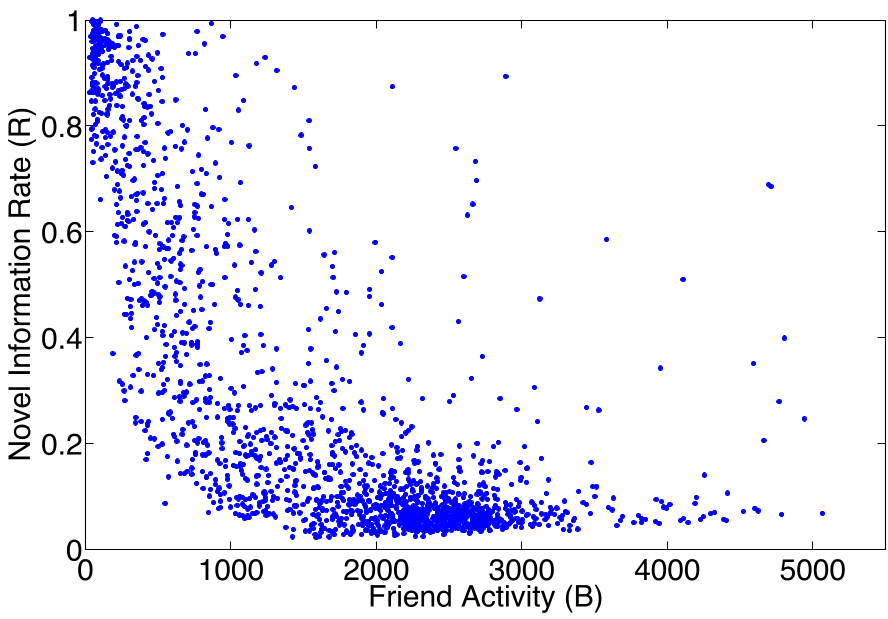 The plot above shows the negative correlation between network diversity and average friend activity, illustrating the "Diversity-Bandwidth Trade-off."
Experimental Results: The Saturation Point
One of the most striking findings is the "diminishing returns" of social links.
- Saturation: As a user adds more friends, the volume of novel information increases until about 100 friends, then plateaus. Doubling your friend count from 500 to 1000 barely increases the unique stories you see.
- Cognitive Decline: There is a "sweet spot" for user activity. Once a user has more than 200 active friends, their own activity (the number of stories they vote for and pass on) actually starts to decrease. The "Information Overload" becomes so great that the user stops processing the feed effectively.
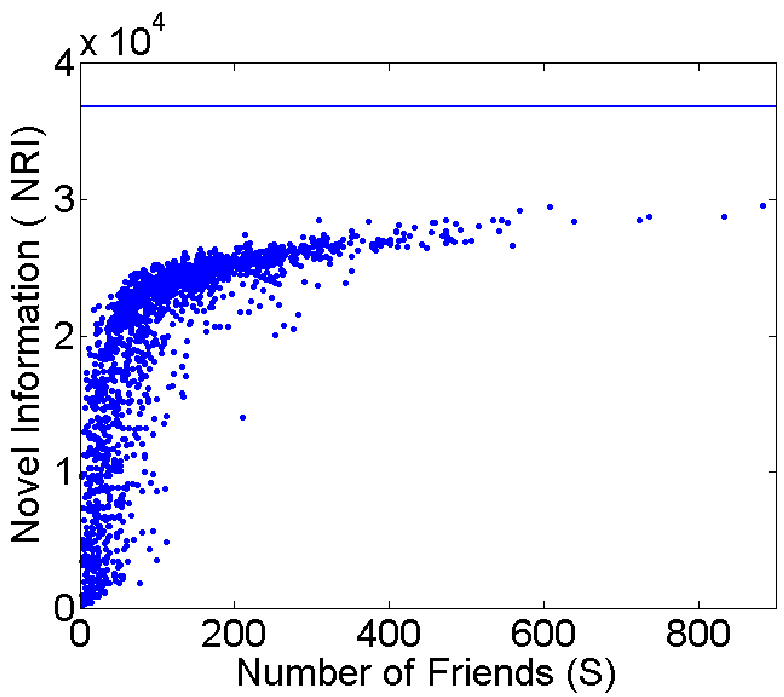 Figure: The amount of novel information saturates quickly as more friends are added, never reaching 100% of available network data.
Critical Insight: The "Information Bottleneck"
The paper concludes that we are limited by both Physics (Structure) and Psychology (Cognition):
- Structural Bottleneck: Diverse friends don't "adopt" each other's news because their interests are too fragmented. Even if the information is "out there," your friends act as a filter that blocks it.
- Cognitive Bottleneck: Our attention is a finite resource. In high-bandwidth networks, redundancy increases, and our brain's capacity to filter the "noise" led to the observed drop-off in engagement after 200 friends—a digital echo of "Dunbar's Number."
Conclusion & Future Outlook
This work challenges the "more is better" philosophy of social media growth. For researchers and product designers, it suggests that merely suggesting "diverse" content isn't enough; we must account for the user's cognitive bandwidth.
Takeaway for users: If you want variety, seek diverse friends. If you want the "latest" in a specific field, seek high-activity clusters. But remember: your brain will likely tap out after the 200th active connection.