
Beyond Vertex Anonymity: Defeating Community Identification in Social Networks
Structural Diversity for Resisting Community Identification in Published Social Networks
The paper introduces k-Structural Diversity, a novel privacy framework for social networks designed to prevent "community identification" attacks. It proposes the k-Structural Diversity Anonymization (k-SDA) model and four scalable heuristic algorithms—EdgeConnect, CreateBySplit, MergeBySplit, and FlexSplit—to ensure that every vertex's degree is shared by vertices across at least k different communities.
TL;DR
While removing names and SSNs from social networks is common practice, this paper reveals a significant vulnerability: Community Identification. Even if an attacker cannot identify who you are, they can often infer which sensitive group you belong to. The authors introduce k-Structural Diversity, an anonymity constraint that forces the structural signatures of users to be spread across different communities, and provide scalable algorithms to enforce it.
The "Community Leak": Why k-Anonymity is Not Enough
Most graph anonymization research focuses on preventing an attacker from linking a real-world person to a specific node (Vertex Identification). For example, "k-degree anonymity" ensures at least nodes share the same degree.
However, the authors point out a fatal flaw: if all nodes with degree 5 happen to be in the "AIDS Support Group" community, an attacker knowing a victim has 5 friends can immediately conclude the victim is in that group. The degree becomes a fingerprint for the community, leaking sensitive membership information.
Methodology: The k-SDA Framework
The goal of k-Structural Diversity Anonymization (k-SDA) is to ensure that for every vertex , there are nodes with the same degree in at least separate communities.
The Two Primary Operations:
- Adding Edge: Connecting two vertices within the same community. This preserves semantic integrity (e.g., adding a friend within a political circle is more realistic than connecting opposing sides).
- Splitting Vertex: A more aggressive operation where a vertex is split into "substitute vertices" (clones). This allows the algorithm to handle cases where adding edges isn't enough to reach the required diversity.
Algorithm Evolution:
- EdgeConnect (EC): Focuses solely on adding edges. High utility but lower success rate for high .
- FlexSplit (FS): The "gold standard" heuristic proposed. It uses a look-ahead mechanism to decide when to split nodes, balancing the preservation of the original graph's degree distribution with the absolute guarantee of privacy.
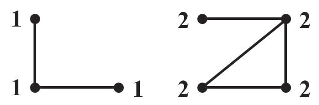 Figure 1: Illustration of the limits of edge addition and the necessity of vertex splitting.
Experimental Validation
The paper rigorously tests these methods against real-world datasets like DBLP and ca-CondMat.
Key Insights from Results:
- Privacy Gap: In the original DBLP dataset, over 8% of nodes violate even basic structural diversity (), proving this is an active threat.
- Utility Preservation: The FlexSplit algorithm manages to keep the Clustering Coefficient (CC) and Average Shortest Path Length (ASPL) remarkably close to the original "clean" graph, significantly outperforming blind k-degree anonymity.
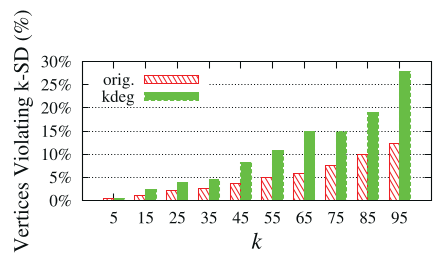 Figure 2: Utility metrics (CC, ASPL, BC) on the DBLP dataset showing that local edge addition preserves community structure better than standard k-anonymity.
Critical Analysis & Conclusion
This work shifts the focus from "Who is this node?" to "What does this node belong to?". By introducing k-Structural Diversity, the authors address the reality that social networks are not flat—they are composed of clusters that carry their own sensitive contexts.
Takeaways:
- Scalability: The heuristics reach complexity, making them practical for networks with hundreds of thousands of nodes.
- The Power of Splitting: While splitting nodes sounds destructive, the authors' strategy of connecting substitutes allows them to preserve connectivity queries, which is vital for research utility.
Future Outlook: As we move toward Graph Neural Networks (GNNs), this type of structural diversity will likely become a prerequisite for training on private graph data to prevent models from learning "community fingerprints."