
Beyond the Bottom Line: Technical and Social Pillars of PPP Success
A Structural Equation Model of Feasibility Evaluation and Project Success for Public–Private Partnerships in Hong Kong
This paper establishes a comprehensive evaluation framework for the initial feasibility of Public-Private Partnership (PPP) projects in Hong Kong. Utilizing Structural Equation Modeling (SEM), the authors identify that technical and social aspects—rather than just financial metrics—are the primary determinants of stakeholder satisfaction and overall project success.
TL;DR
A successful Public-Private Partnership (PPP) is often reduced to a simple financial equation: Does it make money? However, research from the University of Hong Kong suggests otherwise. By employing Structural Equation Modeling (SEM), this study proves that Technical Innovation and Social Acceptance are the true drivers of project success, outweighing traditional financial metrics in terms of multi-stakeholder satisfaction.
The "Financial Myopia" in Infrastructure
Historically, the decision to greenlight a PPP project has been dominated by the Public Sector Comparator (PSC). While effective at measuring "Value-for-Money" in terms of dollars, the PSC is blind to the qualitative friction that often sinks massive projects: public protests over tolls, lack of political support, or the inability of a consortium to provide innovative technical solutions.
The authors argue that feasibility is not a one-dimensional financial gate but a five-dimensional balancing act involving technical, financial, social, political, and staff-related factors.
Methodology: Mapping Complexity with SEM
The researchers didn't just list factors; they mapped the causal relationships between them. Using a survey of 181 experts across the government, private sector, and community, they built an SEM to see how different feasibility categories influence the ultimate goal: Stakeholder Satisfaction.
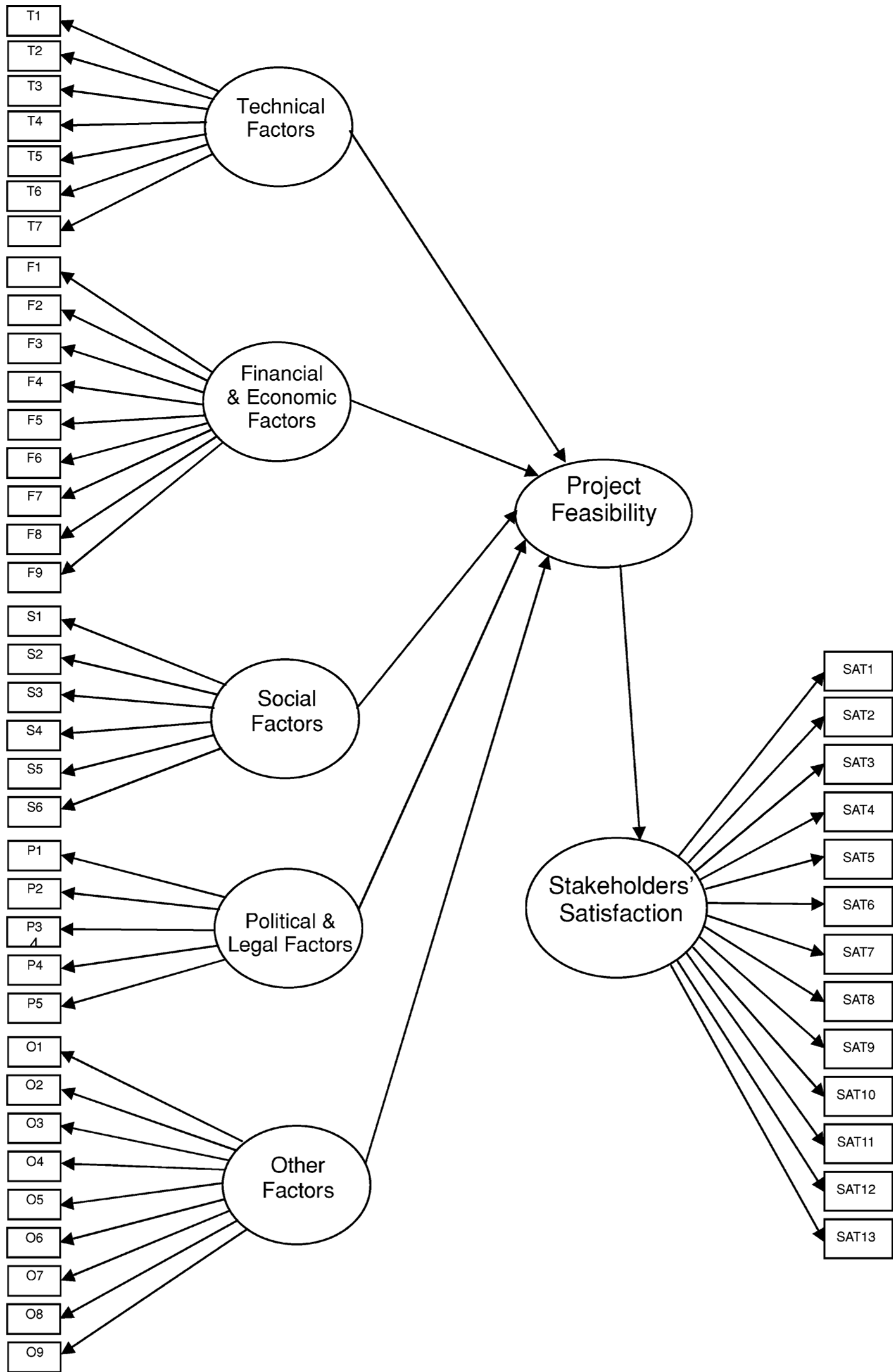
The model was refined through confirmatory factor analysis, stripping away low-correlation variables to find the "Critical Success Factors" (CSFs) that truly move the needle.
Core Findings: The Technical and Social Dominance
The most striking discovery of the study was the hierarchy of influence. Among the latent constructs:
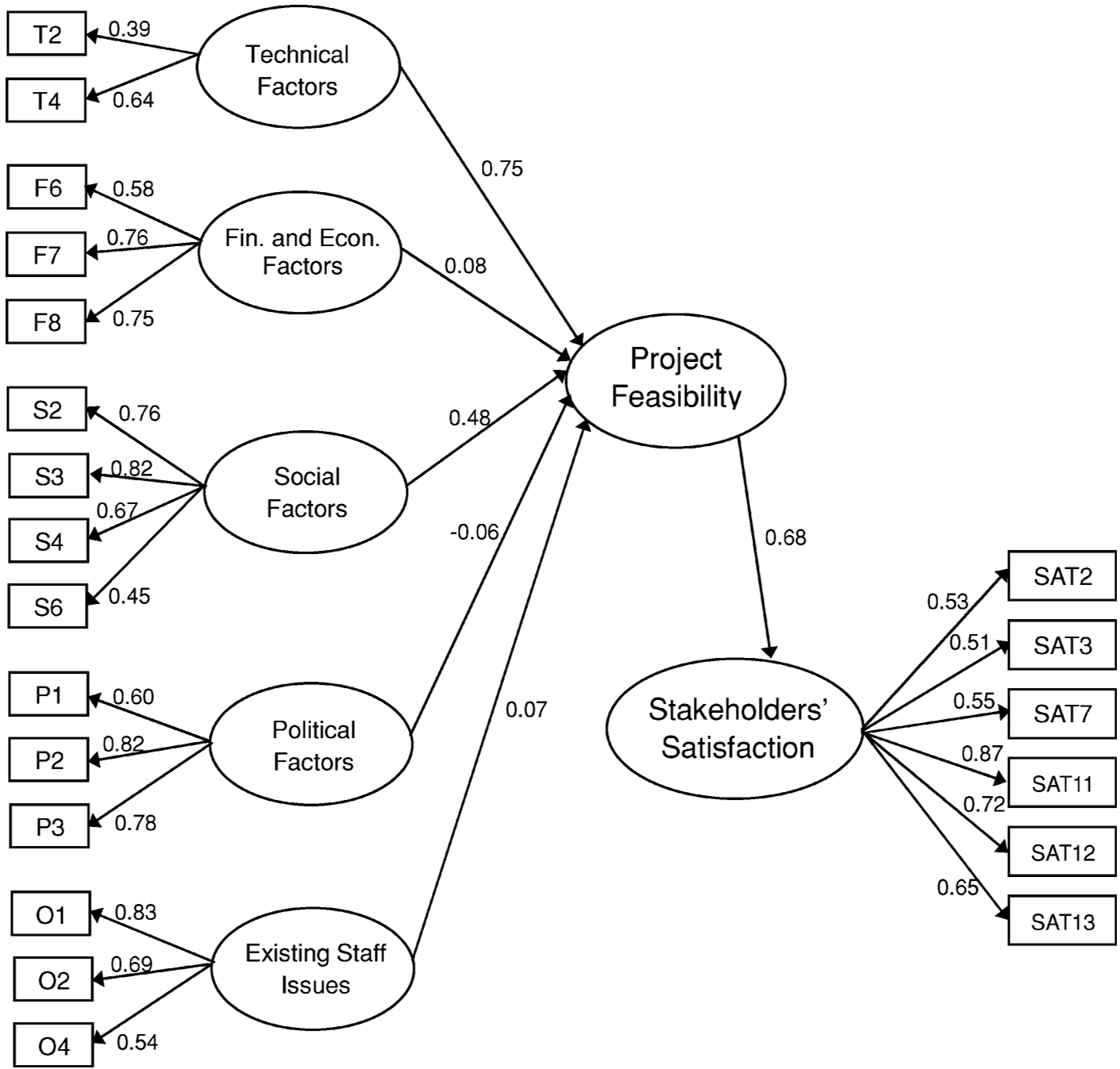
- Technical Feasibility (Standardized Coeff: 0.75): The private sector’s ability to offer innovative solutions and the presence of a reliable consortium are the strongest predictors of success.
- Social Feasibility (Standardized Coeff: 0.48): Community support and "reasonableness of tolls" (the highest-rated individual factor at 5.78/7.0) are critical.
- The Satisfaction Link: The model established a 0.68 correlation between robust initial feasibility and final stakeholder satisfaction.
The final framework illustrates these paths clearly:
Deep Insight: Why Financial Success Isn't Enough
The paper challenges the industry standard. While a project must be "bankable," the authors emphasize that social aspects like environmental sustainability and fairness of tariffs are the "make-or-break" variables. In a modern political climate, a financially profitable project that lacks social legitimacy will likely be aborted or face crippling delays.
Furthermore, the ripple effect identified in the intercorrelation matrix (Table VIII) shows that political stability and financial interest are deeply intertwined (0.613 correlation). You cannot have one without the other.
Critical Analysis & Future Outlook
Takeaway: Engineering managers must expand their roles from technical leads to "integrative business roles," balancing technical excellence with social advocacy.
Limitations: The study is geographically focused on Hong Kong. The "Political" stability found in the 2026 survey context may differ significantly in other jurisdictions with different legal maturities.
Future Work: As infrastructure shifts toward "Green PPPs," future research should investigate how "Environmental Sustainability" (Factor S6 in this paper) can be converted into a primary latent construct rather than a sub-factor of social feasibility.
Conclusion
The Hong Kong model serves as a vital checklist for decision-makers. It demands that we move beyond the spreadsheet and consider the technical soul and social heart of a project. Only when the community, the government, and the private sector find common ground can a PPP truly be called a "partnership."