
Software as a Social Network: Uncovering the Hidden Logic of Structural Evolution
Structural evolution of software: a social network perspective
2014-05-20
Summary
Problem
Method
Results
Takeaways
Abstract
This paper investigates the structural evolution of Object-Oriented (OO) software using Social Network Analysis (SNA) on class collaboration networks. It identifies that software grows into scale-free (SF) topologies through an inherent hierarchical optimization process, rather than by random chance.
## TL;DR
Why does software structure become harder to manage over time? This paper argues that software evolution isn't just about adding lines of code; it's a process of **structural optimization**. By viewing classes as "social actors" in a network, the authors reveal that software naturally evolves from random clusters into a **scale-free hierarchy**, driven by complex relationships that traditional metrics completely miss.
## The Failure of Traditional Metrics
For decades, we have relied on Object-Oriented (OO) metrics to judge code quality. However, these metrics focus on the "atom" (the class) rather than the "molecule" (the collaboration). The authors point out a critical flaw: traditional metrics are often skewed by the size of the software and ignore how complex relations span across the entire system.
The central motivation here is to treat software as a **Complex Network**. Just like biological proteins or human social circles, software components form signatures that dictate how the system grows and where it breaks.
## Methodology: The Social Network Lens
The researchers analyzed 8 major open-source projects (like Ant, Azureus, and Cassandra) over three stages of their life cycle:
1. **PR1**: Early childhood (<1 year).
2. **PR2**: Adolescence (1-3 years).
3. **PR3**: Maturity (>3 years).
They looked at the **Class Collaboration Network (CCN)** where nodes are classes and edges are relationships. They used three sophisticated SNA tools:
* **Triad Motifs**: Small patterns of 3-node connections that act as the "building blocks" of a network.
* **Brokerage Roles**: Identifying classes that act as "gatekeepers" or "liaisons" between different functional modules.
* **Social Capital**: Measuring a class's influence (Proximity Prestige) and its freedom/redundancy (Constraint).

*Fig 1: The study framework observing software from inception to maturity.*
## Key Insights: How Software "Optimizes" Itself
The research found that software is not a random mess; it exhibits **Scale-Free (SF) properties**. In an SF network, a few "hub" classes have many connections, while most have few.
### 1. From Simple to Complex Motifs
The researchers found that simple relations exist early on, but as software matures, "complex motifs" (hierarchical triangles) increase. Interestingly, the ratio between simple and complex relations stays relatively stable, meaning the software is constantly converting basic connections into structured hierarchies.
### 2. The Rise of the Liaison
During the middle stage (PR2), there is a significant spike in **Liaison roles**. This implies that as software grows, it's not just getting bigger; it's forming more complex bridges between different concepts or functional "neighborhoods."
### 3. Emergence of Influential Nodes
By the third stage (PR3), certain classes achieve very high **Proximity Prestige**. These are the "VIPs" of your codebase. They are the core concepts that everything else depends on.
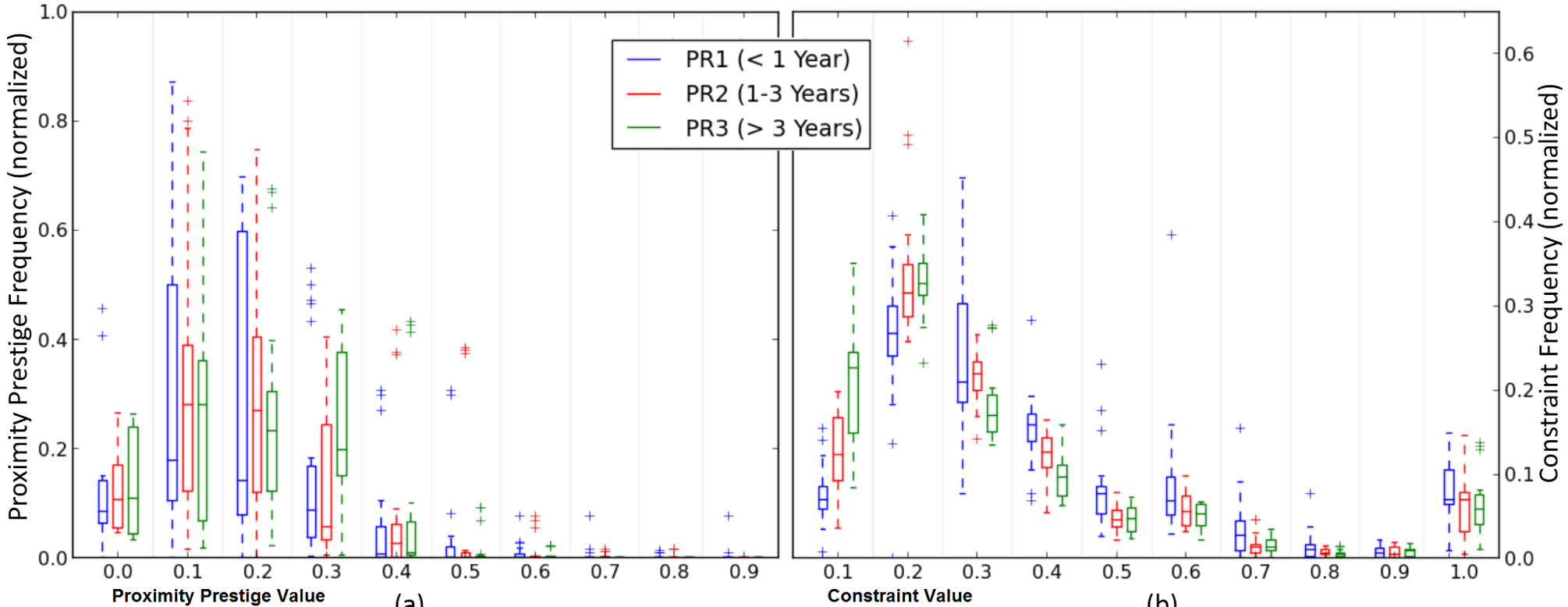
*Fig 2: Statistical significance of influence (Prestige) and freedom (Constraint) over time.*
## Critical Analysis & Conclusion
**The Takeaway**: Software structural evolution is a path toward **optimal hierarchy**. If a developer understands the "social standing" of a class, they can better predict which changes will cause a ripple effect across the system.
**Limitations**: The study relies on 3-node motifs. In modern massive microservices or distributed systems, "motifs" might consist of dozens of nodes, requiring more computationally expensive analysis. Furthermore, the 3-year "maturity" benchmark may vary wildly in the modern era of Rapid Application Development (RAD).
**Future Outlook**: This work opens the door for "Social-Aware Refactoring"—tools that don't just tell you a class is too long, but tell you that a class has become a "systemic bottleneck" based on its social capital in the network.