
The Innovation Bridge: How Structural Holes Drive Public Health Creativity
Structural Hole and Personal Innovativeness in a Bureau of Health
This study investigates the nexus between Social Network Analysis (SNA) metrics—specifically structural holes—and personal innovativeness within a public health bureaucracy. Using UCINET6 to analyze employee networks, the research demonstrates that "Efficiency" in a social network significantly predicts an individual's self-perceived innovativeness.
TL;DR
Is innovation a personality trait, or a function of who you talk to? This study explores the "Structural Hole" theory within a Bureau of Health, revealing that Network Efficiency—the ability to maintain non-redundant professional relationships—is a primary driver of person-level innovativeness. In short: if your professional circle is a closed loop, your ideas likely are too.
Background: Beyond the Organizational Chart
In public health, innovation isn't just about new technology; it’s about managing emerging crises and diffusing health strategies. While we often blame "bureaucracy" for stagnation, this paper argues the real culprit is network redundancy. When you only talk to people who talk to each other, you are trapped in a "constrained" network where everyone possesses the same information.
The Core Insight: Structural Holes
The "Structural Hole" is the invisible gap between two dense clusters of people. An individual who "bridges" this gap gains a competitive advantage.
- Efficiency: The ratio of non-redundant contacts to total contacts.
- Constraint: The degree to which your network is localized and redundant.
The authors argue that individuals with high efficiency save "social energy" by not maintaining redundant ties, allowing them to scout for diverse information across groups—the literal raw material of innovation.
Methodology & Architecture
The researchers surveyed 118 employees at a Taiwanese Bureau of Health, mapping relationships based on knowledge awareness, access, and shared problem-solving.
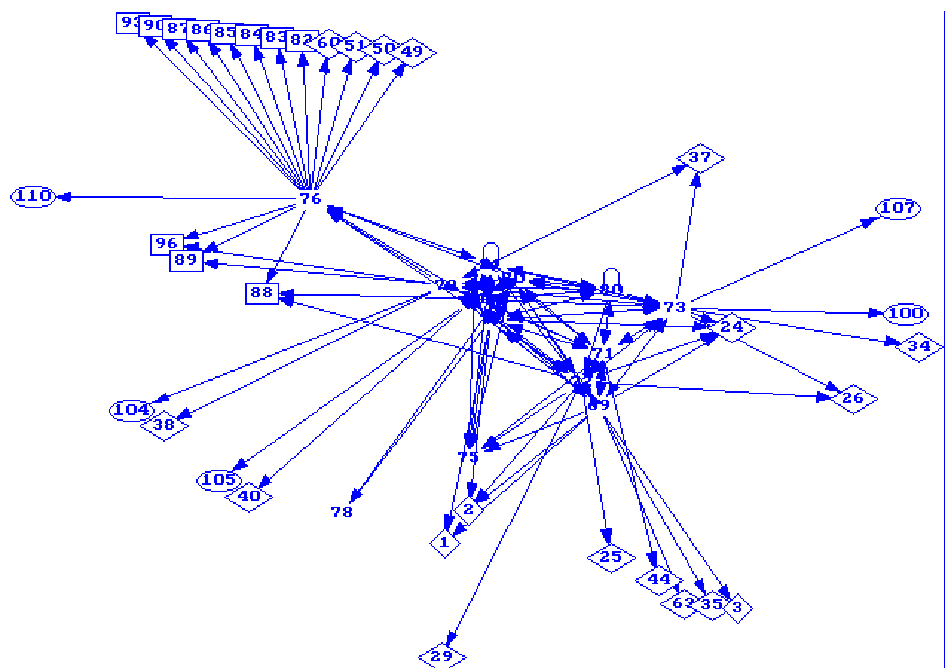 Above: The Disease Control section (Fig 1) showing a high-efficiency network with numerous external links.
By using UCINET6 for network metrics and SPSS for regression, they sought to see if these structural features could predict self-reported innovativeness.
Key Results: The "Disease Control" Advantage
The study found a stark contrast between different departments:
- Efficiency Wins: Efficiency significantly predicted innovativeness (p = 0.04).
- The Silicon Valley of the Bureau: The Disease Control unit had the highest efficiency (0.56) among staff sections. Why? Their job—epidemiological investigation—forces them to talk to outsiders (health stations, labs, etc.).
- The Redundancy Trap: The Health Promotion unit had the lowest efficiency (0.34). Their network was a "closed circle," where employees mostly interacted with their immediate peers, leading to lower innovativeness scores.
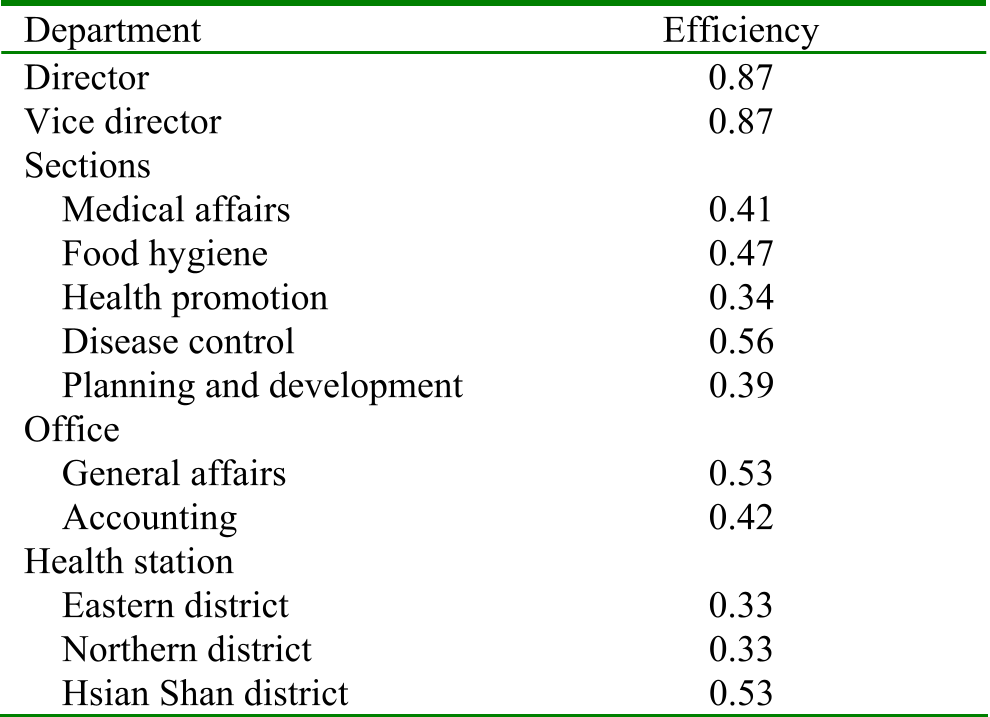 The data confirms: Leaders and external-facing units maintain the leanest, most efficient networks.
Critical Analysis & Conclusion
This paper provides empirical evidence that organizational design is network design.
- Managerial Takeaway: If a department like "Health Promotion" is stagnant, the solution isn't just "brainstorming sessions"—it's reallocating personnel or creating tasks that mandate cross-functional collaboration.
- The Tenure Paradox: The study noted that 20% of employees had 20+ years of tenure. Long-term tenure often leads to "safe and steady" dense networks. To maintain innovation, directors must consciously "disrupt" these networks by rotating staff or introducing "brokerage" roles.
Final Thought
Innovation isn't found in a vacuum; it’s found in the "holes" between groups. By becoming a bridge, an employee doesn't just work harder—they work smarter, leveraging the diverse knowledge of the entire organization.
Reference: Yang, H-H., et al. (2026). Structural Hole and Personal Innovativeness in a Bureau of Health.