
Structural Influence Maximization: Why Your Friends' Friends Matter
Structural Influence Maximization in Social Networks
This paper introduces the Structural Influence Maximization (SIM) problem and proposes the Structural Information Diffusion (SID) model. It focuses on how triangle structures (relationships between neighbors) impact information propagation in social networks, providing a deterministic framework for influence maximization.
TL;DR
Current social influence models often miss the "forest for the trees" by looking at individual connections while ignoring local group dynamics. This paper introduces the Structural Information Diffusion (SID) model, which proves that the presence of triangle structures (relationships between your friends) dramatically changes how information spreads. The authors demonstrate that the influence maximization problem here is NP-complete and offer greedy heuristics that outperform traditional metrics like PageRank in structurally-aware environments.
Problem & Motivation: The Independent Influence Myth
In the classical Linear Threshold (LT) or Independent Cascade (IC) models, if two of your friends, Alice and Bob, buy a new phone, their influence on you is treated as two separate events.
However, research into real-world datasets (like Sina Weibo) suggests a massive "Structural Influence" gap: if Alice and Bob are also friends with each other, your likelihood of being influenced by them isn't just cumulative—it triples. This "triangle effect" is a blind spot in previous SOTA methods. The authors argue that influence is not just about who follows you, but how those followers are connected to each other.
Methodology: The SID Model
The authors propose the Structural Information Diffusion (SID) model. Unlike probabilistic models, SID is deterministic to allow for a pure study of structural effects.
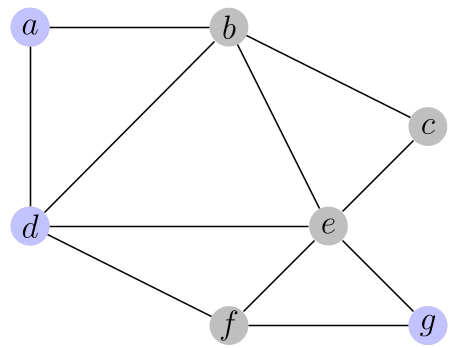
The Rule of Activation: A node becomes active at time if there exist two neighbors and such that:
- Both and were active before time .
- There is an edge between and (forming a triangle with ).
Heuristic Algorithms
Since they prove the problem is NP-complete (via reduction from Set Cover), they propose two main heuristics:
- NodeGreedy: Prioritizes nodes involved in the highest number of triangles.
- EdgeGreedy: Prioritizes edges that participate in the most triangles. Unlike NodeGreedy, it selects pairs of nodes, ensuring a "seed" already has the potential to trigger the structural activation rule immediately.
Experiments & Critical Insight
The authors tested their approach on three major networks: Google, Twitter, and WikiVote.
Performance on SID vs. LT Models
The results show a stark contrast in strategy effectiveness:
- In SID Environments: EdgeGreedy is the clear winner. Traditional metrics like HighDegree or PageRank fail because they don't value the "connectedness" of the neighborhood.
- In LT Environments: While the structural algorithms aren't optimized for Linear Threshold models, EdgeGreedy still performs competitively with general-purpose algorithms.
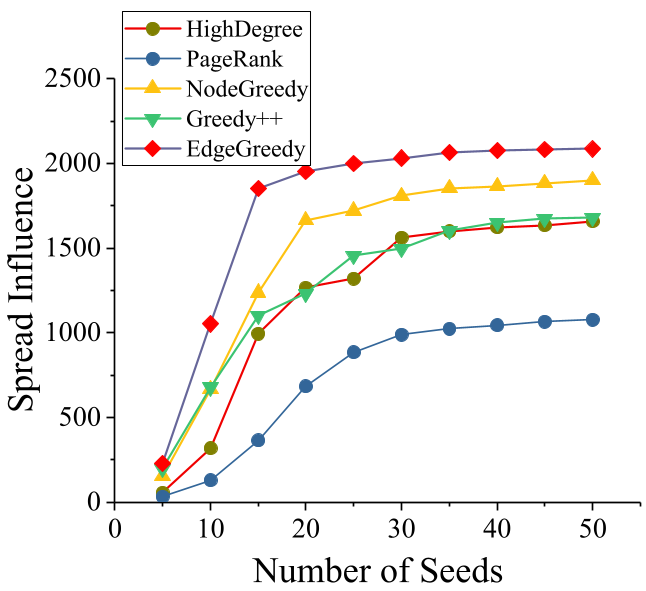
The figure above compares influence spread across SID and LT models. Note how EdgeGreedy (in red) dominates the structural diffusion tests (left column).
Critical Analysis & Conclusion
The Takeaway: If you are launching a viral marketing campaign, don't just look for "influencers" with high follower counts. Look for clusters of interconnected users. A small group of friends who all talk to each other is a much more potent seed set for structural diffusion than a set of isolated "superstars."
Limitations: The SID model is strictly deterministic. In reality, structural influence likely co-exists with probabilistic edge weights. The paper suggests an "Integration" method (using a promotion ratio for structural edges), but the experiments primarily focus on the pure model. Future research should look into a hybrid "Probabilistic-Structural" framework that can handle both the randomness of human behavior and the rigidity of network topology.
Future Outlook: This work paves the way for "Topology-Aware" social analysis. As social networks become more densely packed, understanding these local motifs (triangles, cliques) will be more important than ever for everything from advertisement placement to stopping the spread of misinformation.