
Digital Migration: How Facebook Fueled the Rise of Germany's New Right
Structural Patterns in the Rise of Germany’s New Right on Facebook
This study analyzes the rapid emergence of the Alternative für Deutschland (AfD) party through a quantitative lens, processing 11 million Facebook interactions from 2014-2015. It identifies structural patterns in social media engagement that correlate with the party's shift from a Eurosceptic fringe to a dominant right-wing political force in Germany.
TL;DR
By analyzing 11 million Facebook interactions, researchers have uncovered the structural blueprint of the Alternative für Deutschland (AfD)'s ascent. The study reveals that the AfD exploited social media with a volume of content nearly ten times higher than established parties, successfully capturing "discontented" users from the governing CDU during the 2015 refugee crisis.
The "Pathological Normalcy" of the Digital Right
For decades, Germany appeared immune to the populist radical right-wing trends sweeping across Europe. However, the emergence of the AfD shattered this "German exception." The researchers frame this shift as a "pathological normalcy"—where radical ideologies find a foothold by radicalizing mainstream values like ethnic nationalism.
The core motivation of this study was to determine if social media metrics could quantify this shift. Why did the AfD succeed where others failed? The answer lies in the massive engagement gap and the strategic siphoning of users from established political "neighborhoods."
Methodology: Mapping the Political Overlap
The researchers didn't just look at the AfD in isolation; they looked at the movement of people between parties. By tracking users who interacted with both the AfD and other parties (co-interaction), they established a digital map of political proximity.
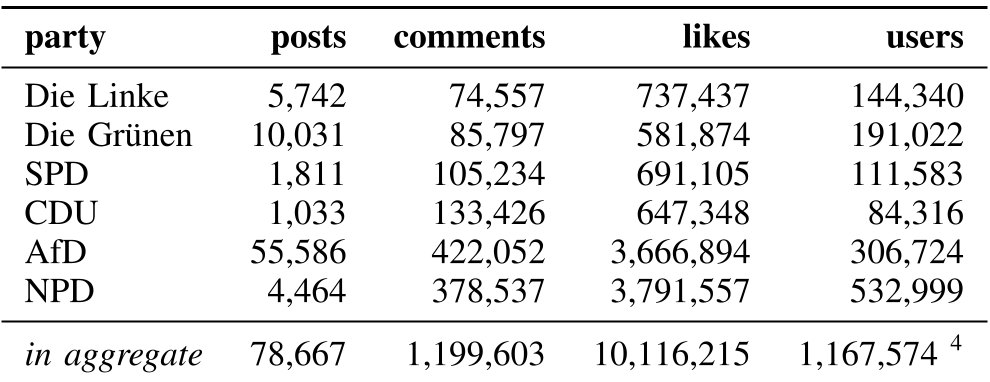 Table I: Basic activity metrics showing the AfD's massive post volume compared to established parties.
The study utilized:
- Bag-of-Words (BOW): Transforming 78,667 posts into mathematical vectors to find covarying keywords.
- Temporal Dynamics: Tracking how "likes" and comments peaked during specific social crises.
- Survey Ground-Truth: Validating social media trends against "Sonntagsfrage" (Sunday poll) data.
Methodology and The Refugee Catalyst
The "How" of the AfD's success is deeply tied to topic salience. When the refugee crisis peaked in late 2015, the AfD's messaging on "borders" (grenzen) and "refugees" (flüchtlinge) acted as a gravitational pull.
 Figure 3: Weekly interactions showing the massive surge for right-spectrum parties in late 2015.
The data shows that 15% of users interacting with the center-right CDU page were also engaging with the AfD. This suggests that the AfD didn't just find new voters; they successfully "poached" or shared an audience with the governing party by being more vocal on high-conflict topics.
Key Results: From Digital Likes to Actual Votes
The transition from digital engagement to political reality is stark. The study found a "pronounced peak" in user overlap between established parties (CDU/SPD) and the AfD at the end of 2015.
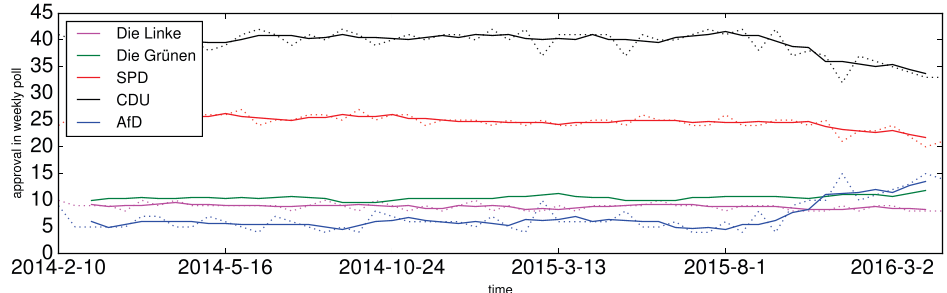 Figure 5: The synchronization between social media user overlap and the dramatic rise in AfD polling.
Critical Insights:
- Volume as Strategy: The AfD published over 55,000 posts in the study period. While many had low individual engagement, the sheer volume ensured constant visibility.
- The "Gateway" Effect: Co-interaction data shows the AfD positioned itself between the extremist NPD and the conservative CDU, serving as a socially "acceptable" alternative for those moving rightward.
- Media Paradox: Despite claiming to reject "mainstream media," the most frequently shared links in AfD circles were from established outlets like Die Welt and Der Spiegel, often used as fodder for criticism or debate.
Critical Analysis & Conclusion
This work demonstrates that social media is more than a communication tool; it is a structural sensor for political shifts. The AfD's rise was not an overnight miracle but a gradual migration of digital attention that preceded electoral results by months.
Limitations: The study relies on "Bag-of-Words" which treats all interactions (positive or negative) as equal. Future research needs to apply sentiment analysis to distinguish between "hate-watching" a party's page and actual support.
Takeaway: For political scientists and tech researchers, the message is clear: the overlap between pages is a more potent predictor of voter migration than simple follower counts.