
OSN Structural Estimation at the Extreme: Navigating the Random Neighbor Access Model
Estimation of structural properties of online social networks at the extreme
This paper introduces the Random Neighbor Access (RNA) model to estimate structural properties of Online Social Networks (OSNs) under extreme data access constraints. The authors propose the RNA-AVG-DEGREE and RNA-HHB-NETSIZE estimators, leveraging a modified random walk (RSRW) and a collision-based degree estimation technique (RNA-REC-DEGREE) to accurately approximate average degree and network size using only random neighbor queries.
TL;DR
How do you measure the size of Facebook or the average number of friends people have if you can't see anyone's actual friend count? This paper tackles the Random Neighbor Access (RNA) model—an "extreme" data constraint where your only tool is asking a node for a random neighbor. The authors develop new estimators to recover average degree and network size, proving that while average degree is surprisingly recoverable, network size requires massive query volumes.
Background: The API Wall
For years, social media providers have been tightening their data belts. Privacy concerns and business competition mean that third-party researchers can no longer simply "crawl" the graph. Most modern APIs act as a black box:
- Query Limitations: You have a limited budget of calls.
- Authorization Barriers: You can't see a node's full list of connections or its degree (friend count).
In this landscape, the authors define the RNA Model. You start with one User ID. Your only move is RN-QUERY(ID), which returns the ID of a random neighbor. You don't know the node's degree. You don't know the graph's total edges. You are effectively walking through a dark room with only a tiny, flickering flashlight.
Problem: The Hidden Degree Bias
Traditional sampling, like Simple Random Walk (SRW), is biased toward high-degree nodes (the "celebrities" of the network). Usually, we correct this bias by weighting samples by the inverse of the node's degree.
The catch? In the RNA model, you don't know the degree. If you visit "Node A," you don't know if it has 5 friends or 5,000. This makes standard unbiased estimators (like Hansen-Hurwitz) unusable in their native form.
Methodology: Probing and Collisions
The authors' breakthrough is a technique called RNA-REC-DEGREE.
1. The Probing Intuition
If you ask a node for a random neighbor 10 times, and you see the same neighbor twice, that "collision" tells you something about the node's degree. A node with many friends will rarely return the same friend twice; a node with few friends will collide often.
2. The Reciprocal Estimator
They prove that the reciprocal of the degree can be estimated as: where is the number of collisions and is the number of probes. This allows them to "plug in" estimated degrees into classic formulas.
3. The Sampling Designs: RSRW and ERSRW
- RSRW (Restricted SRW): Move to a random neighbor after every single query.
- ERSRW (Exploratory RSRW): Stay at a node, probe it times to estimate its degree, and then move.
Experiments: Real World vs. Synthetic
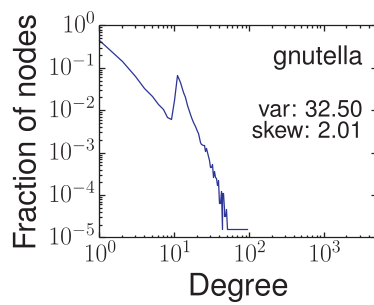
The authors tested these methods on Gnutella, Enron, and Facebook datasets.
- Average Degree Results: Surprisingly good. With a probing factor of , the estimates converge quickly toward the true population mean.
- Network Size Results: Much tougher. Accurately estimating the total number of nodes requires observing "edge collisions" (seeing the same connection twice across the whole walk). Because social networks are vast, the probability of an edge collision is tiny, meaning you might need to sample the actual size of the network to get a stable estimate.
Deep Insights: The Trade-off
The core lesson here is the Query Budget Trade-off. If you have a budget of 10,000 API calls:
- Should you use ? You will know the degrees of 100 nodes very accurately, but you'll only see a tiny fraction of the graph.
- Should you use ? You will see 5,000 nodes, but your degree estimates for each will be noisy.
The authors' simulation on Dynamic Graphs also adds a layer of reality: in a growing network, your "window" of samples must be small enough to be recent, but large enough to be statistically significant.
Conclusion
This work is a vital contribution to "Black-box Graph Mining." It proves that the structural properties of even the most protected OSNs can be audited via statistical side-channels (collisions), though it warns that measuring the total size of a "dark" network requires an immense amount of "probing" patience.
Limitations: The model assumes a static, connected graph. Future work needs to address highly disconnected components or graphs that shift faster than the walk can move.