
Beyond Cohesion: Redefining Community Detection via Structural and Regular Equivalence
Structural and regular equivalence of community detection in social networks
This paper explores Community Detection in social networks through the lens of Blockmodeling, specifically comparing the concepts of Structural and Regular Equivalence. The authors utilize the Euclidean distance algorithm and the REGE algorithm to partition the classic Zachary’s Karate Club network into functional modules and role-based clusters.
TL;DR
The study of social networks has long been dominated by the search for "cliques"—groups of people who talk to each other frequently. However, this paper argues that true social structure is found in Equivalence. By utilizing Blockmodeling and algorithms like REGE and Euclidean Distance, the authors demonstrate how to identify "positions" and "roles" in the Zachary’s Karate Club network, revealing layers of organization that traditional modularity methods miss.
The Problem: The "Cohesion" Trap
In network science, most researchers look for cohesive subgroups: areas of a graph where edge density is high. While useful, this approach fails to distinguish between who people are and what they do.
Consider two CEOs of different companies. They don't talk to each other (no cohesion), but they both manage employees and report to boards. In a traditional community detection model, they are strangers. In a Blockmodel, they are Structurally Equivalent. The limitation of prior work is that it often overlooks these functional roles, which are critical for understanding how information or influence actually flows through a system.
Methodology: The Logic of Equivalence
The authors break down the solution into two mathematical frameworks:
1. Structural Equivalence (The Identical Twin)
Two nodes are structurally equivalent if they have the same relationships with all other actors. If you swapped actor and actor , the network's adjacency matrix would remain unchanged.
- Measurement: Euclidean Distance. The distance is 0 if two nodes have identical row and column profiles in the sociomatrix.
2. Regular Equivalence (The Role Mirror)
This is a more relaxed and "smarter" definition. Two nodes are regularly equivalent if they relate to similar types of others. You don't need to be friends with the same people; you just need to be friends with the same kind of people (e.g., two teachers are regularly equivalent because they both have students, even if they teach in different schools).
- Measurement: The REGE Algorithm. An iterative process that updates the similarity between nodes based on the similarity of their neighbors.
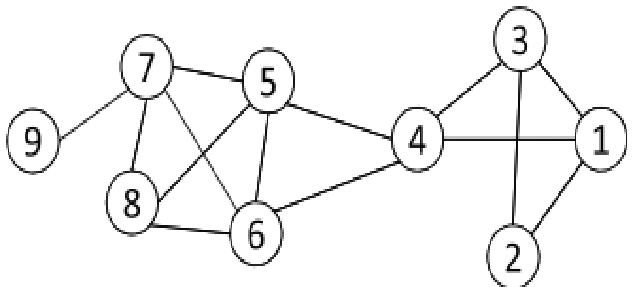 Figure 1: A visualization of a social network (9 actors) and its corresponding Adjacency Matrix used for equivalence calculations.
Experiments: The Karate Club Test
The authors apply these concepts to the famous Zachary’s Karate Club dataset.
Structural Equivalence Results
Using Euclidean distance and hierarchical clustering, the network was split into 4 communities. The "tightness" of these groups was measured by dissimilarity scores, showing that some nodes were almost perfectly substitutable in their local connectivity.
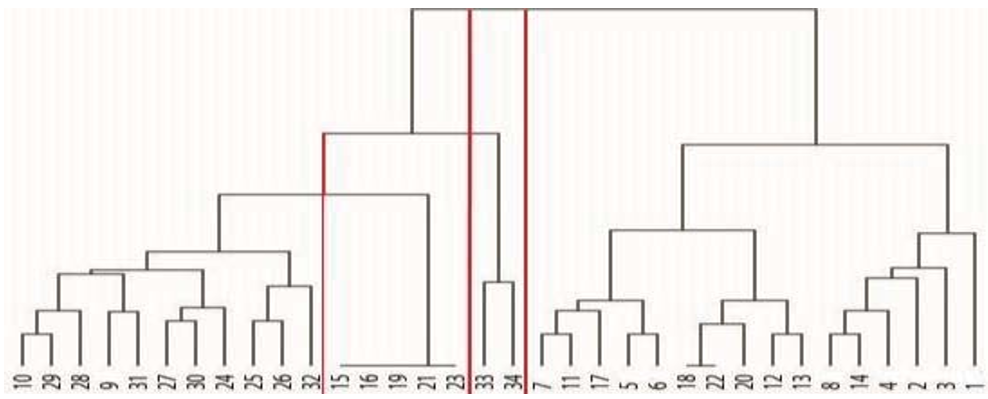 Figure 2: Dendrogram showing the structural equivalence clustering. The vertical axis represents the dissimilarity score (higher = less equivalent).
Regular Equivalence Results
The REGE algorithm, after two iterations, provided a similarity matrix where values ranged from 0 to 1. This method yielded 3 primary communities. Unlike the structural approach, REGE emphasized the roles nodes played within the club's factional split (the conflict between the Administrator and the Instructor).
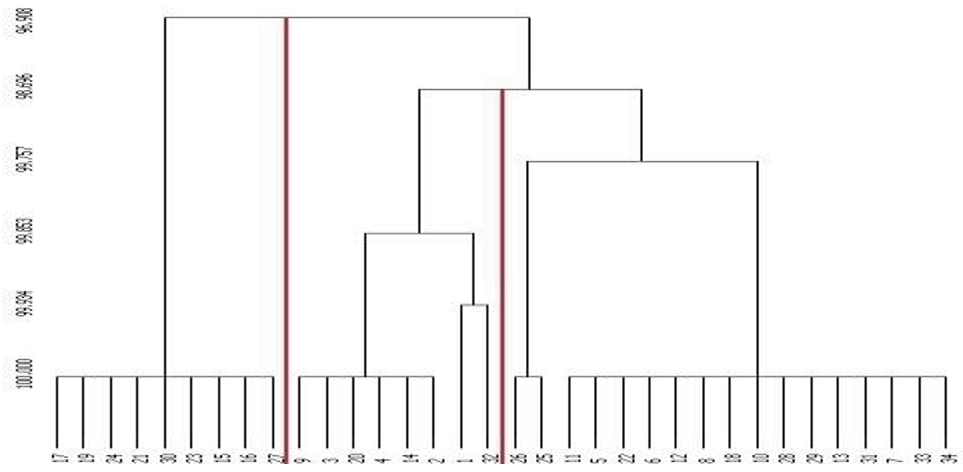 Figure 3: Graphical representation of actors partitioned by Regular Equivalence, highlighting functional "roles" rather than just friendship groups.
Critical Analysis: Why This Matters
The power of Blockmodeling lies in its Inductive Bias. Most algorithms assume communities are "blobs" of connected nodes. Blockmodeling allows for:
- Bipartite Structures: Groups that only connect to other groups, not themselves.
- Core-Periphery: Detecting "leaders" vs. "followers".
- Role Identification: Finding "brokers" who bridge different segments.
Limitations: The primary drawback noted by the authors is scalability. REGE and Euclidean computations on dense matrices are computationally expensive ( or higher depending on iterations). While perfect for the small Karate Club (34 nodes), these methods require significant optimization or sparse-matrix approximations for modern platforms like Twitter or LinkedIn.
Conclusion
This paper serves as a vital reminder that "Community" doesn't just mean "Neighbors." By mathematically defining Structural and Regular Equivalence, we can move from simple graph partitioning to true Sociological Modeling. For practitioners, this means moving beyond just finding clusters to identifying the specific functional roles that drive network dynamics.