
ART2-Protein: Unsupervised Neural Networks for Deep Structural Classification
Structural SCOP Superfamily Level Classification Using Unsupervised Machine Learning
This paper introduces an automated unsupervised machine learning framework for protein structural classification at the SCOP superfamily level. By combining BLAST E-values with the ART2 (Adaptive Resonance Theory) neural network, the authors achieve high classification accuracy (0.82 to 0.97 f-measure) without requiring pre-labeled training data.
TL;DR
In the race to classify the ever-growing number of uncharacterized protein sequences, manual curation remains a bottleneck. This paper proposes a breakthrough using the ART2 (Adaptive Resonance Theory) neural network, an unsupervised model that classifies proteins at the SCOP superfamily level using only BLAST-derived similarity data. The result? A system that achieves up to 97% accuracy without needing a single human label for training.
The Bottleneck of Manual Curation
The Structural Classification of Proteins (SCOP) is the "Gold Standard" of bioinformatics, but it has a major flaw: it is updated manually. As genomic sequencing outpaces structural analysis, thousands of proteins remain "unclassified."
Existing automated solutions typically fall into two categories:
- Supervised Learning (SVM, Random Forest): Highly dependent on existing labels and often struggle with "unseen" families.
- Hard Thresholding: Using a fixed BLAST E-value cutoff. This is notoriously unreliable because superfamilies often share very weak sequence identity (sometimes below 15%).
The authors' insight was to treat protein classification not as a search problem, but as a continuous pattern recognition task.
Methodology: The ART2 Advantage
The core of this research is the ART2 Neural Network. Unlike standard backpropagation-based networks, ART2 is designed for stable, self-organizing unsupervised learning of analog signals.
1. The Input: Sigmoid P-Values
Instead of raw E-values, the authors use a sigmoid function to transform BLAST results into input vectors: This normalizes the data into a range suitable for neural processing.
2. Architecture: Stability and Plasticity
The ART2 architecture consists of two main layers:
- F1 Layer: Handles normalization and noise suppression. It ensures that "weak" signals (low similarity) don't derail the clustering process.
- F2 Layer: A competitive layer where neurons compete to represent an input pattern.
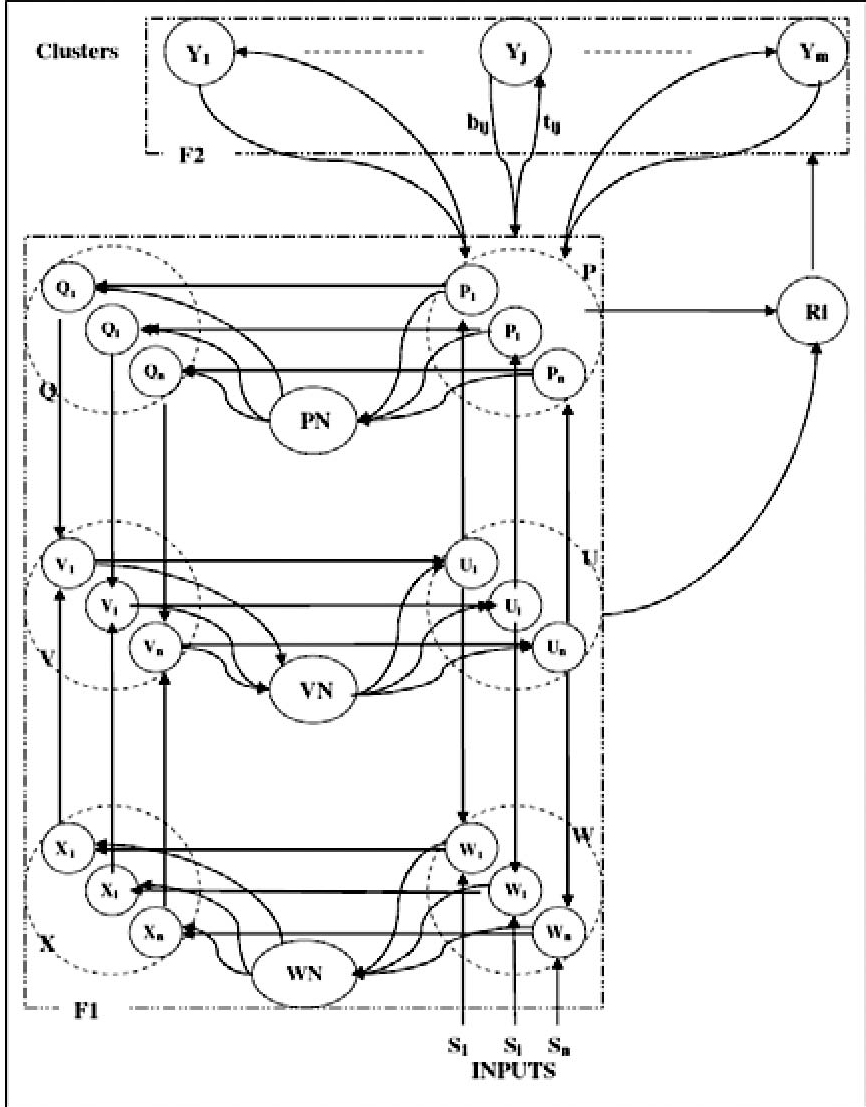
The Vigilance Parameter () is the "secret sauce" here. It controls how similar a new pattern must be to an existing cluster to be merged. If the similarity is too low, ART2 creates a new category automatically—solving the "threshold" problem inherent in other methods.
Experimental Results: Beating the Baselines
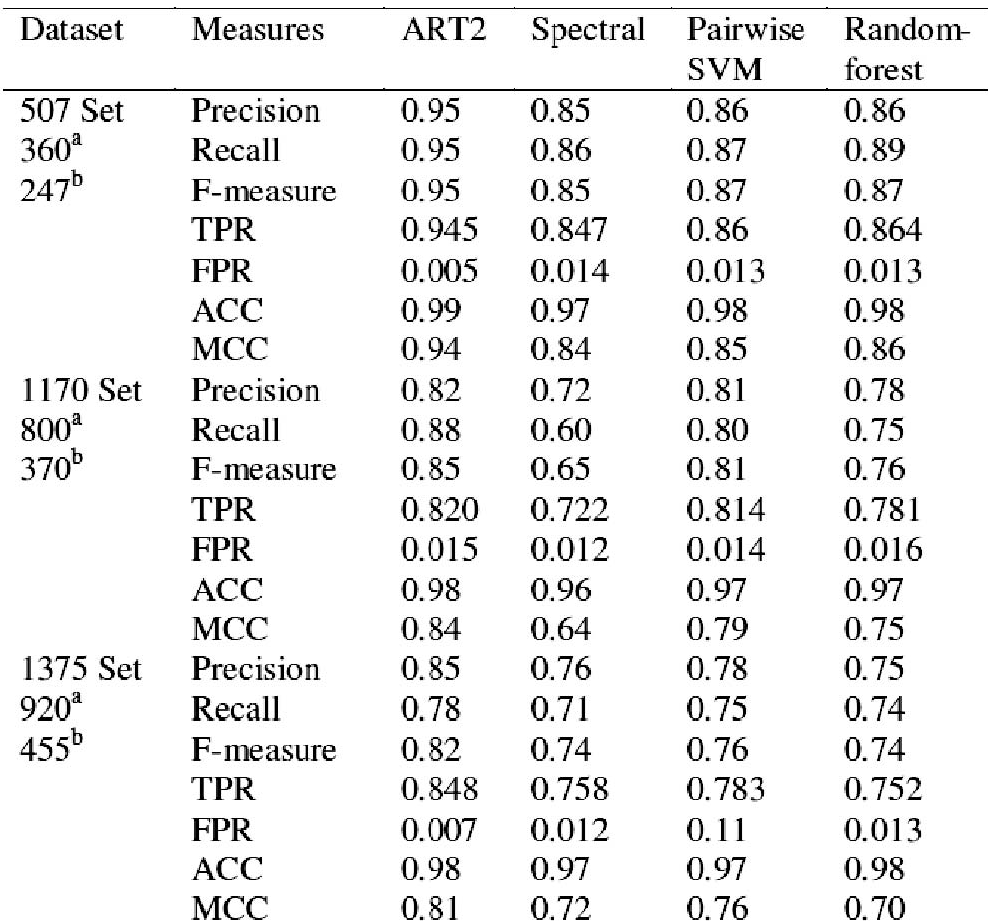
The authors tested ART2 against Spectral Clustering, SVM, and Random Forest. In a critical test involving 507 highly divergent sequences (including Globin-like proteins with very low identity), ART2 dominated.
| Method | Precision | Recall | F-measure |
|---|---|---|---|
| ART2 | 0.95 | 0.95 | 0.95 |
| Pairwise SVM | 0.86 | 0.87 | 0.87 |
| Spectral | 0.85 | 0.86 | 0.85 |
As shown in the table above, ART2 provides a significant jump in F-measure, proving it is far more sensitive to the subtle "noise-shrouded" similarities in protein superfamilies.
Critical Insight: Why ART2?
The primary reason ART2 works where Spectral Clustering fails is the Reset Mechanism. In Spectral Clustering, the number of clusters () must often be predefined or estimated via eigengap, which is often inaccurate for biological data. ART2 dynamically adjusts the number of clusters based on the data's inherent distribution and the vigilance parameter.
However, the study also reveals a limitation: HHpred, which uses Profile-HMM (Hidden Markov Models), still outperforms ART2. This is because sequence-sequence comparison (BLAST) loses information that profile-profile comparison (which considers evolutionary conservation at each position) retains.
Conclusion & Future Outlook
This work demonstrates that unsupervised neural networks can match or exceed the performance of supervised models in complex biological domains. By utilizing the ART2 framework, researchers can bridge the gap between "unclassified" primary sequences and the "gold standard" SCOP database.
For future work, the logic is clear: Integrating HMM-profiles as inputs to an ART2-like unsupervised network could potentially create the most powerful automated protein annotator to date.