
Mapping Scientific Reorientation: How AI Decodes the Impact of German Reunification on Research
A structural topic model approach to scientific reorientation of economics and chemistry after German reunification
This paper presents a novel machine learning framework utilizing Structural Topic Modeling (STM) combined with cosine similarity and linear regression to analyze scientific reorientation. It specifically maps the convergence of research topics in Economics and Chemistry between East and West Germany following the 1990 reunification using dissertation titles.
TL;DR
Can an algorithm detect the "death" of socialist ideology in economics? By analyzing decades of German dissertation titles using Structural Topic Modeling (STM), this research quantifies how East German science pivoted toward Western standards after 1990. The study reveals a dramatic "thematic collapse" in Economics compared to a steady, industry-driven continuity in Chemistry.
The Problem: Data Overload and the "Expert" Dependency
As scientific literature grows exponentially, the ability of experts to manually classify research fields hits a ceiling. Traditional metrics (citations, pre-defined keywords) often miss the nuances of what is actually being discussed. This is particularly problematic when studying "Scientific Reorientation"—how external factors like political revolutions force scientists to change their research problems.
The Methodology: Beyond Standard LDA
The author moves beyond the standard Latent Dirichlet Allocation (LDA) by adopting Structural Topic Modeling (STM).
Why STM?
In standard LDA, topic proportions are drawn from a global distribution. STM, however, allows for covariate-induced prevalence. This means the model "knows" that a dissertation from East Berlin in 1985 is more likely to discuss "Socialist Planning" than one from Munich in 2005.
The Analytical Pipeline
- Training: STM is trained on 75% of the titles, using university and year as "structuring" variables.
- Vectorization: Remaining titles are transformed into topic-probability vectors.
- Similarity Measurement: Cosine similarity is calculated between every pair of titles.
- Statistical Validations: A linear regression model treats these similarities as the dependent variable to isolate the effects of time and region.
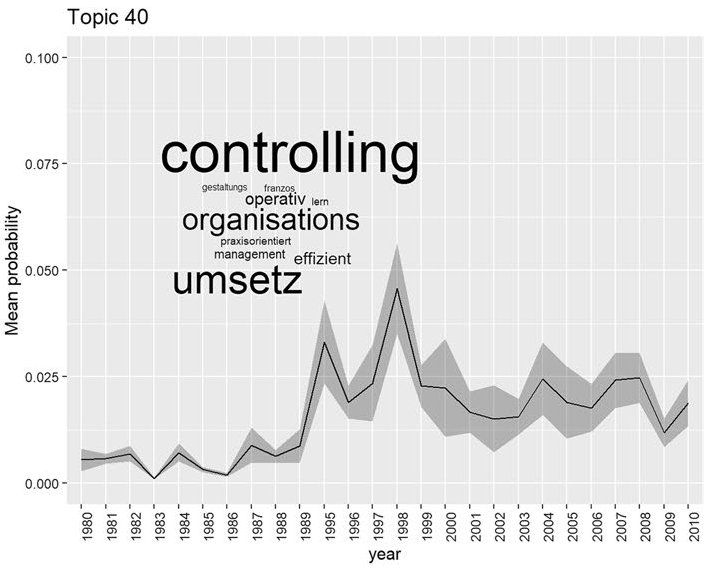 Figure 1: The model captures the literal extinction of Topic 11 (Socialism) and the rise of Topic 40 (Capitalist Controlling) in Economics.
Experiments & Results: Ideology vs. Industry
The study highlights two distinct patterns of scientific evolution:
1. Economics: The Radical Pivot
Before 1990, East and West German Economics were practically different languages. East German topics were heavily concentrated in state-mandated niches (Kombinats, Socialist Planning). Post-1990, the replacement of roughly 90% of East German chairs with West Germans led to a rapid thematic conformation.
2. Chemistry: The Hidden Continuity
Curiously, Chemistry showed much smaller differences between East and West even during the Cold War. The author attributes this to the "industrial productive force" of chemistry—both sides were solving similar problems related to polymers and catalysts, though the East was restricted by a reliance on lignite (coal) due to oil shortages.
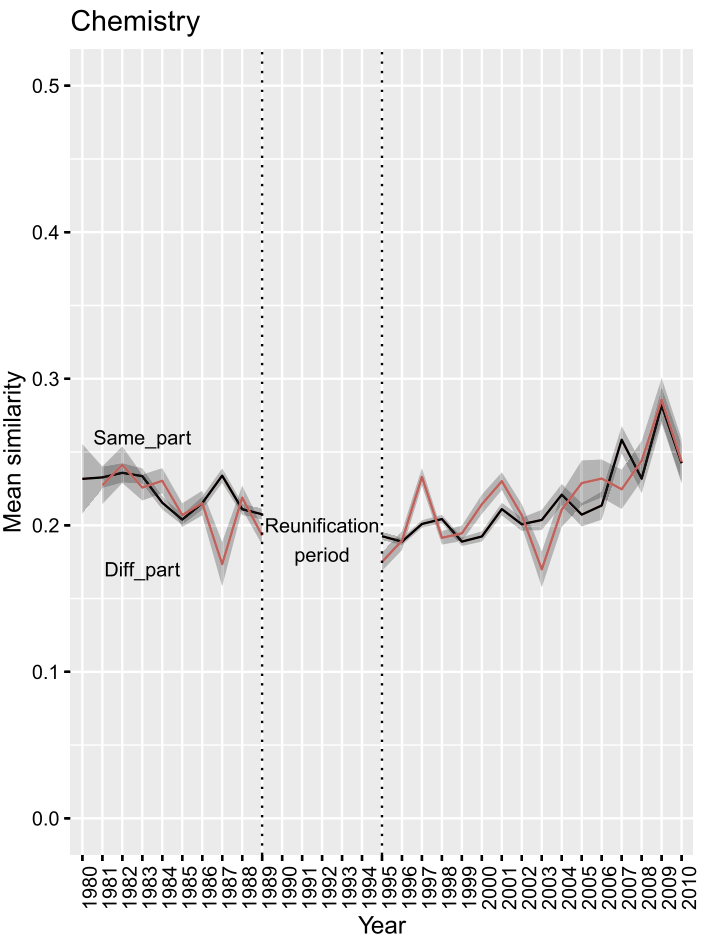 Figure 2: Mean topic prevalence shift—notice the "flattening" of East German topics in Economics post-reunification, indicating a move toward diversified Western topics.
Critical Insight: The "Same University" Effect
An interesting side finding from the regression models (Tables 3 & 4) is the "Same Uni" boost. Titles from the same university, regardless of the era, show significantly higher similarity. This quantifies the influence of the "Doktorvater" (the doctoral advisor) and the institutional "school of thought" that persists despite broader national shifts.
Conclusion & Limitations
This paper offers a robust methodological template for computational history of science. While the use of short titles (instead of full abstracts) limits the depth of topic discovery, the success of the model on "unseen data" proves that titles are a highly condensed but reliable signal for research orientation.
The ultimate takeaway? Social sciences are an extension of the political system, while natural sciences are an extension of the industrial infrastructure. When the politics change, the economists are replaced; when the technology remains, the chemists carry on.