
Structural Topic Modeling: Decoding Geopolitics and Author Sympathies in Social Media
Using Structural Topic Modeling to Detect Events and Cluster Twitter Users in the Ukrainian Crisis
This paper explores the application of Structural Topic Modeling (STM) to Russian social media data during the Ukrainian crisis. It successfully utilizes STM to detect significant geopolitical events (e.g., the MH17 crash) and to cluster Twitter users based on their political sympathies or identify potential "sockpuppet" accounts.
TL;DR
Researchers at the University of Maryland have demonstrated that Structural Topic Modeling (STM) can effectively navigate the chaotic landscape of social media during international crises. By incorporating metadata directly into the statistical model, they successfully detected the MH17 aircraft tragedy and distinguished between Pro-Russian and Pro-Ukrainian Twitter users, proving that "who" and "when" are just as important as "what" is being said.
The "Static" Problem in Topic Modeling
For years, Latent Dirichlet Allocation (LDA) has been the gold standard for unsupervised text analysis. However, it has a major blind spot: it treats all documents in a corpus as if they exist in a vacuum. In the fast-moving world of Twitter (X) or VKontakte, discussions are inextricably linked to time and identity.
Existing methods often struggle with:
- Contextual Ignorance: Not knowing that a tweet on July 18th is fundamentally different from one on July 16th.
- Author Blindness: Failing to group users who consistently use the same ideological framing.
- Noisy Data: Social media’s character limits and slang make traditional linguistic markers less reliable.
Methodology: Bringing Structure to Chaos
Unlike LDA, Structural Topic Modeling (STM) allows researchers to use metadata (covariates) to influence the model. The authors focused on two dimensions:
- Topical Prevalence: How much of a document is dedicated to a specific topic.
- Topical Content: The specific words used to describe a topic.
By conditioning these on time (pre/post-event) and author identity, the model moves beyond simple word-counting to understanding systemic shifts in discourse.
Event Detection: The MH17 Case Study
In the first study, the authors analyzed 50,000 Russian-language posts from VKontakte. By setting time as a covariate ("t1" vs "t2"), the STM identified a massive surge in topics related to "Boeing," "Buk missile system," and "investigation" immediately following the crash.
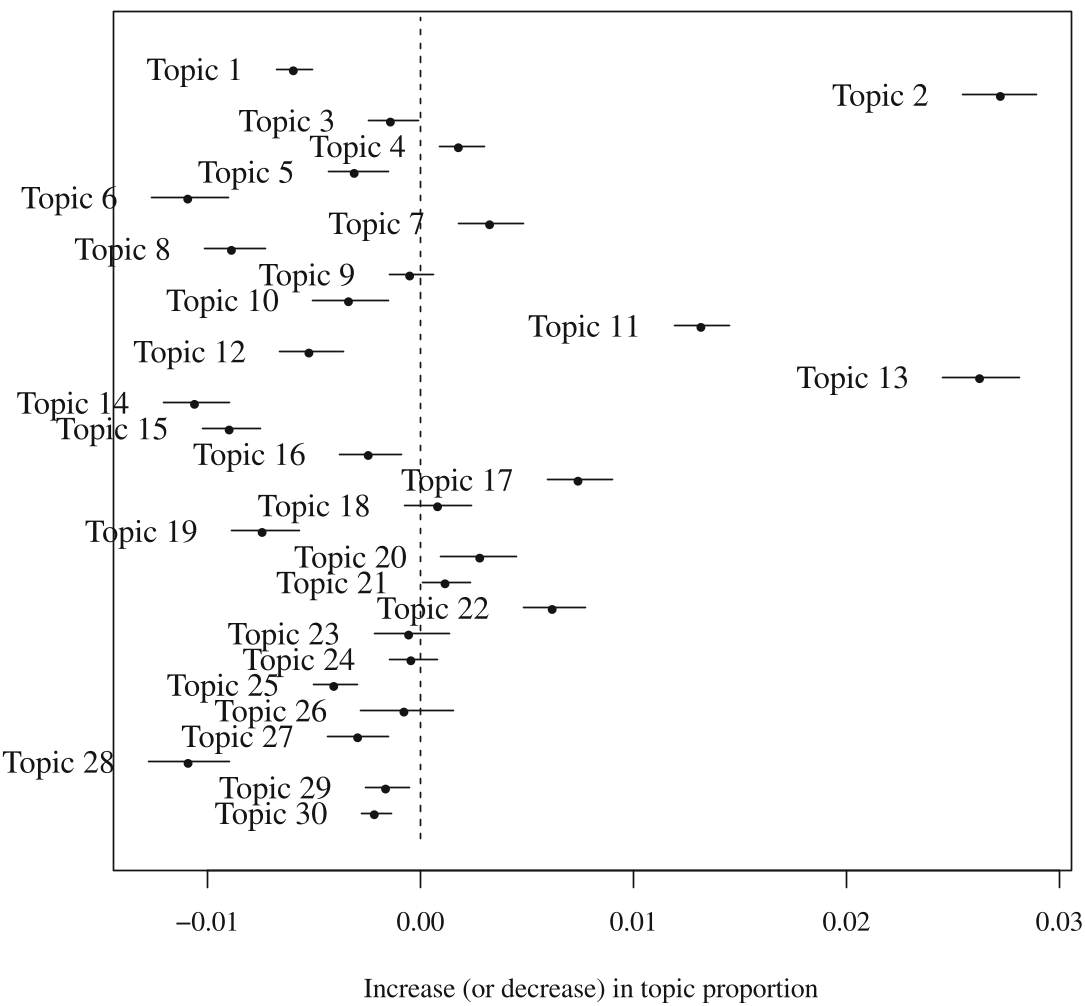 Figure 1: Comparison of topical prevalence showing the surge in specific topics (Topic 2 and 13) post-MH17.
Identifying Ideological Clusters & Sockpuppets
The second study applied STM to 4,000 tweets from four specific users. The goal was to see if the model could autonomously group users with similar political leanings.
The results were striking:
- Pro-Ukraine Cluster: Users S, K, and L showed high topical similarity, focusing on the human and military cost in regions like Donetsk and Luhansk (Topic 4).
- Pro-Russia Cluster: User T stood out as a clear outlier, focusing more on geopolitical sovereignty and "borders" (Topic 3).
- Sockpuppet Validation: The model corroborated findings from separate authorship attribution studies, showing that users K and L had nearly identical topical distributions, suggesting they might be the same individual.
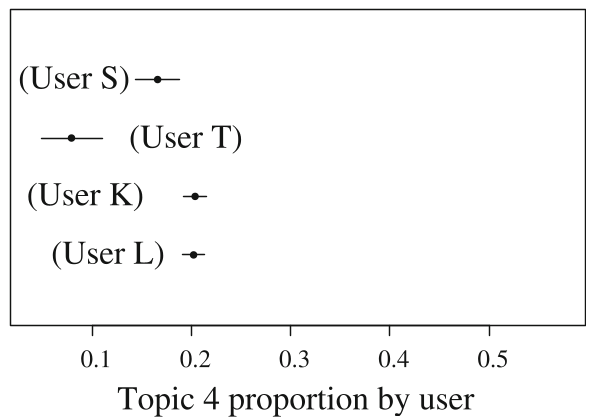 Figure 2: Plot of topic prevalence by author, maintaining the distinct separation of User T (Pro-Russia).
Critical Insight: Why This Matters
The power of STM lies in its interpretability. For a researcher or intelligence analyst, it provides a "first-pass" filter. Instead of reading tens of thousands of tweets, the analyst can look at the prevalence charts, identify the "anomalous" topics, and then drill down into the specific posts that contributed to those topics.
Limitations & Future Work
While successful as a proof-of-concept, the authors acknowledge certain hurdles:
- Scalability: Applying this to an arbitrary, continuous timeline (rather than a pre-defined "before and after") remains a challenge.
- Demographic Inference: Can STM identify subtle markers like age, gender, or nationality? Future research will need to test the limits of topical "fingerprints."
Conclusion
This work elevates topic modeling from a mere descriptive tool to a diagnostic tool. By proving that structural metadata can reveal hidden ideological divides and major historical inflection points, the authors have provided a blueprint for more sophisticated social media monitoring in the age of digital warfare.