
SAHP: Harmonizing Structure, Attributes, and Homophily for Superior Social Network Embedding
Structure, Attribute and Homophily Preserved Social Network Embedding
This paper introduces SAHP (Structure, Attribute, and Homophily Preserved), a network embedding algorithm that maps social network nodes into low-dimensional vectors. It achieves SOTA performance by jointly optimizing three information sources: topological structure, node attributes, and the principle of homophily using a Gaussian Mixture Model (GMM) framework.
TL;DR
SAHP (Structure, Attribute, and Homophily Preserved) is a next-generation social network embedding algorithm. Unlike its predecessors that treat node attributes and network links as separate entities, SAHP introduces the Principle of Homophily into the optimization loop. By leveraging a Gaussian Mixture Model (GMM) within a joint optimization framework, it yields embeddings that capture not just the "what" (attributes) and "where" (structure), but the "why" (social clustering logic) of a network.
Problem & Motivation: The Missing Link in Embedding
While traditional methods like DeepWalk or Node2Vec excel at capturing the "neighborhood" of a node, they are blind to the rich metadata (attributes) attached to users. Conversely, content-augmented methods often struggle with the sparsity and noise found in real-world social data.
The authors identify a critical gap: Homophily. This social principle suggests that "birds of a feather flock together"—nodes with similar attributes are more likely to form dense connections. Most SOTA models fail to explicitly model these "homogeneous parts," leading to embeddings that don't truly reflect the underlying community dynamics.
Methodology: The SAHP Trifecta
The SAHP framework operates through a sophisticated joint optimization of three distinct components:
1. Structure Preservation
Borrowing from the Skip-Gram intuition, SAHP uses random walks to define node contexts, ensuring that structurally adjacent nodes stay close in the latent space.
2. Attribute Mapping with Noise Reduction
To handle sparse and noisy attributes, SAHP employs a non-linear mapping via Fourier transforms. This maps raw attributes into a feasible low-dimensional feature space that remains consistent with the topological structure.
3. Homophily via GMM
This is the "secret sauce." The authors treat homogeneous parts of the network as multivariate Gaussian distributions. By incorporating a GMM objective, the model forces nodes belonging to the same "social cluster" to center around a shared mean () in the embedding space.

The Optimization Loop
The model uses an alternating optimization strategy:
- EM Step: Fixes the embeddings and updates the GMM parameters (means, covariances, and cluster assignments).
- SGD Step: Fixes the cluster parameters and updates the node embeddings and attribute mapping parameters.
Experiments & Results
The authors validated SAHP on three Facebook-derived datasets. The results demonstrate a clear hierarchy of performance:
- Pure Structural (DeepWalk, Node2Vec): Lowest performance, as metadata is ignored.
- Content-Augmented (LANE, UPP-SNE): Moderate performance; they use attributes but ignore homophily.
- SAHP: The winner.
| Dataset | Best Baseline (UPP-SNE) | SAHP |
|---|---|---|
| Ego-Facebook | 85.58% | 88.42% |
| Hamilton | 91.71% | 93.88% |
| Rochester | 87.83% | 90.66% |
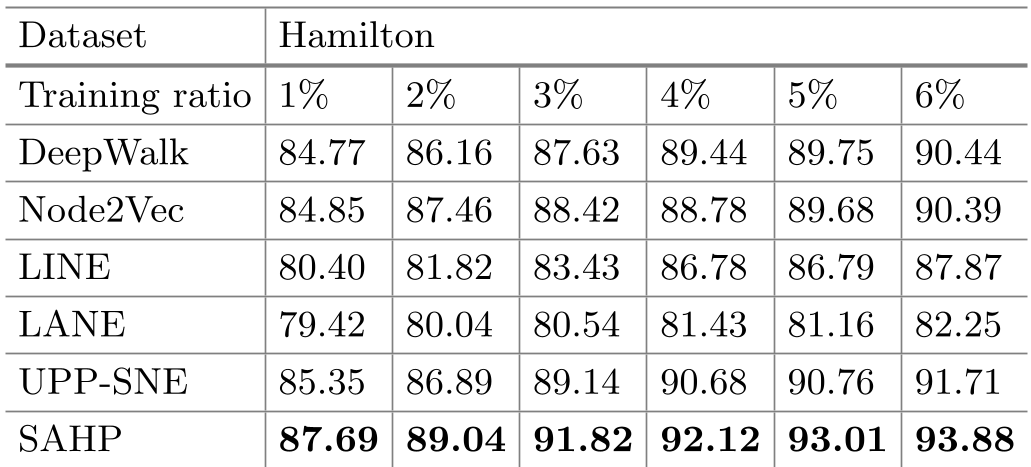
The Ablation Study (implied by the comparison with UPP-SNE) confirms that the addition of the homophily preservation objective () is what provides the competitive edge, especially when training data is scarce (e.g., at a 1% training ratio).
Critical Analysis & Conclusion
Takeaway
SAHP proves that network embedding isn't just a geometry problem; it's a social science problem. By translating the social concept of homophily into a GMM-based constraint, the authors created a more "socially aware" representation.
Limitations & Future Work
One potential bottleneck is the computational cost of EM in very large graphs with thousands of clusters (). Furthermore, the current model assumes Gaussian clusters; however, social communities often exhibit non-Gaussian or hierarchical structures. The authors' future plan to incorporate richer textual features (NLP) suggests a move toward even more complex multi-modal embeddings.
Final Verdict: SAHP is an essential read for researchers looking to bridge the gap between traditional graph theory and modern representation learning.