
SybilSCAR: Bridging the Gap Between Scalability and Robustness in Sybil Detection
Structure-Based Sybil Detection in Social Networks via Local Rule-Based Propagation
This paper introduces SybilSCAR, a structure-based Sybil detection method that unifies Random Walk (RW) and Loopy Belief Propagation (LBP) approaches through a local rule-based framework. SybilSCAR achieves state-of-the-art performance by being simultaneously scalable, convergent, and robust to label noise, outperforming SybilRank and SybilBelief on large-scale datasets like Twitter (41.7M nodes).
TL;DR
SybilSCAR is a revolutionary framework for detecting fake accounts (Sybils) in massive social networks. By unifying the efficiency of Random Walks with the robustness of Loopy Belief Propagation, it provides a method that is Scalable, Convergent, Accurate, and Robust (SCAR). In a 1.2-billion-edge Twitter graph, it identified Sybils with 95.8% precision in its top results, vastly outperforming existing standards.
Problem & Motivation: The Structural Gap
The fundamental intuition in structure-based Sybil detection is Homophily: benign users tend to trust other benign users, making it difficult for attackers to create a large number of "trust" edges (attack edges) into the benign region.
However, the industry has long faced a trade-off:
- RW-based methods (e.g., SybilRank): Are fast but "allergic" to noisy data. One mislabeled benign user can pollute the entire score distribution.
- LBP-based methods (e.g., SybilBelief): Are robust to noise but hit a "memory wall." They require storing messages for every single edge (O|E|), which is prohibitive for graphs with billions of connections.
Methodology: The Local Rule-Based Framework
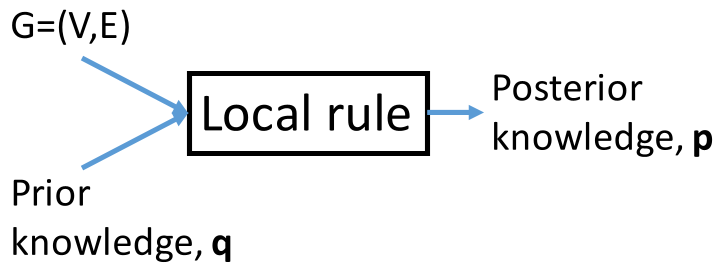
The researchers' brilliant insight was to realize that both RW and LBP are actually doing the same thing: applying a Local Rule to propagate information.
The SybilSCAR Innovation
SybilSCAR defines a new local rule that models the probability of a node being a Sybil () based on its neighbors. While the logic is derived from multiplicative LBP (which is robust), the authors used a mathematical trick—Linearization. By applying the approximation , they transformed a complex edge-based message system into a simple, node-based additive system:
This allows the model to converge predictably (like a Random Walk) while maintaining the noise-filtering properties of LBP.
Experimental Results: Dominating at Scale
The authors tested SybilSCAR against the industry leaders across various datasets.
1. Accuracy and Robustness
In the presence of "Label Noise" (where training data is imperfect), SybilSCAR remains stable whereas SybilRank's performance collapses.
2. Real-World Impact (Twitter Dataset)
On a massive Twitter dump (41.7M nodes, 1.2B edges), the precision of the "Top-10K" list is critical. SybilSCAR achieved 95.8% precision, meaning nearly every account flagged for manual review was a confirmed fake. In contrast, SybilRank was effectively no better than random guessing at this scale.
3. Scalability
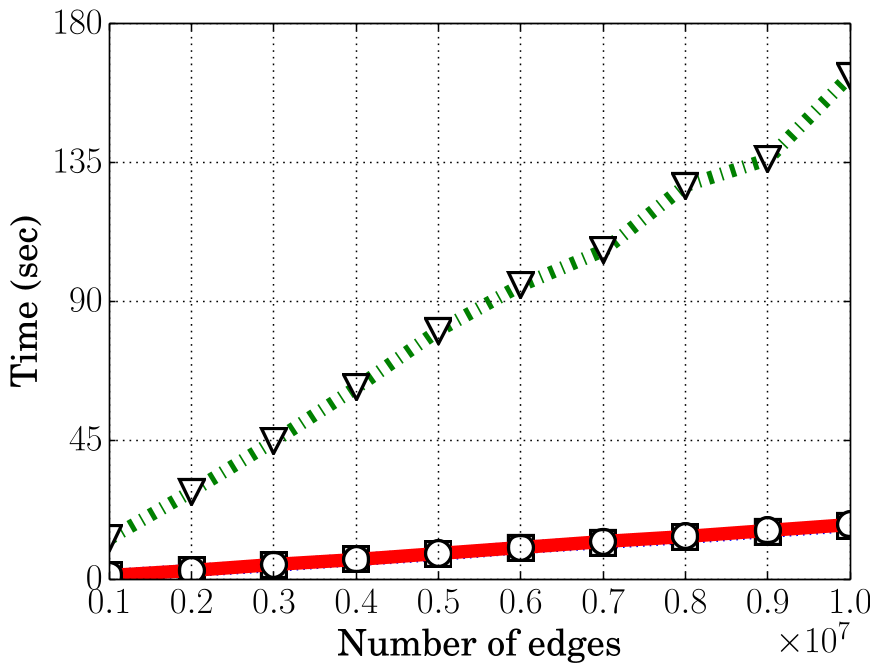
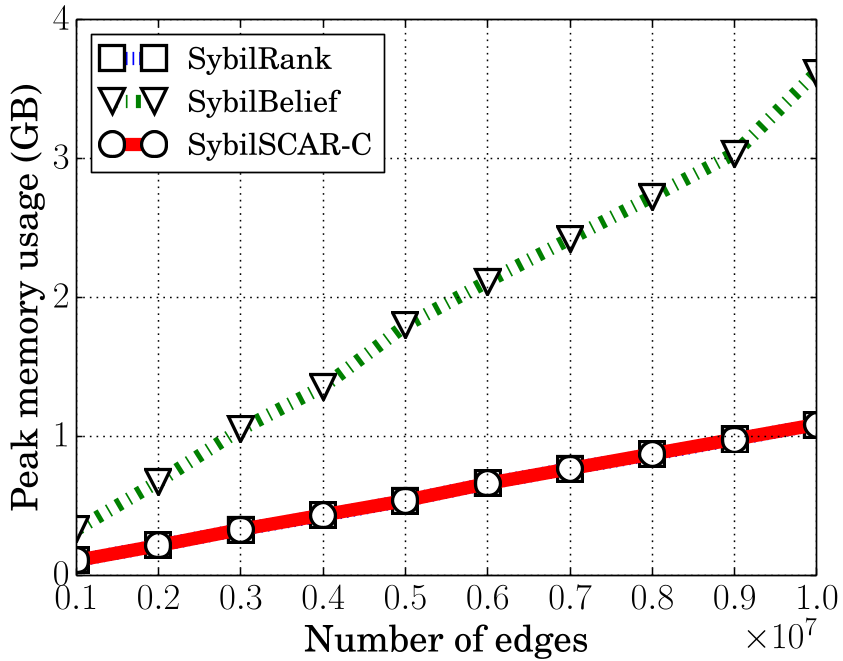
SybilSCAR demonstrated linear scalability, proving to be one order of magnitude faster and significantly more memory-efficient than SybilBelief.
Critical Analysis & Conclusion
SybilSCAR's primary contribution is proof that we don't need to choose between speed and reliability. By linearizing the LBP update, the authors achieved the "Golden Mean" of graph security.
Limitations: The method still relies on the Homophily Assumption. In networks where "friendship" is cheap (e.g., follow-back cultures), the structural gap might blur, requiring even more advanced feature integration.
Future Outlook: This work paves the way for integrating SybilSCAR with Feature-based Deep Learning. Imagine using a GNN to learn the "edge weights" () and then using SybilSCAR's fast propagation to clean the labels—a powerful combination for modern trust and safety teams.