
Detecting the Invisible Shift: Structure Emergence and Stability in Evolving Social Networks
Structure emergence in the evolution of social networks and its case study a
This paper explores "structure emergence" in social networks using the Clique Percolation Method (CPM). It proposes a quantitative framework for identifying stable communities, tracking their evolution (inheritance, split, merger), and measuring network stability during external environmental shifts.
TL;DR
This research provides a mathematical lens to view how social networks "crystallize" into stable structures. By utilizing the Clique Percolation Method (CPM) and introducing a new Stability Index, the authors demonstrate how microscopic interactions (like emails) evolve into macroscopic communities. Their analysis of the Enron scandal proves that structural changes in communication networks often precede major organizational collapses.
The "Emergence" Intuition: Beyond Static Graphs
In classical network science, we often look at a "snapshot." However, social networks are more like fluids—constantly shifting. The authors argue that the true "Emergence" of a network occurs when it transitions from one stable state to another. These states are called Steady States.
The core challenge is: How do we know if a group of people is a permanent community or just a passing interaction? Most algorithms fail to distinguish between noise and significant structural formation. The authors solve this by looking for k-cliques (fully connected subgraphs) that overlap, forming a "percolated" structure that resists minor changes.
Methodology: The Mechanics of Stability
The research employs a two-pronged algorithmic approach to track evolution:
1. Identifying the "Overlapping" Core
Unlike strict partitioning, social communities overlap (you belong to a family, a company, and a hobby group simultaneously). The authors use a Clique Overlap Matrix to identify these intersections.
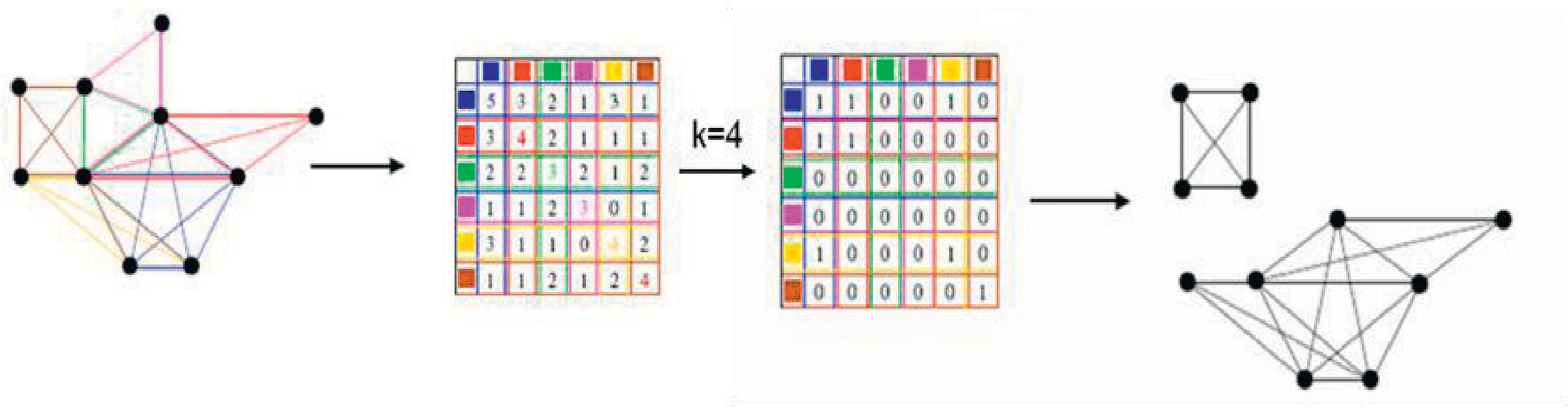 Figure: The process of building a community connection matrix from overlapping k-cliques.
2. Measuring the "Will to Stay"
The most innovative part of the paper is the Stability Index (). It measures how many members remain in a community over successive time windows. They also propose a Split Index, which mimics physical "evaporation": If a node’s "external" communication weight () far exceeds its "internal" weight (), the community is likely to dissolve.
Case Study: The Enron Autopsy
The authors applied their model to the infamous Enron email dataset. By slicing the data into quarters, they visualized the "Death" and "Rebirth" of communities during the company's collapse.
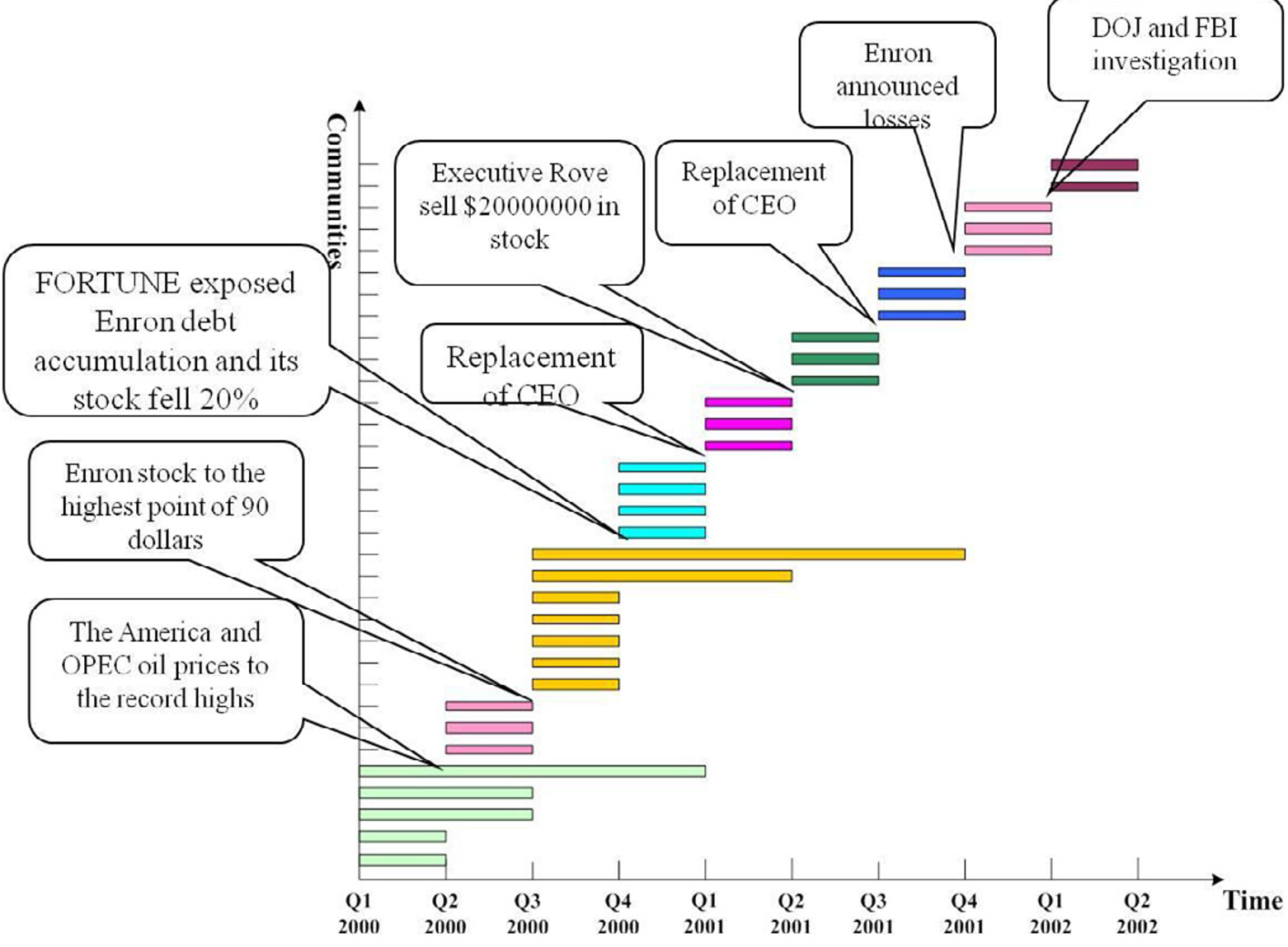 Figure: The evolution of email communities. Yellow lines track communities that remained stable despite the falling stock price.
Key Findings from Enron:
- Pre-emptive Signals: Significant structural shifts (splits and mergers) occurred in the 3rd and 4th quarters of 2000, coinciding with the stock price peaking and then dropping 20%.
- Resilience: Even in a failing company, certain "core" communities remain stable longer than others, indicating a high degree of internal trust or shared crisis management.
Critical Insight: The Predictive Power of Topology
This paper moves community detection from "descriptive" to "predictive." By monitoring the stability index, organizations could theoretically:
- Forecast Crisis: Detect if an organization is "fragmenting" before performance KPIs drop.
- Public Opinion: Predict the "burst" of a topic on social media by seeing if a stable k-clique structure is forming.
The limitation, however, remains the computational cost of finding large cliques in ultra-scale networks (billions of nodes), which suggests that future work should focus on approximating these indices using localized sampling.
Conclusion
Social networks are more than just nodes; they are living systems that reach "steady states" through local rules. As the authors conclude, the emergence of a new community structure is often the first visible symptom of a major external pressure—making network science an essential tool for modern risk management.