
Decoding the Ecology of Violence: A Network Analysis of Sudan's Ethnic Conflict
Structure of ethnic violence in Sudan: a semi-automated network analysis of online news (2003–2010)
The paper introduces a semi-automated "Data-to-Model" (D2M) framework using Network Text Analysis (NTA) to analyze ethnic violence in Sudan (2003–2010). By mining 8 years of online news from the Sudan Tribune, the authors modeled how ethnic groups' spheres of influence—specifically their connections to livestock, biomes, and other groups—correlate with severe conflict or peace.
TL;DR
Researchers have pioneered a semi-automated way to map the "DNA" of civil war. By mining nearly a decade of online news reports from the Sudan Tribune, this study reveals that ethnic violence isn't just about "having" resources—it's about the structure of how groups interact with livestock and their environment. Key finding: Cattle ties breed conflict, while "Biome Richness" (ecological diversity) promotes peace.
Beyond Bullet Counts: The Motivation
Historically, political scientists studied war using the Correlates of War (COW) project, which typically ignores any conflict with fewer than 1,000 deaths. This "death-threshold" approach misses the early warning signs and the complex ethnographic drivers of localized violence.
The authors argue that the long-standing debate—Does resource scarcity or abundance cause war?—is missing a crucial dimension: Structure. They propose that by looking at the "Sphere of Influence" of an ethnic group through the lens of Network Text Analysis (NTA), we can see how socio-political and environmental nodes (like water, grass, or sheep) act as bridges or triggers for violence.
Methodology: From Text to Meta-Networks
The study utilizes a Data-to-Model (D2M) approach. This isn't just simple keyword counting; it's a sophisticated extraction of relational data.
- Extraction: 2003–2010 Sudan Tribune articles were processed through AutoMap to resolve anaphors (linking "he" to "the rebel leader") and remove noise.
- Coding: An "apriori" thesaurus (pre-defined terms) and "inductive" coding (discovering high-frequency words) were used to categorize terms into Socio-political or Environmental nodes.
- Network Mapping: If an ethnic group and a resource (e.g., "Cattle") appeared within 7 words of each other, a "tie" was created.
The Sphere of Influence
The researchers visualized the "ego-networks" of 42 ethnic groups. If Group A is connected to "Livestock," and "Livestock" is connected to Group B, Group A's sphere of influence expands.
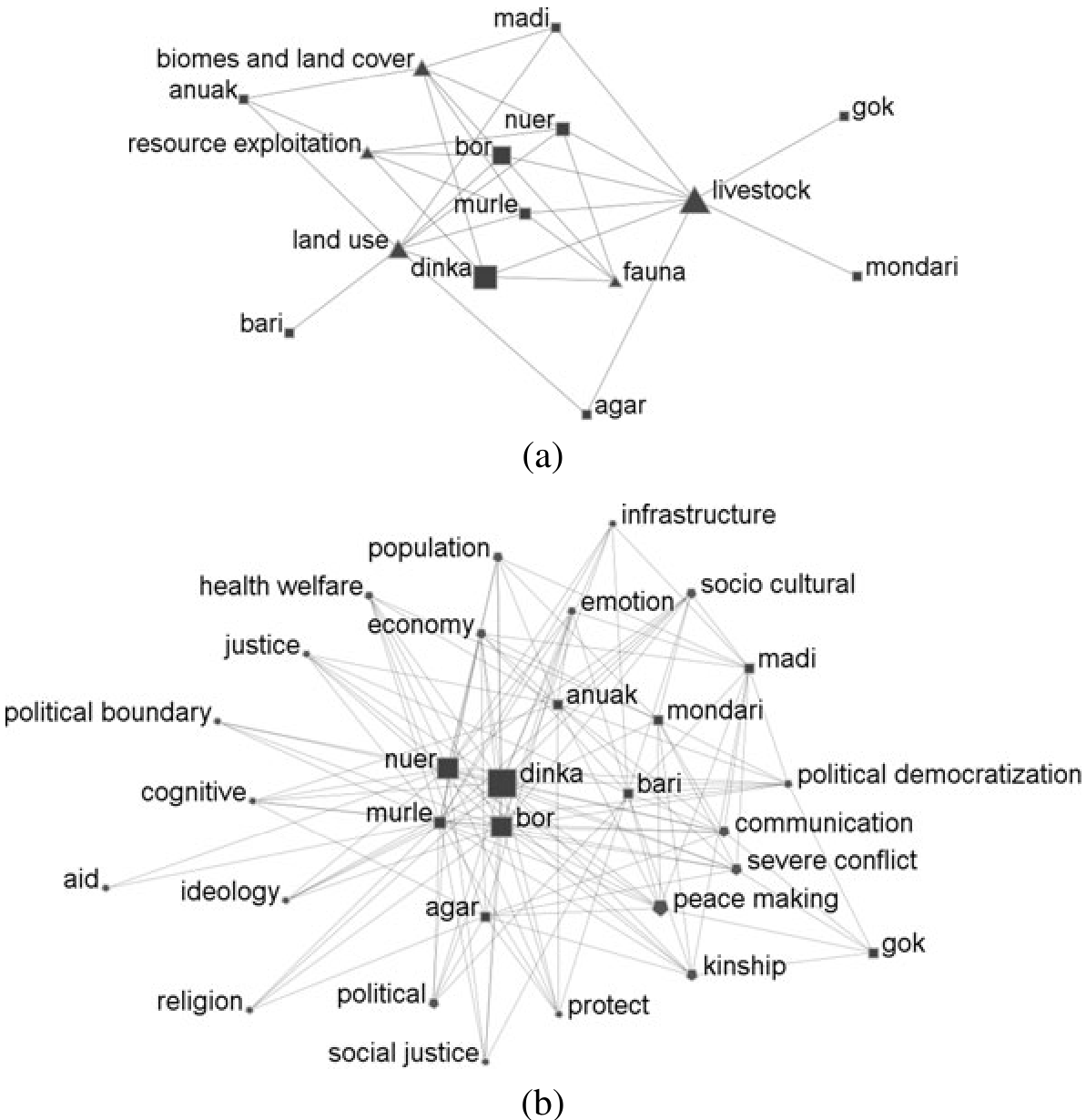 Figure 1: Comparison of Environmental (left) vs. Socio-political (right) spheres of influence for the Murle ethnic group.
Key Insights: Livestock, Biomes, and Blood
The results from the regression models (Adjusted R² up to 0.66) provide a striking view of the triggers of violence:
- The Livestock Trap: Hypotheses H1 and H2 were confirmed. Groups with dense ties to livestock had a significantly higher frequency of "Severe Conflict" terms. Specifically, raiding of cattle (sheep, goats, cows) remains the primary catalyst for inter-ethnic friction.
- Biomes as Peace-Keepers: Interestingly, H3 showed that groups connected to diverse biomes (forests, mountains, rivers) were more frequently associated with peace terms. This suggests that ecological redundancy acts as a buffer; if one resource fails, the group has alternatives, reducing the "zero-sum" pressure to fight.
- The Geometry of Overlap: Using geospatial mapping, the study found that locations where many ethnic groups overlap (Ethnic Richness) are hotspots for violence.
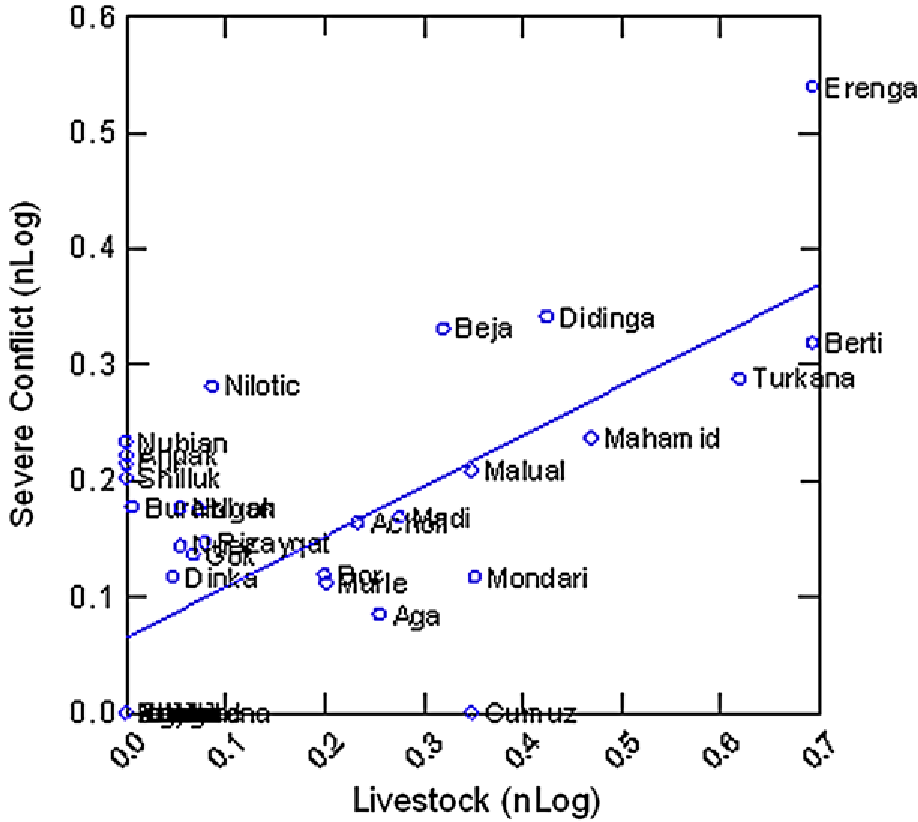 Figure 2: Scatterplot showing the strong positive correlation between an ethnic group's association with livestock and their involvement in severe conflict.
Global Implications and Limitations
This research shifts the focus from State-level politics to Group-level ecology. It confirms that in areas like Sudan, interventions that worsen resource competition are doomed to fail.
Limitations:
- The data is limited to English-language news, which might have a Western-centric or urban reporting bias.
- "Point data" for ethnic groups doesn't fully capture the fluid movement of nomadic pastoralists.
Final Takeaway
The "Data-to-Model" framework proves that we can turn "soft" news text into "hard" predictive models. In the future, this methodology could allow humanitarian organizations to monitor "structural friction" in a region long before the first shot is fired, simply by tracking how resource-related terms are clustering in local reports.