
The Hidden Architecture of Education: How "Multivocality" Unites a Fractured Field
The structure of educational research: The role of multivocality in promoting cohesion in an article interlock network
2007-09-17
Summary
Problem
Method
Results
Takeaways
Abstract
This paper investigates the social and intellectual structure of the educational research field by constructing an "article interlock network" based on shared readership data from the Teachers College Record. It demonstrates that the field functions as a hybrid small-world and structurally cohesive model, challenging the prevalent "plural-worlds" view of total fragmentation.
## TL;DR
Educational research is often dismissed as a "Balkanized" field of isolated specialists. However, by analyzing how thousands of readers consume articles, this study reveals a robust, "small-world" network. The secret glue isn't just shared topics, but **multivocal articles**—ambiguous, broad-reaching works that act as strategic hubs, allowing ideas to flow between distant intellectual islands.
## The "Plural-Worlds" Fallacy
For decades, critics have argued that educational research is in a state of intellectual anomie. This "plural-worlds" model suggests that researchers are trapped in specialty silos (e.g., vouchers vs. pedagogy) with no common language or shared evaluation standards.
Brian V. Carolan challenges this by shifting the focus from **production** (who writes with whom) to **consumption** (who reads what). If readers are actually crossing topical boundaries, the "fractured" view of the field might be an optical illusion caused by looking only at authorship.
## Methodology: Mapping the Reader’s Footprint
The study utilizes data from the *Teachers College Record* (TCR) online database. A network was constructed where two articles are "interlocked" if they share at least 10% of their readership.
Using the **Girvan-Newman algorithm**, the author partitioned the network into 34 communities. They then compared this empirical network against a randomized version to test for "Small-World" properties:
* **Clustering (C):** Do articles in the same group tend to be read together?
* **Path Length (L):** How many "jumps" (shared readers) does it take to get from a paper on "Literacy" to one on "High School Reform"?
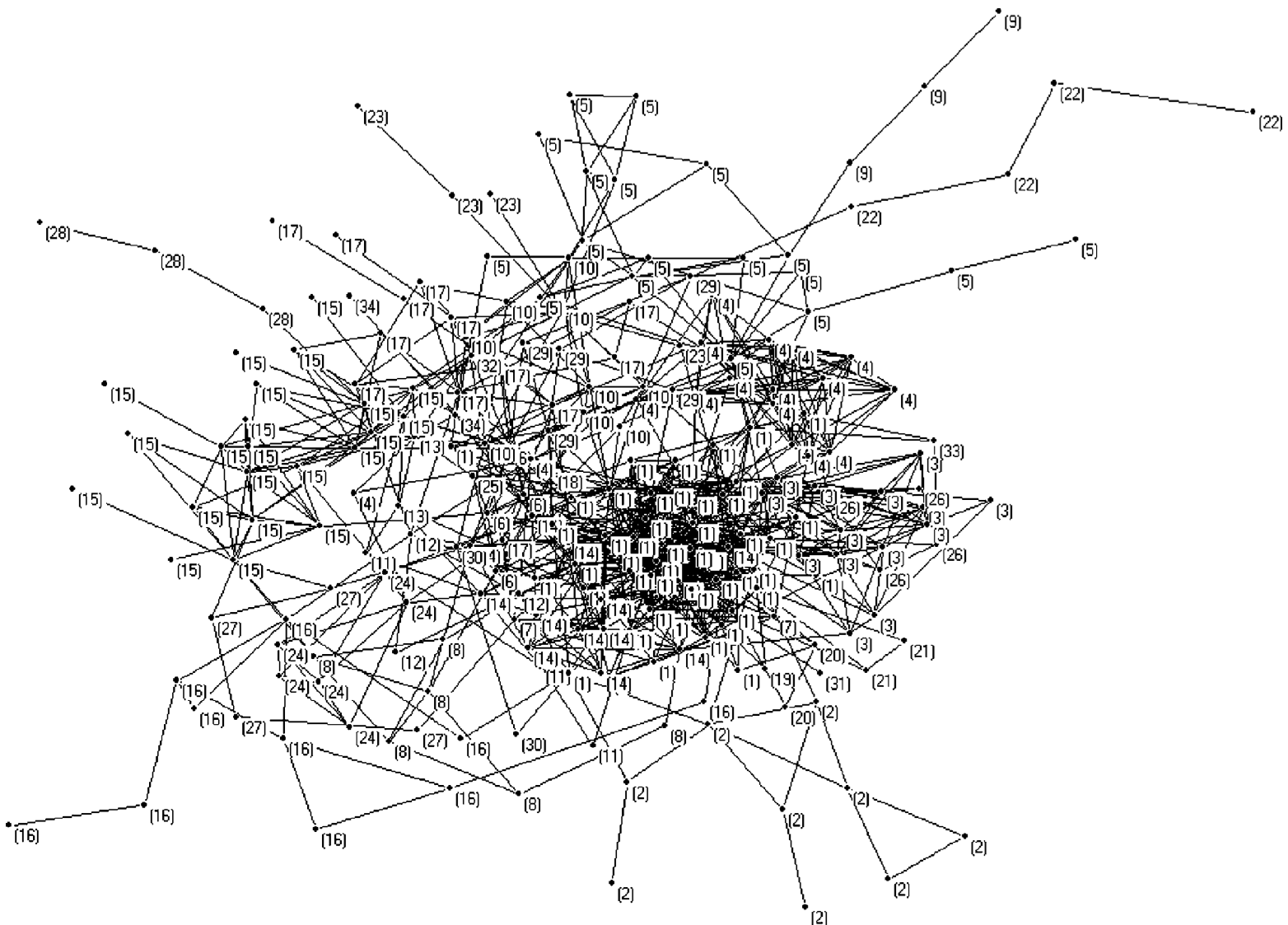
*Above: The article interlock network showing distinct communities yet a highly connected core.*
## The Core Discovery: Multivocality as a Bridge
The most striking finding is the existence of a **Multivocal Hub**. Unlike topical clusters (like "Vouchers and Charters"), this core community lacks a single subject. Instead, it is defined by a mix of book reviews, commentaries, and broad essays.
### Why does this work?
1. **Ambiguity as Asset**: These articles possess a "multivocal identity." They are written in a way that appeals to researchers, practitioners, and policymakers simultaneously.
2. **The Mixing Space**: Because they are less technical or "informal," they serve as a entry point for readers from different silos.
3. **Structural Bottlenecks**: The hub had a normalized betweenness score of **56.28**, meaning over half of all network paths pass through this group. It is the "Grand Central Station" of educational ideas.
## Results: Small-World, Big Cohesion
The data categorically rejects the plural-worlds model.
* **Reachability**: 94% of the articles are connected in a single component. You can get from almost any paper to another through a chain of shared readers.
* **Robustness**: The network doesn't collapse if you remove a few "star" articles. It is **structurally cohesive**, meaning multiple independent paths connect the field.
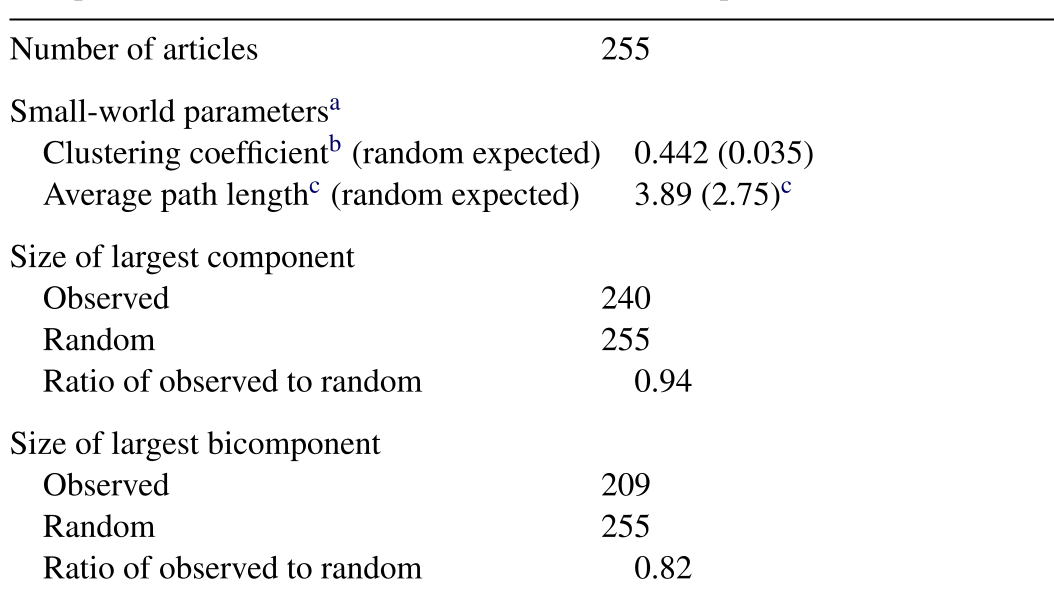
*Table: Comparison of observed network metrics against random expectations, confirming hybrid small-world/cohesive properties.*
## Critical Analysis & Conclusion
This research provides a refreshing perspective on academic "silos." It suggests that the **format** of scholarly communication matters as much as the content. Highly technical, narrow research papers create clusters, but it is the "softer," multivocal content—the commentaries and reviews—that prevent the field from drifting apart.
**Takeaway for Editors and Authors:**
To increase the impact of a journal or a specific research agenda, one must cultivate "multivocal" spaces. If every article is written only for a narrow specialist, the small-world shortcuts disappear, and the field effectively fractures. Disciplinary health depends on the bridges, not just the islands.
**Limitations:**
The study is a single-journal snapshot (TCR). Future work should include cross-journal data and longitudinal tracking to see if these multivocal hubs evolve or remain static as new research "trends" emerge.