
[Research Deep Dive] Structure Tree-LSTM: Capturing the Hidden Hierarchy of Long Documents
Structure Tree-LSTM: Structure-aware Attentional Document Encoders
The paper introduces the Structure Tree-LSTM, a novel document encoder that mirros the physical hierarchy of long texts (words, sentences, paragraphs, sections) to generate representative embeddings. By adapting the Tree-LSTM architecture from sentence-level to document-level tasks, it achieves state-of-the-art results in multi-class document classification.
TL;DR
While standard NLP models treat documents as flat sequences of tokens, humans understand text through a nested hierarchy of sentences, paragraphs, and sections. This paper introduces the Structure Tree-LSTM, an interpretable encoder that mirrors a document's physical tree. By transforming forget gates into a hierarchical attention mechanism, the model achieves SOTA performance in classification while allowing researchers to visualize exactly which sections (e.g., a "Career" section in a biography) drive the model's decisions.
The Motivation: Why Flat Attention Fails
Long-form text is a nightmare for standard RNNs. Even with Attention mechanisms, "flat" models struggle as the sequence length grows, leading to noise and high computational costs. Previous attempts like Hierarchical Attention Networks (HAN) introduced a two-level hierarchy (word and sentence), but real-world documents—like Wikipedia articles or medical records—are much deeper.
The authors' key insight is that the Tree-LSTM, usually reserved for sentence-level dependency parsing, is the perfect candidate for document-level modeling if we can adapt it to handle varying branching factors and arbitrary depths.
Methodology: From Syntax Trees to Document Trees
The core of the method lies in mapping a document’s Table of Contents directly onto the neural architecture.
1. The Structural Mapping
Instead of a binary tree, the authors use a Child-Sum Tree-LSTM. In this setup:
- Leaf Units: Represent the smallest units (words or sentences) and receive standard embeddings (word2vec or sent2vec).
- Non-Leaf Units: Represent structural blocks (paragraphs, subsections). They don't have "content" in the traditional sense; instead, they aggregate information from their children.
2. The "Zero Vector" Innovation
To force the model to focus purely on structural aggregation, the authors found that initializing non-leaf units with Zero Vectors worked best. This simplifies the LSTM transition equations. Specifically, the forget gate for a child becomes a pure function of the child's hidden state: This effectively turns the forget gate into an Attention Weight, determining how much information from a specific paragraph should flow upward to the section level.
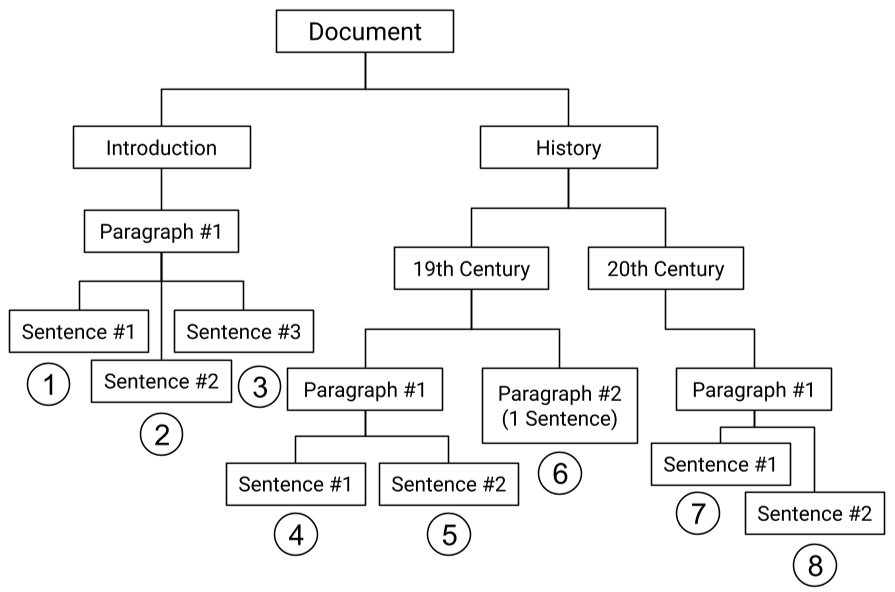 Figure 1: The conversion of a physical document structure into a Tree-LSTM backbone.
Experiments: Proving the Value of Structure
The authors tested the model across three distinct domains: Enron Emails (minimalist structure), Wikipedia (deep structure), and MIMIC-III medical records (set-of-documents structure).
Performance Leap
On the Wikipedia dataset, the Structure Tree-LSTM with Zero Vectors dominated the baselines:
- Macro-F1: ~0.85 (vs. 0.78 for standard MLP and 0.64 for Sequential LSTM).
- Accuracy: ~88.7%.
The model was also notably more data-efficient than HAN, which struggled on smaller datasets like Enron.
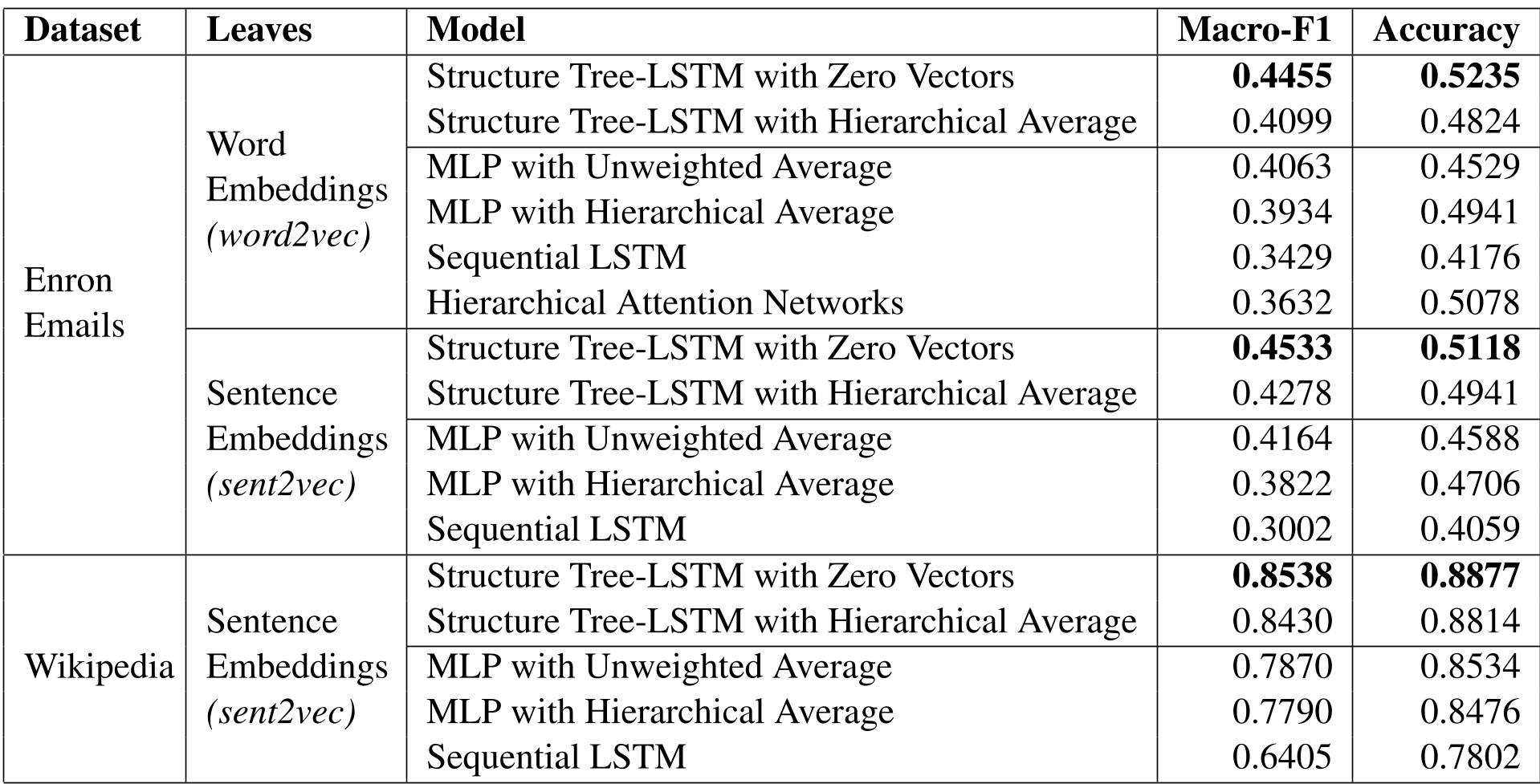 Table 2: Comparison of F1 scores across different datasets and embedding types.
Interpretability: Seeing the "Why"
One of the most compelling features of this model is its interpretability. By visualizing the attention weights, we can see the model "reading." For an artist's biography, the model correctly placed the highest attention weights on the "Career" and "Exhibitions" sections rather than the "Early Life" or "References" sections.
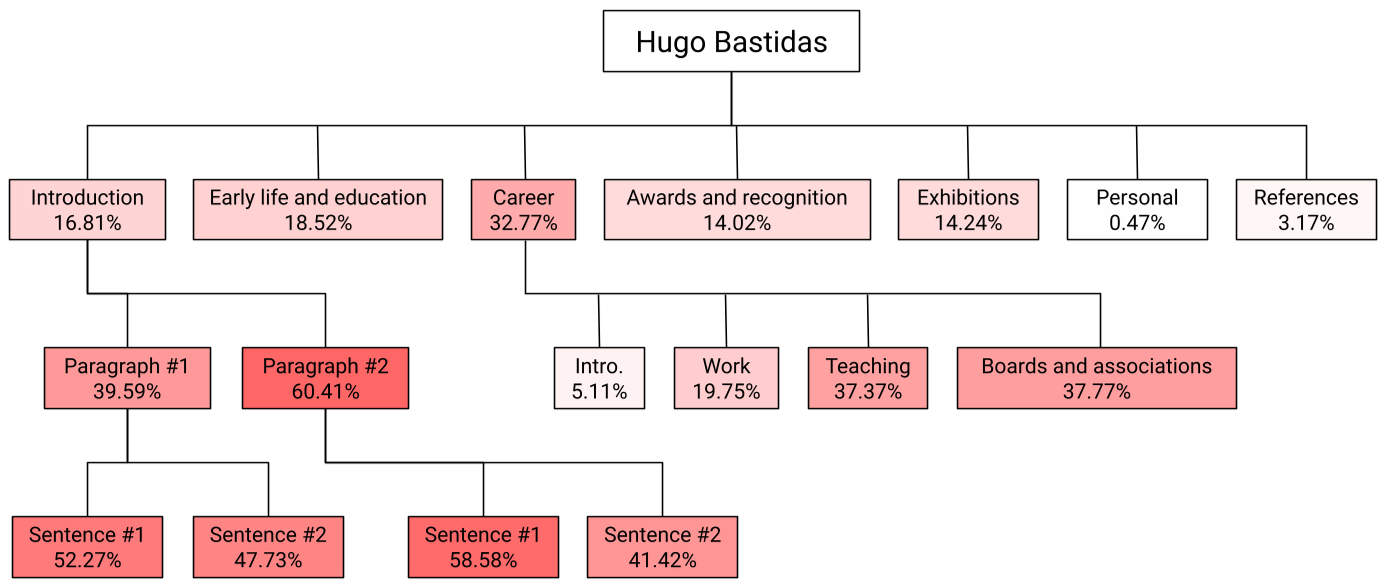 Figure 5: Heatmap showing how attention is distributed across an artist's Wikipedia page.
Beyond Single Documents: Medical Mortality Prediction
The researchers pushed the model further by treating a patient as the root of the tree and their individual medical reports as children nodes. Even without temporal information (the order in which reports were filed), the model achieved an AUC of 0.958, nearly matching a highly Optimized CNN baseline (0.963) that did use temporal data.
Critical Analysis & Conclusion
The Good:
- Inductive Bias: Properly reflects how documents are actually authored.
- Modularity: Can work with any embedding (word or sentence level).
- Transparency: No longer a "black box"; structural importance is explicit.
The Limitations:
- No Temporal Order: The Child-Sum variant ignores the sequence of children (e.g., in medical trends, "getting better" vs. "getting worse").
- Dependency on Pre-processing: Requires a clean structural parse (markdown or XML) of the input document to build the tree.
Final Takeaway
The Structure Tree-LSTM proves that structure-aware encoding is not just a theoretical "nice-to-have" but a practical necessity for long-form document understanding. For industries dealing with heavily formatted text (legal, medical, academic), this structural approach offers a robust path toward more accurate and explainable AI.