
Beyond the OS: A Structural Approach to Social Cloud Virtualization
A Structured Approach to Virtualization in Order to Support a Social Media Oriented Cloud Computing
The paper introduces a structured approach to Virtualization aimed at formalizing a social media-oriented Cloud Computing model, specifically for Digital Humanities. It utilizes the "Cognitive Framework" to move beyond OS-centric virtualization, enabling collaborative knowledge construction in Virtual Heritage projects like NU.M.E. 2010.
TL;DR
This paper challenges the traditional, enterprise-heavy view of Cloud Computing. Instead of seeing it just as a business tool (Infrastructure as a Service), the authors propose a structured cognitive framework for Virtualization. By decoupling virtualization from the Operating System (OS) layer, they demonstrate how "Social Media oriented Cloud" models can revolutionize Digital Humanities, enabling collaborative 3D reconstructions of historical sites like medieval Bologna.
Background: The Misconception of the Cloud
In the early 2010s, Cloud Computing was often treated as an "umbrella term" full of ambiguity. Computer Science was obsessed with transactional efficiency (Amazon EC2), but a more "human" side—the Google-like social approach—was emerging. The author argues that we lack a formal way to describe how virtualization enables this social interaction.
The Problem: The OS-Centric Bottleneck
Most technical literature (e.g., Smith and Nair) defines Virtualization from an OS perspective. This "coarse-grained" approach treats Virtual Machines (VMs) as black boxes. However, for collaborative social media and digital heritage, we need fine-grained solutions that work at the middleware or application level.
The core insight here is that virtualization isn't just a technology; it's a metaphor for mapping resources through interfaces.
Methodology: The Cognitive Framework
To bridge the gap between heavy enterprise servers and social collaboration, the author introduces a four-pillar framework to analyze any virtualization solution:
- The Interface: The boundary where interaction happens (e.g., System Call, API).
- Resource Mapping: How real resources are translated to virtual ones.
- Real Instructions: The actual hardware/software commands (e.g.,
ptrace()). - The Virtualization Metaphor: The logic that makes the user believe they are using a standalone system (e.g., the "mount" metaphor).
From OS to Social Containers
By applying this framework, we can see J2EE Application Servers as VMs. These software "containers" allow us to inject code between requests, creating "mashups" or gadgets that can be embedded into metaverses or mobile apps.
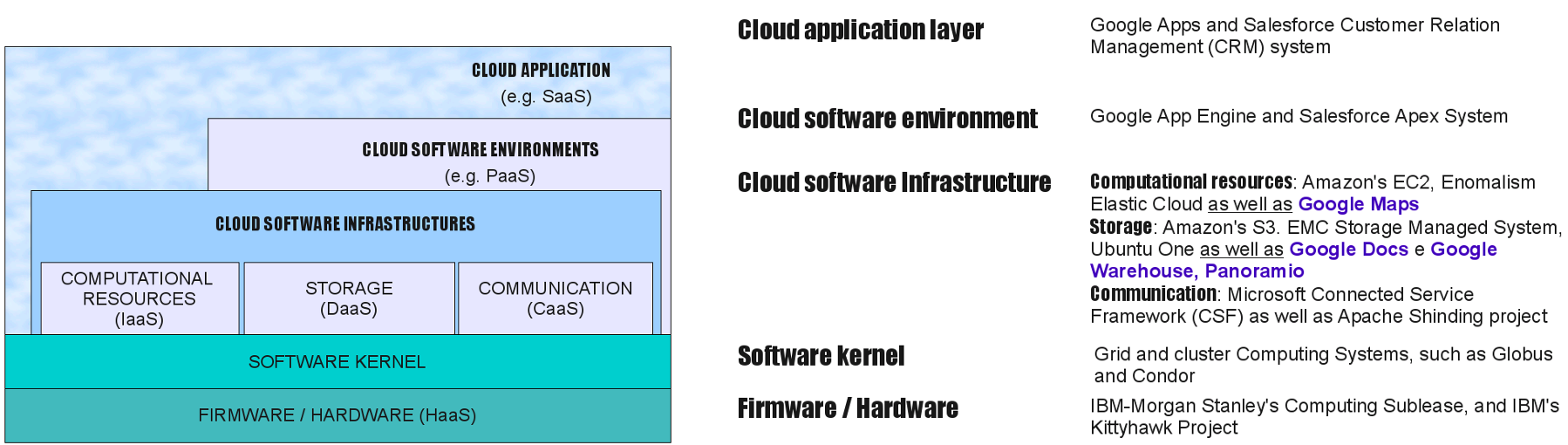 Fig 1. A proposed Cloud Computing ontology extending traditional layers into the social media domain.
Case Studies: Virtual Heritage in Action
1. NU.M.E. 2010: The Cultural Metaverse
The authors used Second Life as a spatial interface to show historical data. By integrating cloud tools like Google Warehouse and Panoramio via "Shared Media" (web browsers mapped onto 3D objects), they allowed users to:
- Download and manipulate 3D models of late medieval Bologna.
- Annotate historical snapshots and position them on maps.
- Create a "participatory model" of cultural creation.
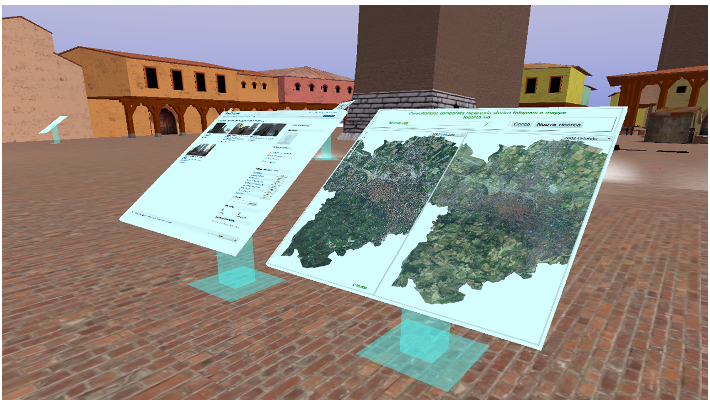 Fig 2. The Shared Media feature in Second Life acting as a container for web-based cloud services.
2. Cineca MDC: Collaborative Pipelines
Collaborating on a 3D movie ("The Big Bang of Bologna") required teams in different cities (Rome and Bologna). Using a virtualization-inspired approach, they adapted "Subversion" (usually for code) and "Google Docs" into an asset production pipeline. This allowed for a unified view of asset life-cycles—from "Working" to "Approved"—even across different local IT infrastructures.
 Fig 3. A structured pipeline management for virtual assets in a distributed project.
Critical Analysis & Conclusion
Takeaway: The paper successfully argues that virtualization's true power lies in its ability to decouple interfaces. In the context of the "Social Cloud," this means creating environments where users don't care about physical location but focus on the "participatory architecture" of information.
Limitations: While the framework is theoretically sound, many of the solutions described (like using Google Docs for pipeline management) required heavy manual intervention in 2011.
Future Outlook: The author points toward Apache Shindig and Django-based containers as the next step. Today, this aligns perfectly with modern Docker/Kubernetes microservices and the burgeoning Web3/Metaverse movement, proving the paper's foresight regarding "components with a view."
Senior Editor's Note: This work marks a pivotal moment where Virtualization moved from being a server-room commodity to a cognitive tool for the Digital Humanities.